

- Bitcoin remains under pressure after breaking below a multi-month rising channel.
- The $60K support zone has held so far, but BTC still needs to reclaim $68K and $72K-$74K to confirm stronger recovery.
- Funding rates have turned positive again, suggesting bearish pressure has eased, though the rebound still looks corrective.
Bitcoin is still fighting to regain control after breaking down from a multi-month ascending channel, a move that shifted market structure sharply in favor of sellers. Buyers did manage to defend the $60K region, which helped spark a short-term rebound, but the larger picture remains fragile. Unless BTC can reclaim several major resistance zones overhead, the latest bounce may be more of a relief rally than a full trend reversal.
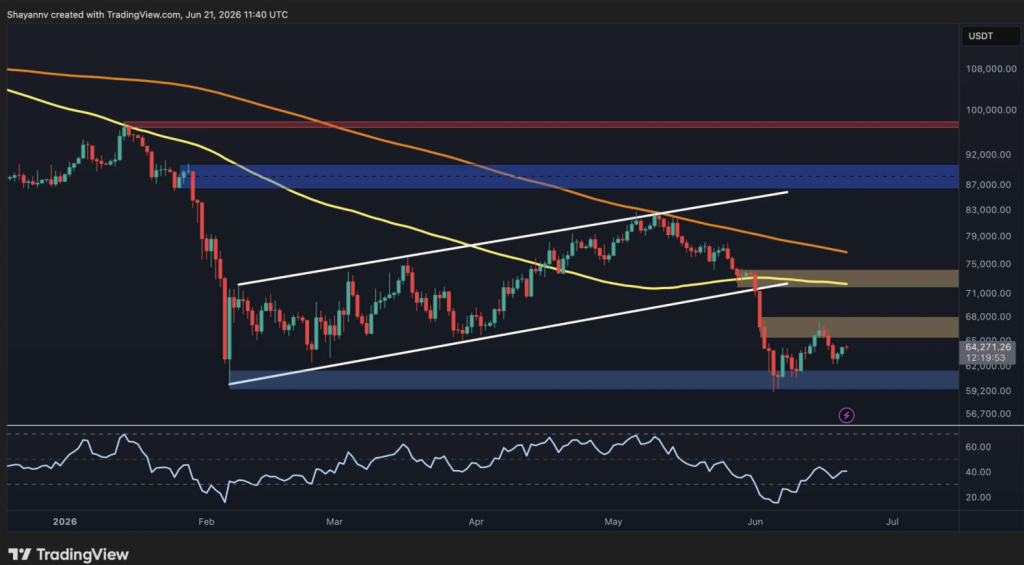
On the daily chart, Bitcoin recently confirmed a bearish breakdown below its rising channel, triggering heavier selling pressure and sending the asset toward the key $60K support area. That zone attracted buyers quickly, preventing a deeper immediate drop. Still, the damage to the trend is clear, and bulls now have quite a bit of work to do.
Bitcoin Loses Key Moving Averages
The selloff pushed Bitcoin below both the 100-day and 200-day moving averages, which are currently positioned near $72K and $76K, respectively. Losing the 100-day moving average is especially important because it had previously acted as a dynamic support level during the broader uptrend.
Once that level broke, the market structure weakened fast. Sellers gained control, and BTC slipped into a more defensive setup. After finding demand around $60K, Bitcoin recovered toward the $64K region, but the rebound has not been strong enough yet to erase the impact of the earlier decline.
The first major resistance now sits between $65K and $68K. This area previously served as support, but after the breakdown, it has flipped into a supply zone where sellers may step in again. Above that, the more important resistance band is located between $72K and $75K, overlapping with the 100-day moving average and the lower boundary of the broken ascending channel.
BTC Needs To Reclaim $72K-$75K
A clean move back above the $72K-$75K range would be the first serious sign that Bitcoin’s recent breakdown may have been a bear trap. Without that reclaim, however, the market remains tilted toward the bears.
For now, the $60K support zone is still the most important level on the downside. If Bitcoin loses this area, the door could open for a deeper correction toward lower liquidity zones. That kind of move could also trigger another wave of capitulation, especially if leveraged traders are caught on the wrong side again.
So, while the bounce from $60K is encouraging in the short term, it has not changed the broader setup just yet.
4-Hour Chart Shows Corrective Recovery
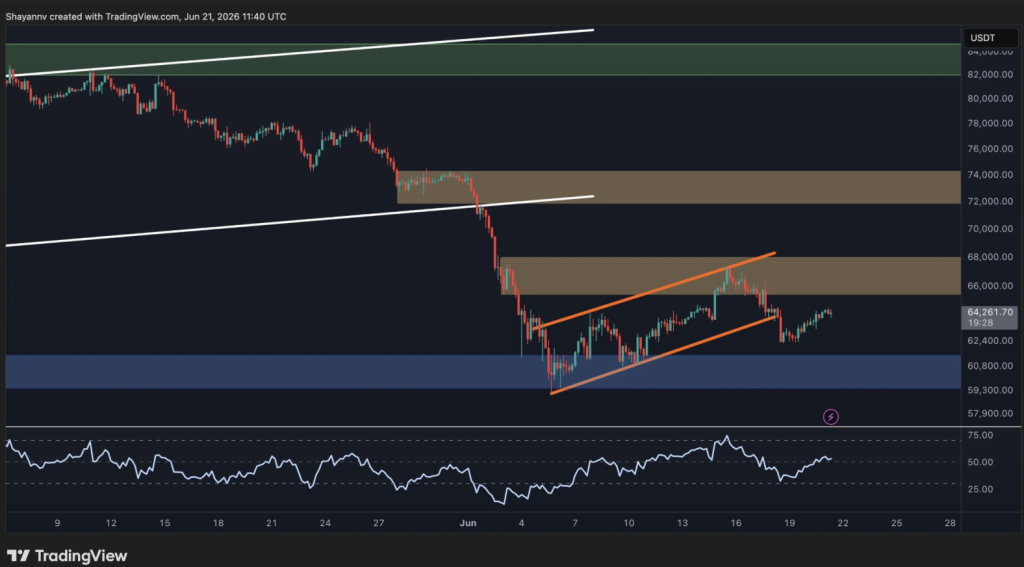
The 4-hour chart gives a clearer look at the recent selloff and the consolidation that followed. After BTC lost the $72K-$74K support region, selling pressure accelerated quickly, driving the price down into the $60K demand area.
Since then, Bitcoin has formed a short-term ascending channel. That may look constructive at first glance, but in this context it appears more like a corrective recovery than a confirmed bullish reversal. The recent rejection from the upper boundary of this channel also suggests buyers are still struggling to regain strong momentum.
Although BTC managed to stabilize around the mid-$64K area, it continues to trade below the key $65K-$68K resistance block. As long as Bitcoin remains capped under this zone, the rebound looks limited. A breakout above $68K could allow BTC to retest the larger resistance cluster between $72K and $74K. But another rejection here would increase the chance of a return to the $60K support level.
RSI Improves, But Bulls Are Not Fully Back
Momentum has improved somewhat on the lower timeframe. The 4-hour RSI has climbed back into neutral territory, showing that short-term selling pressure has cooled. Still, it has not reached a strongly bullish range, which means buyers have not taken full control yet.
This supports the idea that Bitcoin is currently going through a relief move inside a weaker market structure. Relief rallies can move quickly, sometimes sharply too, but they still need confirmation before traders can treat them as the start of a larger recovery.
For BTC, that confirmation likely begins above $68K, and becomes more convincing only if the price can reclaim the $72K-$74K zone.
Funding Rates Show Bearish Pressure Has Eased
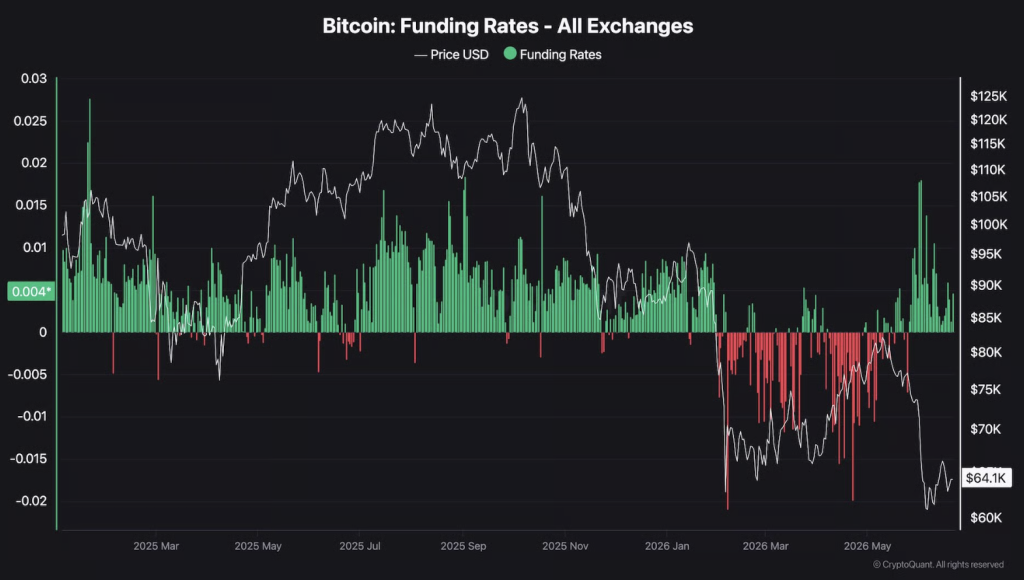
Derivatives data offers a slightly more constructive signal. During much of the recent decline, Bitcoin funding rates stayed mostly negative, showing that short positions dominated the market. This reflected strong bearish sentiment as traders continued betting on lower prices.
More recently, however, funding rates have moved back into positive territory, hovering near 0.004. This shift suggests traders are slowly rebuilding long exposure after Bitcoin’s bounce from the $60K support area.
From a contrarian perspective, this normalization can be seen as a healthy development. The market has already gone through a major deleveraging event, and the return to positive funding hints that confidence among futures traders is improving. That said, current funding levels remain far below the overheated readings seen during stronger bullish phases.
Bitcoin Still Needs a Stronger Breakout
Overall, the data suggests that bearish pressure has eased, but Bitcoin has not yet confirmed a broader bullish recovery. The $60K support zone remains the key level bulls must defend, while $65K-$68K is the first major resistance area standing in the way.
A breakout above $68K could strengthen short-term momentum and open the path toward $72K-$74K. But until Bitcoin reclaims those higher levels, the current move still looks more like a relief rally within a weakened structure, not a clean reversal.
For now, traders are watching whether BTC can hold above $60K and build enough strength to challenge overhead resistance. If it can, the market may start talking about recovery again. If not, sellers could make another push lower.