

BlockNews
FOLLOW ON X
  • BITCOIN
  • CRYPTO
    • ETHEREUM
    • RIPPLE XRP
    • SOLANA
    • CARDANO
    • BINANCE BNB
    • DOGECOIN
    • TRON
    • SUI
    • CHAINLINK
    • LITECOIN
  • FINANCE
  • POLITICS
  • MEMECOINS
  • NFT
  • OPINION
No Result
View All Result
BlockNews
  • BITCOIN
  • CRYPTO
    • ETHEREUM
    • RIPPLE XRP
    • SOLANA
    • CARDANO
    • BINANCE BNB
    • DOGECOIN
    • TRON
    • SUI
    • CHAINLINK
    • LITECOIN
  • FINANCE
  • POLITICS
  • MEMECOINS
  • NFT
  • OPINION
No Result
View All Result
BlockNews
Home CRYPTO BITCOIN

Bitcoin Crypto Lawsuit Targets $293 Billion in Dormant BTC – Here Is Why the Case Could Reshape Ownership Rights

Gary Ponce by Gary Ponce
May 28, 2026
in BITCOIN, CRYPTO, FINANCE, OPINION
Share on XShare in TelegramShare on Reddit
  • A man calling himself Noah Doe is suing for ownership of 39,069 dormant Bitcoin wallets worth roughly $293 billion.
  • The lawsuit relies on a New York lost-property law originally written for physical objects like wallets and jewelry.
  • Legal experts say even a court victory would not allow the plaintiff to move the Bitcoin without private keys.

A mysterious figure using the name “Noah Doe” has launched what could become one of the strangest legal battles crypto has ever seen. Together with two Wyoming-based LLCs, Doe filed a lawsuit in New York Supreme Court claiming ownership over 39,069 dormant Bitcoin addresses containing nearly 3.8 million BTC, currently valued at roughly $293 billion. If that number sounds absurdly huge, well… it is. The case was originally filed on March 11, 2026, then later amended in May, and legal analysts already say it may be the first serious attempt in U.S. history to claim Bitcoin through a lost-property law meant for physical items.

At the center of the lawsuit is New York Personal Property Law Article 7-B, a statute designed decades ago for lost wallets, jewelry, bags left in taxis, that sort of thing. Under the law, if someone finds lost property, reports it to police, and no rightful owner appears after a certain period, ownership can eventually transfer to the finder. Noah Doe argues dormant Bitcoin wallets should qualify under the same framework. According to the complaint, USB drives containing the address data were delivered to the NYPD’s 17th Precinct, supposedly satisfying the statute’s deposit requirement, even though the plaintiff never possessed the private keys tied to the wallets.

That distinction matters a lot. Unlike a physical wallet sitting forgotten on a park bench, Bitcoin addresses remain fully usable by whoever controls the cryptographic keys. The coins never actually leave the original owner’s control unless a valid signature moves them onchain. In other words, someone can “find” an address all day long, but without the keys, they can’t touch the BTC. That’s one reason many crypto lawyers believe the lawsuit faces an uphill battle, though nobody seems fully certain how courts will interpret it because, honestly, there’s almost no direct precedent here.
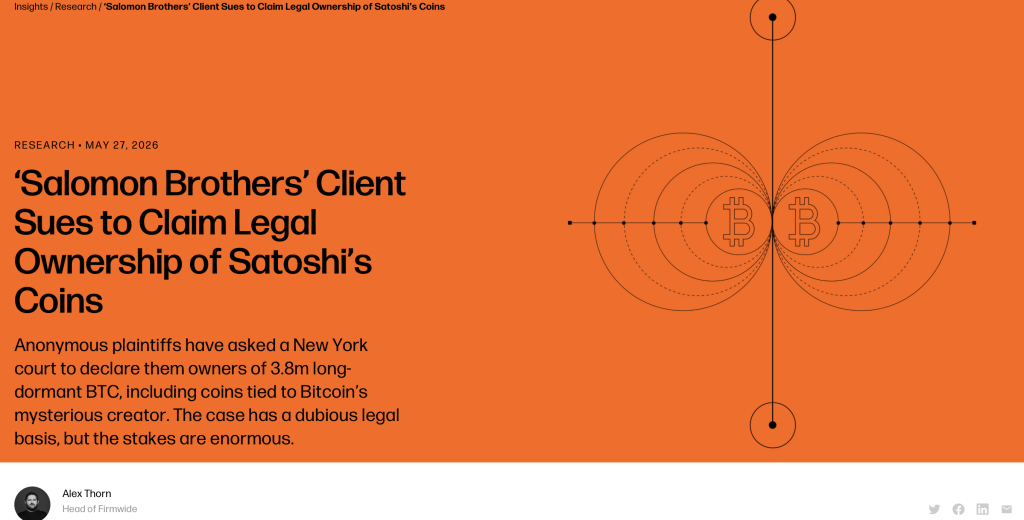
Salomon Brothers sues Satoshi Nakamoto

The Lawsuit Targets Wallets Linked to Satoshi and Mt. Gox

The addresses named in the lawsuit are not random inactive wallets sitting untouched somewhere in the blockchain abyss. Research from Galaxy Digital revealed that more than 21,000 of the addresses appear connected to the famous “Patoshi” mining pattern, an onchain fingerprint long associated with Bitcoin creator Satoshi Nakamoto. Those wallets alone reportedly hold over 1 million BTC, worth nearly $85 billion at current prices. If true, the lawsuit is effectively attempting to claim a chunk of Satoshi’s legendary untouched stash.

The defendant list also includes an address containing nearly 80,000 BTC stolen during the infamous 2011 Mt. Gox hack. Those coins have been tracked publicly for years and are tied to ongoing recovery efforts, making the idea that they are “abandoned” highly questionable. Another address included in the filing is a known Counterparty burn address, which is mathematically unspendable and was never controlled by a human owner in the first place. That inclusion raised eyebrows fast, because it suggests the filing may have swept up addresses without carefully distinguishing what they actually represent.

Interestingly, the lawsuit depends heavily on a controversial valuation argument. The plaintiffs claim each address was worth less than $10 “as found” because recovering the assets tied to them is uncertain. That number sounds tiny compared to the billions involved, but legally it’s critical. By valuing the addresses below $10, the plaintiffs place them into the fastest ownership-transfer category under New York law, allowing title to transfer after just one year rather than waiting through a multi-year holding period.

Critics say that argument feels almost engineered to fit the statute. If the wallets were valued based on the actual BTC inside them, they would likely fall into the law’s highest bracket, requiring a much longer process before ownership could transfer. Oddly enough, the expert responsible for the sub-$10 valuation isn’t identified anywhere in the public filings, which has only added more skepticism around the case.
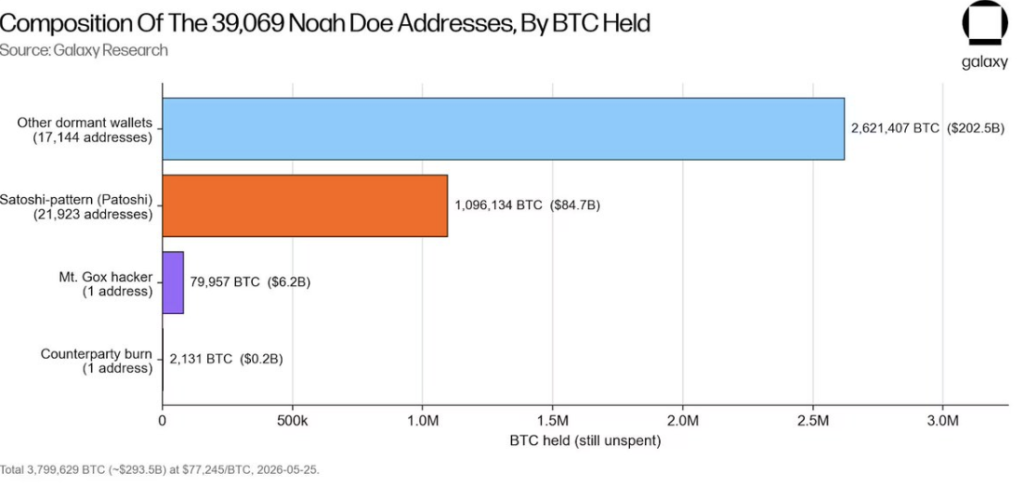
Composition of the 39,069 Noah Doe Addresses

The Strange Link to a 2025 Bitcoin Dusting Campaign

The lawsuit becomes even weirder once you follow the blockchain trail backward. According to Galaxy Research, nearly all the defendant addresses were previously involved in a 2025 “dusting” campaign. In crypto, dusting refers to sending tiny amounts of BTC to wallets, often for tracking or analytical purposes. Between June and July of 2025, over 39,000 addresses received small Bitcoin transactions containing OP_RETURN messages claiming the sender had taken “constructive possession” of the coins.

Galaxy’s researchers concluded those messages looked less like spam and more like early groundwork for a future legal claim. Turns out, they may have been right. Their investigation later traced both the 2025 dusting campaign and the 2026 court-notice transactions back to the same funding source, a wallet they labeled the “Bankroll” address. According to the firm, roughly 99.6% of the dusting activity was connected within two blockchain hops of that address.

Because the defendants are anonymous Bitcoin wallets rather than identifiable people, the court approved an unusual form of legal service. Each address received a tiny 546-satoshi transaction carrying an OP_RETURN message linking to a website hosting the lawsuit documents. Galaxy confirmed that 98 batch transactions distributed these notices across all 39,069 wallets during May 2026. Still, whether this counts as legally sufficient notice is far from settled.

Ethereum-based cases have used onchain legal notices before, but Bitcoin works differently. Many Bitcoin wallets don’t even display OP_RETURN data, and dust transactions are often automatically filtered out as spam. So while the notices technically reached the blockchain, there’s a very real chance many wallet owners would never actually see them. Kind of a legal gray zone, honestly.

Even a Court Victory May Not Unlock the Bitcoin

One point almost every legal observer agrees on is this: even if Noah Doe somehow wins the case outright, that victory would not magically unlock the coins. Bitcoin’s network doesn’t care about court orders, judicial opinions, or declarations of title. Without the private keys, nobody can move the BTC. The blockchain only responds to valid cryptographic signatures, period.

The bigger concern involves centralized exchanges and custodians. Legal experts say a court declaration could create what’s called a “cloud on title,” meaning the plaintiffs might present the ruling to exchanges if any of the disputed coins are deposited there in the future. That could potentially freeze funds and force wallet owners to identify themselves publicly in order to reclaim access. For early Bitcoin holders who value anonymity, that alone could become a serious problem.

Since the defendant wallets themselves obviously won’t appear in court, a default judgment is theoretically possible sometime around late June 2026. If that happens, the plaintiffs could request a formal declaration of ownership. Still, judges have broad discretion in unusual cases like this, especially when billions of dollars and completely untested legal theories are involved.

And honestly, the sheer scale of it all makes the case hard to ignore. Whether it succeeds or collapses under scrutiny, this lawsuit may end up shaping how courts think about abandoned crypto assets for years.


Disclaimer: BlockNews provides independent reporting on crypto, blockchain, and digital finance. All content is for informational purposes only and does not constitute financial advice. Readers should do their own research before making investment decisions. Some articles may use AI tools to assist in drafting, but every piece is reviewed and edited by our editorial team of experienced crypto writers and analysts before publication.
Tags: BitcoinBlockchaincryptoLawsuitMtGoxSatoshi
TweetShareShare
Gary Ponce

Gary Ponce

Gary has been active in the crypto space since 2019, developing hands-on experience in trading, airdrop hunting, and identifying emerging narratives in low-cap tokens. For over four years, he has contributed research and editorial content with Aiur Labs and BlockNews, focusing on market analysis and community insights. His work reflects both transparency and independent reporting, with an emphasis on simplifying complex ideas for readers. Gary is a long-term believer in Bitcoin, Sui, Hype, Litecoin, XRP, AVAX, and select meme tokens, combining personal trading knowledge with professional editorial standards.

DON'T MISS THESE! HOT OFF THE PRESS

Bitcoin Treasury Dream Collapses as Sequans Dumps BTC Holdings – Here Is What Went Wrong
BITCOIN

Bitcoin Treasury Dream Collapses as Sequans Dumps BTC Holdings – Here Is What Went Wrong

May 28, 2026
NFT Inventor Kevin McCoy Thinks Digital Ownership Already Quietly Won
NFT

NFT Inventor Kevin McCoy Thinks Digital Ownership Already Quietly Won

May 28, 2026
Solana Trader Drama Returns as James Wynn Denies $WORLD Rug Pull Claims
CRYPTO

Solana Trader Drama Returns as James Wynn Denies $WORLD Rug Pull Claims

May 28, 2026
Vitalik Buterin Says Europe’s AI Future Depends on Going Fully Open Source
CRYPTO

Vitalik Buterin Says Europe’s AI Future Depends on Going Fully Open Source

May 28, 2026
Your Bitcoin Wallet Might Die With You if Nobody Knows the Password
BITCOIN

Your Bitcoin Wallet Might Die With You if Nobody Knows the Password

May 28, 2026
ERC-8257 Could Turn NFTs Into the Access Layer for AI Agents
NFT

ERC-8257 Could Turn NFTs Into the Access Layer for AI Agents

May 28, 2026
Load More

Related News

Bitcoin Crypto Lawsuit Targets $293 Billion in Dormant BTC – Here Is Why the Case Could Reshape Ownership Rights

Bitcoin Crypto Lawsuit Targets $293 Billion in Dormant BTC – Here Is Why the Case Could Reshape Ownership Rights

May 28, 2026
Bitcoin Treasury Dream Collapses as Sequans Dumps BTC Holdings – Here Is What Went Wrong

Bitcoin Treasury Dream Collapses as Sequans Dumps BTC Holdings – Here Is What Went Wrong

May 28, 2026
NFT Inventor Kevin McCoy Thinks Digital Ownership Already Quietly Won

NFT Inventor Kevin McCoy Thinks Digital Ownership Already Quietly Won

May 28, 2026
Solana Trader Drama Returns as James Wynn Denies $WORLD Rug Pull Claims

Solana Trader Drama Returns as James Wynn Denies $WORLD Rug Pull Claims

May 28, 2026
Vitalik Buterin Says Europe’s AI Future Depends on Going Fully Open Source

Vitalik Buterin Says Europe’s AI Future Depends on Going Fully Open Source

May 28, 2026
Twitter Telegram Threads

BLOCKNEWS.COM

BlockNews is your premier source for real-time cryptocurrency, blockchain, political and financial market news.

Stay ahead of the herd with BlockNews

RESOURCES

  • About Us
  • Contact Us
  • Editorial Policies
  • Terms and Conditions
  • Privacy Policy
  • Sitemap

DISCLOSURES AND POLICIES

BlockNews provides independent reporting on crypto, blockchain, and digital finance. Content is for informational purposes only and does not constitute financial advice. Sponsored material is always disclosed. By using this site, you agree to our Terms and Conditions and Privacy Policy.

© 2025 BlockNews

Cookie Consent
To provide the best experiences, we use technologies like cookies to store and/or access device information. Consenting to these technologies will allow us to process data such as browsing behavior or unique IDs on this site. Not consenting or withdrawing consent, may adversely affect certain features and functions.
Functional Always active
The technical storage or access is strictly necessary for the legitimate purpose of enabling the use of a specific service explicitly requested by the subscriber or user, or for the sole purpose of carrying out the transmission of a communication over an electronic communications network.
Preferences
The technical storage or access is necessary for the legitimate purpose of storing preferences that are not requested by the subscriber or user.
Statistics
The technical storage or access that is used exclusively for statistical purposes. The technical storage or access that is used exclusively for anonymous statistical purposes. Without a subpoena, voluntary compliance on the part of your Internet Service Provider, or additional records from a third party, information stored or retrieved for this purpose alone cannot usually be used to identify you.
Marketing
The technical storage or access is required to create user profiles to send advertising, or to track the user on a website or across several websites for similar marketing purposes.
  • Manage options
  • Manage services
  • Manage {vendor_count} vendors
  • Read more about these purposes
View preferences
  • {title}
  • {title}
  • {title}
Cookie Consent
To provide the best experiences, we use technologies like cookies to store and/or access device information. Consenting to these technologies will allow us to process data such as browsing behavior or unique IDs on this site. Not consenting or withdrawing consent, may adversely affect certain features and functions.
Functional Always active
The technical storage or access is strictly necessary for the legitimate purpose of enabling the use of a specific service explicitly requested by the subscriber or user, or for the sole purpose of carrying out the transmission of a communication over an electronic communications network.
Preferences
The technical storage or access is necessary for the legitimate purpose of storing preferences that are not requested by the subscriber or user.
Statistics
The technical storage or access that is used exclusively for statistical purposes. The technical storage or access that is used exclusively for anonymous statistical purposes. Without a subpoena, voluntary compliance on the part of your Internet Service Provider, or additional records from a third party, information stored or retrieved for this purpose alone cannot usually be used to identify you.
Marketing
The technical storage or access is required to create user profiles to send advertising, or to track the user on a website or across several websites for similar marketing purposes.
  • Manage options
  • Manage services
  • Manage {vendor_count} vendors
  • Read more about these purposes
View preferences
  • {title}
  • {title}
  • {title}
No Result
View All Result
  • HOME
  • BITCOIN
  • CRYPTO
    • ETHEREUM
    • RIPPLE XRP
    • SOLANA
    • CARDANO
    • BINANCE BNB
    • DOGECOIN
    • TRON
    • LITECOIN
    • CHAINLINK
    • SUI
  • MEMECOINS
  • POLITICS
  • FINANCE
  • NFT
  • DEFI
  • GUIDES

© 2025 BlockNews