

- AAVE climbed roughly 3% as investors looked past a major one-time recovery expense.
- The protocol absorbed a $39 million recovery contribution while maintaining strong core revenue activity.
- Traders are watching the $80 level closely, as a breakout could strengthen the case for a larger recovery.
AAVE may only be up around 3% today, but the story developing underneath the price action is arguably much bigger than a short-term bounce. At a time when decentralized finance continues to face fragile sentiment and cautious investors, Aave is quietly proving something important: resilience still matters.
The protocol recently reported a sizeable monthly loss, a figure that initially raised concerns across parts of the market. But once investors dug into the numbers, the picture became a lot more nuanced. In fact, many traders now view the event as a demonstration of strength rather than weakness.
Aave Absorbed a Major Financial Hit
At first glance, the numbers were ugly.
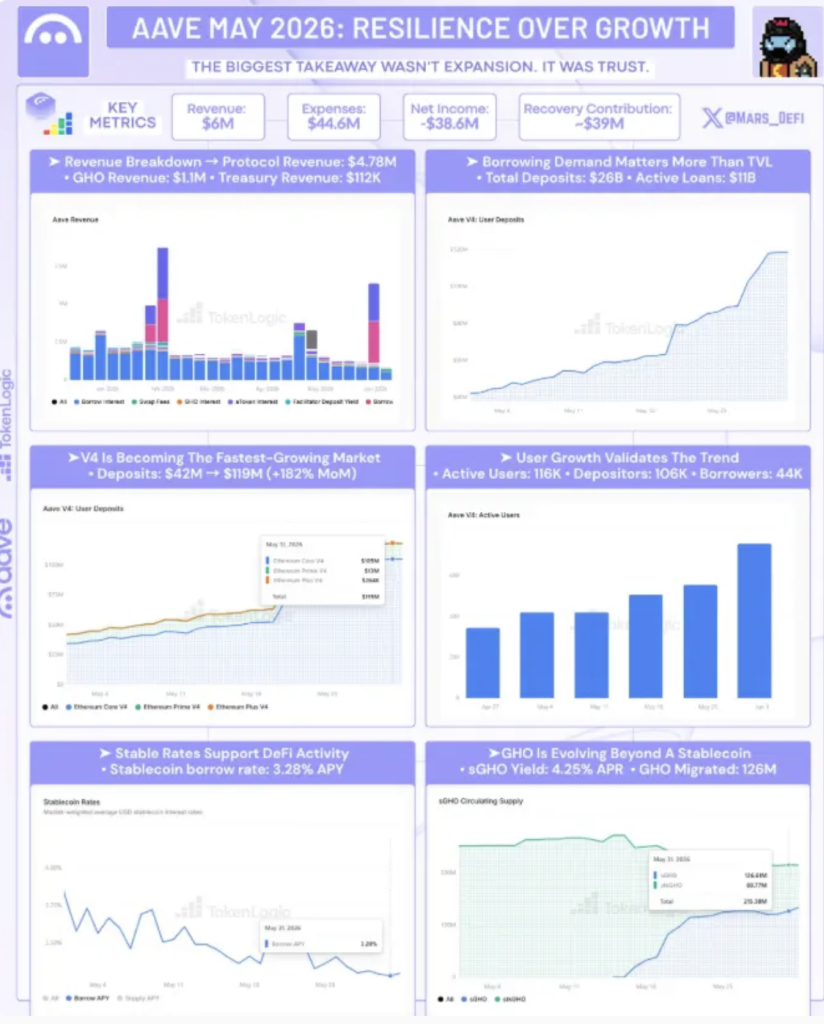
Aave reported approximately $44.6 million in expenses during the month against roughly $6 million in revenue, resulting in a net loss close to $38.6 million. On paper, that looks alarming. Markets rarely celebrate losses, especially in a sector already battling uncertainty.
The catch is that most of the loss came from a one-time recovery contribution tied to the broader srsETH exploit recovery effort. Aave reportedly contributed around $39 million as part of an initiative that committed more than $160 million toward helping affected users recover losses.
That context changes the conversation.
Rather than signaling operational weakness, many market participants interpreted the move as a decision to prioritize ecosystem stability and user trust over short-term profitability. In DeFi, reputation is often as valuable as revenue, and Aave appears to have chosen the long game.
Core Revenue Remains Healthy
Once the recovery contribution is removed from the equation, Aave’s underlying business looks considerably stronger.
The protocol generated approximately $4.78 million in core revenue during the period. Additional income came from its GHO stablecoin ecosystem, which contributed roughly $1.1 million, while treasury operations added another six-figure revenue stream.
Those figures suggest that user activity has remained relatively stable despite the challenging environment.
This distinction matters because one-time expenses tell investors very little about the long-term health of a platform. Sustainable revenue generation, on the other hand, provides a clearer picture of whether users are continuing to engage with the protocol.
And for Aave, the answer appears to be yes.
AAVE Price Faces a Critical Test
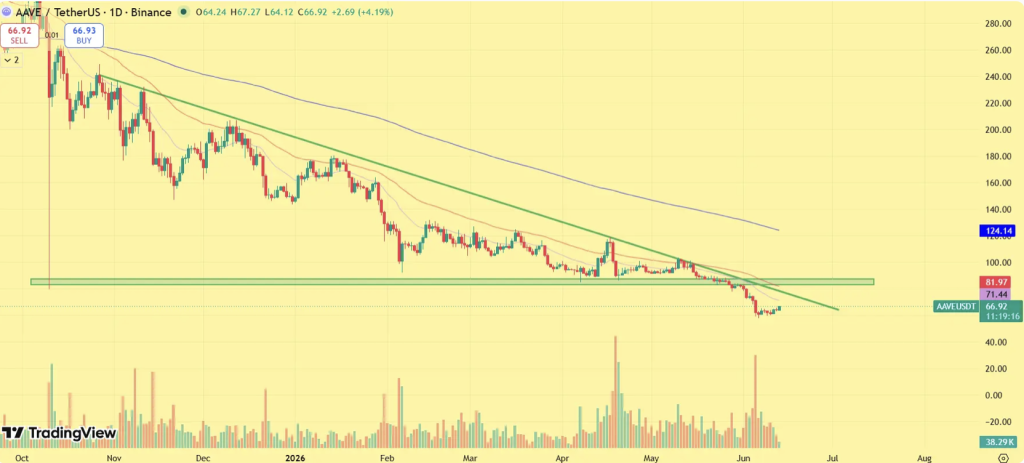
From a technical perspective, AAVE has started stabilizing after a period of heavy selling pressure.
Buyers recently defended the support zone between roughly $60 and $65, preventing a deeper breakdown and helping fuel the current rebound. The move has improved short-term sentiment, although several major hurdles still sit overhead.
The first notable resistance level is near $72. Beyond that, the more significant barrier sits between $80 and $82. This area carries extra importance because it aligns with previous support levels that later became resistance, while also matching a descending trendline visible on higher timeframes.
A clean breakout above $80 would likely change the technical narrative considerably. If that happens, traders could begin targeting the psychologically important $100 level once again.
On the flip side, failure to maintain recent momentum could leave the token vulnerable to renewed downside pressure.
Lending Activity Continues Supporting the Bull Case
Beyond charts and price levels, one of the strongest arguments for Aave remains its lending activity.
Recent protocol data shows approximately $26 billion in deposits across the platform, while active loans sit near $11 billion. Those are significant figures, particularly given the uncertain conditions facing the broader crypto market.
In decentralized finance, borrowing demand often provides a stronger signal than total value locked alone.
Large deposits can sometimes represent passive capital sitting idle. Active loans, however, indicate users are actually utilizing the protocol’s core functionality. They are borrowing, leveraging positions, and engaging with the ecosystem.
That level of participation suggests Aave’s utility remains intact even during periods of market weakness.
Can AAVE Turn Fundamentals Into a Breakout?
The market appears to be slowly reassessing Aave’s situation.
What initially looked like a major financial setback is increasingly being viewed as a one-time event tied to ecosystem protection. Meanwhile, core revenue generation remains healthy, borrowing activity continues to show strength, and users are still actively utilizing the protocol.
The challenge now is translating those fundamentals into sustained price momentum.
If AAVE can reclaim the $80 region while maintaining strong protocol metrics, today’s modest rebound could end up being remembered as the beginning of a broader recovery rather than just another temporary bounce. That’s not guaranteed, of course. Crypto markets rarely make things easy.
Still, among DeFi projects navigating a difficult environment, Aave is showing signs that it remains one of the sector’s strongest survivors.