

BlockNews
FOLLOW ON X
  • BITCOIN
  • CRYPTO
    • ETHEREUM
    • RIPPLE XRP
    • SOLANA
    • CARDANO
    • BINANCE BNB
    • DOGECOIN
    • TRON
    • SUI
    • CHAINLINK
    • LITECOIN
  • FINANCE
  • POLITICS
  • MEMECOINS
  • NFT
  • OPINION
No Result
View All Result
BlockNews
  • BITCOIN
  • CRYPTO
    • ETHEREUM
    • RIPPLE XRP
    • SOLANA
    • CARDANO
    • BINANCE BNB
    • DOGECOIN
    • TRON
    • SUI
    • CHAINLINK
    • LITECOIN
  • FINANCE
  • POLITICS
  • MEMECOINS
  • NFT
  • OPINION
No Result
View All Result
BlockNews
Home CRYPTO BITCOIN

Banks Are Quietly Tokenizing Trillions in Assets — Here Is Why JPMorgan Sees a Long-Term Threat to Bitcoin

Gary Ponce by Gary Ponce
July 9, 2026
in BITCOIN, CRYPTO, FINANCE, OPINION
Share on XShare in TelegramShare on Reddit
  • JPMorgan believes private blockchain adoption by major banks poses a greater long-term challenge to Bitcoin than corporate BTC accumulation.
  • More than 15 global banks are expanding tokenized finance initiatives on permissioned blockchain networks designed for institutions.
  • While Bitcoin may still benefit from its scarcity, banks appear increasingly focused on regulated blockchain infrastructure instead.

For years, Bitcoin (BTC) has been viewed as the biggest winner if blockchain technology became mainstream. JPMorgan, however, thinks that assumption may not hold forever.

The bank argues that the real long-term challenge for Bitcoin isn’t companies like Strategy (formerly MicroStrategy) buying massive amounts of BTC. Instead, it’s the growing number of financial institutions building blockchain systems that don’t rely on public crypto networks at all.

According to analysts led by Nikolaos Panigirtzoglou, if banks continue shifting payments, settlements, and financial assets onto private blockchains, public networks could gradually lose activity, liquidity, and eventually capital. It’s not an overnight threat—but one that could quietly reshape the industry over time.
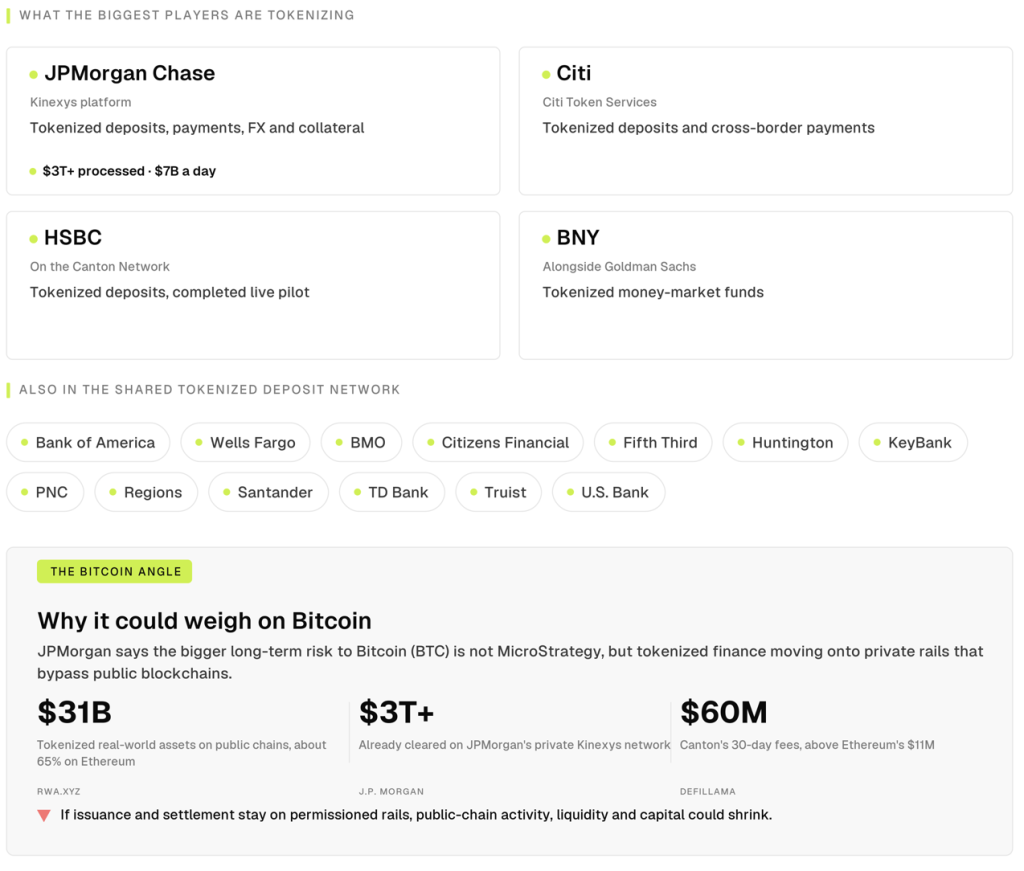
17 Banks are building tokenized finance

Wall Street Continues Expanding Tokenized Finance

JPMorgan has already made significant progress through its blockchain platform, Kinexys. Originally launched as Onyx in 2020 before being rebranded in 2024, the platform has processed more than $3 trillion in transactions since its launch and now handles over $7 billion in daily volume.

Ironically, this growth has happened while JPMorgan CEO Jamie Dimon has continued voicing skepticism about Bitcoin itself.

Much of this institutional activity takes place on permissioned blockchain infrastructure. The Canton Network has become one of the leading examples, attracting some of the biggest names in finance.

DTCC is working toward tokenizing the U.S. Treasury securities it holds in custody, with broader implementation targeted for 2026. HSBC has already completed a tokenized deposit pilot on the network, while Goldman Sachs is using similar infrastructure to settle tokenized bond transactions.

The financial impact is already becoming visible. According to DeFiLlama, Canton generated roughly $60 million in fees during the 30 days leading into late June. During the same period, Ethereum produced around $11 million, highlighting how quickly institutional blockchain usage is growing.

The trend extends beyond a handful of banks. More than 15 major financial institutions are participating in a shared tokenized deposit initiative backed by The Clearing House, with the broader network targeting a 2027 launch as tokenized settlement becomes increasingly common across traditional finance.

JPMorgan Says Public Blockchains Face a Bigger Test

In its July 9 research report, JPMorgan argued that institutions increasingly favor permissioned blockchain systems because they offer stronger governance, improved privacy protections, and greater regulatory certainty.

That view isn’t unique.

The Bank for International Settlements has repeatedly expressed concerns about public, permissionless blockchains, citing issues surrounding scalability, governance, and financial integrity. Instead, it has supported more regulated blockchain infrastructure built specifically for institutional use.
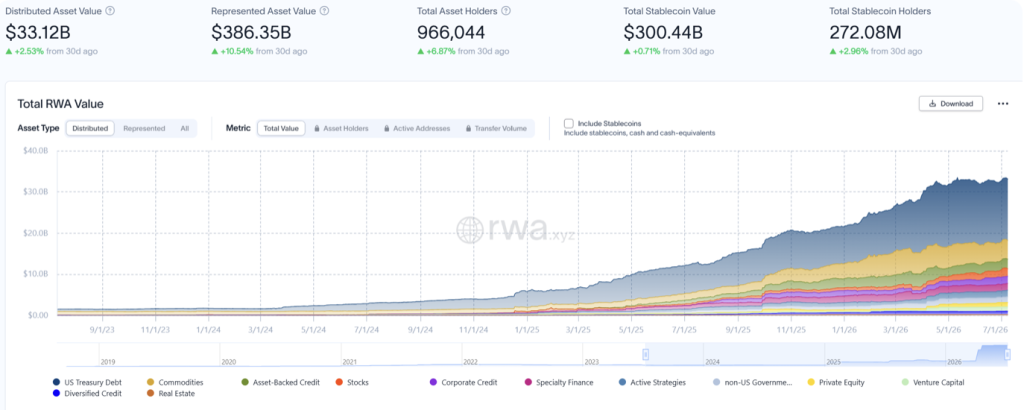
Total RWA Value

Meanwhile, tokenized real-world assets continue expanding rapidly. Data from rwa.xyz shows that public blockchains currently host around $31 billion worth of tokenized assets, with Ethereum accounting for roughly two-thirds of that total.

JPMorgan believes a growing share of future issuance and settlement could eventually migrate toward permissioned networks as adoption accelerates.

Bitcoin’s Value Proposition May Remain Different

Despite raising concerns about institutional blockchain adoption, JPMorgan doesn’t see Strategy’s Bitcoin holdings as the primary structural risk.

The analysts noted that the company’s ownership of roughly 4% of Bitcoin’s circulating supply, along with its evolving BTC acquisition strategy, could certainly create short-term volatility. Still, they don’t believe it fundamentally threatens Bitcoin’s long-term position.

Supporters of Bitcoin would likely argue that its value has never depended on processing institutional settlements. Instead, Bitcoin derives its strength from decentralization, scarcity, censorship resistance, and neutrality—qualities private banking networks simply don’t offer.

At the same time, some financial advisors are increasingly steering clients toward stablecoins and tokenized financial products rather than direct Bitcoin exposure, reflecting how blockchain adoption is evolving in different directions.

For now, one thing seems clear: the world’s largest banks aren’t rejecting blockchain technology. They’re embracing it, just on infrastructure built for their own regulatory and operational needs. Whether public blockchains can maintain a meaningful share of that rapidly expanding tokenized economy may become one of crypto’s biggest questions over the next several years.


Disclaimer: BlockNews provides independent reporting on crypto, blockchain, and digital finance. All content is for informational purposes only and does not constitute financial advice. Readers should do their own research before making investment decisions. Some articles may use AI tools to assist in drafting, but every piece is reviewed and edited by our editorial team of experienced crypto writers and analysts before publication.
Tags: banksBitcoinBlockchainethereumJPMorganTokenization
TweetShareShare
Gary Ponce

Gary Ponce

Gary has been active in the crypto space since 2019, developing hands-on experience in trading, airdrop hunting, and identifying emerging narratives in low-cap tokens. For over four years, he has contributed research and editorial content with Aiur Labs and BlockNews, focusing on market analysis and community insights. His work reflects both transparency and independent reporting, with an emphasis on simplifying complex ideas for readers. Gary is a long-term believer in Bitcoin, Sui, Hype, Litecoin, XRP, AVAX, and select meme tokens, combining personal trading knowledge with professional editorial standards.

DON'T MISS THESE! HOT OFF THE PRESS

Avalanche Climbs After Grayscale Spotlight – Here Is Why AVAX Could Be Approaching a Key Breakout
CRYPTO

Avalanche Climbs After Grayscale Spotlight – Here Is Why AVAX Could Be Approaching a Key Breakout

July 9, 2026
Phantom and Hyperliquid Urge CFTC Reform – Here Is Why Onchain Trading Rules Could Change
CRYPTO

Phantom and Hyperliquid Urge CFTC Reform – Here Is Why Onchain Trading Rules Could Change

July 9, 2026
JPMorgan Warns of Bigger Bitcoin Risk Than Strategy – Here Is Why Blockchain Adoption Could Bypass Crypto
BITCOIN

JPMorgan Warns of Bigger Bitcoin Risk Than Strategy – Here Is Why Blockchain Adoption Could Bypass Crypto

July 9, 2026
PayPal Expands PYUSD to Polygon – Here Is Why Stablecoin Adoption Could Accelerate
CRYPTO

PayPal Expands PYUSD to Polygon – Here Is Why Stablecoin Adoption Could Accelerate

July 9, 2026
CFTC Chair Pushes Congress on Crypto Bill – Here Is Why the CLARITY Act Could Reshape the Industry
CRYPTO

CFTC Chair Pushes Congress on Crypto Bill – Here Is Why the CLARITY Act Could Reshape the Industry

July 9, 2026
Russia’s Alfa-Bank Prepares Crypto Services – Here Is Why Institutional Adoption Is Growing
CRYPTO

Russia’s Alfa-Bank Prepares Crypto Services – Here Is Why Institutional Adoption Is Growing

July 9, 2026
Load More

Related News

Banks Are Quietly Tokenizing Trillions in Assets — Here Is Why JPMorgan Sees a Long-Term Threat to Bitcoin

Banks Are Quietly Tokenizing Trillions in Assets — Here Is Why JPMorgan Sees a Long-Term Threat to Bitcoin

July 9, 2026
Avalanche Climbs After Grayscale Spotlight – Here Is Why AVAX Could Be Approaching a Key Breakout

Avalanche Climbs After Grayscale Spotlight – Here Is Why AVAX Could Be Approaching a Key Breakout

July 9, 2026
Phantom and Hyperliquid Urge CFTC Reform – Here Is Why Onchain Trading Rules Could Change

Phantom and Hyperliquid Urge CFTC Reform – Here Is Why Onchain Trading Rules Could Change

July 9, 2026
JPMorgan Warns of Bigger Bitcoin Risk Than Strategy – Here Is Why Blockchain Adoption Could Bypass Crypto

JPMorgan Warns of Bigger Bitcoin Risk Than Strategy – Here Is Why Blockchain Adoption Could Bypass Crypto

July 9, 2026
PayPal Expands PYUSD to Polygon – Here Is Why Stablecoin Adoption Could Accelerate

PayPal Expands PYUSD to Polygon – Here Is Why Stablecoin Adoption Could Accelerate

July 9, 2026
Twitter Telegram Threads

BLOCKNEWS.COM

BlockNews is your premier source for real-time cryptocurrency, blockchain, political and financial market news.

Stay ahead of the herd with BlockNews

RESOURCES

  • About Us
  • Contact Us
  • Editorial Policies
  • Terms and Conditions
  • Privacy Policy
  • Sitemap

DISCLOSURES AND POLICIES

BlockNews provides independent reporting on crypto, blockchain, and digital finance. Content is for informational purposes only and does not constitute financial advice. Sponsored material is always disclosed. By using this site, you agree to our Terms and Conditions and Privacy Policy.

© 2025 BlockNews

Cookie Consent
To provide the best experiences, we use technologies like cookies to store and/or access device information. Consenting to these technologies will allow us to process data such as browsing behavior or unique IDs on this site. Not consenting or withdrawing consent, may adversely affect certain features and functions.
Functional Always active
The technical storage or access is strictly necessary for the legitimate purpose of enabling the use of a specific service explicitly requested by the subscriber or user, or for the sole purpose of carrying out the transmission of a communication over an electronic communications network.
Preferences
The technical storage or access is necessary for the legitimate purpose of storing preferences that are not requested by the subscriber or user.
Statistics
The technical storage or access that is used exclusively for statistical purposes. The technical storage or access that is used exclusively for anonymous statistical purposes. Without a subpoena, voluntary compliance on the part of your Internet Service Provider, or additional records from a third party, information stored or retrieved for this purpose alone cannot usually be used to identify you.
Marketing
The technical storage or access is required to create user profiles to send advertising, or to track the user on a website or across several websites for similar marketing purposes.
  • Manage options
  • Manage services
  • Manage {vendor_count} vendors
  • Read more about these purposes
View preferences
  • {title}
  • {title}
  • {title}
Cookie Consent
To provide the best experiences, we use technologies like cookies to store and/or access device information. Consenting to these technologies will allow us to process data such as browsing behavior or unique IDs on this site. Not consenting or withdrawing consent, may adversely affect certain features and functions.
Functional Always active
The technical storage or access is strictly necessary for the legitimate purpose of enabling the use of a specific service explicitly requested by the subscriber or user, or for the sole purpose of carrying out the transmission of a communication over an electronic communications network.
Preferences
The technical storage or access is necessary for the legitimate purpose of storing preferences that are not requested by the subscriber or user.
Statistics
The technical storage or access that is used exclusively for statistical purposes. The technical storage or access that is used exclusively for anonymous statistical purposes. Without a subpoena, voluntary compliance on the part of your Internet Service Provider, or additional records from a third party, information stored or retrieved for this purpose alone cannot usually be used to identify you.
Marketing
The technical storage or access is required to create user profiles to send advertising, or to track the user on a website or across several websites for similar marketing purposes.
  • Manage options
  • Manage services
  • Manage {vendor_count} vendors
  • Read more about these purposes
View preferences
  • {title}
  • {title}
  • {title}
No Result
View All Result
  • HOME
  • BITCOIN
  • CRYPTO
    • ETHEREUM
    • RIPPLE XRP
    • SOLANA
    • CARDANO
    • BINANCE BNB
    • DOGECOIN
    • TRON
    • LITECOIN
    • CHAINLINK
    • SUI
  • MEMECOINS
  • POLITICS
  • FINANCE
  • NFT
  • DEFI
  • GUIDES

© 2025 BlockNews