

- The Hyperliquid Policy Center is urging U.S. regulators to create a unified framework for perpetual contracts.
- Hyperliquid’s HIP-3 markets have generated more than $480 billion in volume and hold roughly $4 billion in open interest.
- The proposal comes as the CFTC works toward bringing Hyperliquid into the U.S. under a compliant regulatory structure.
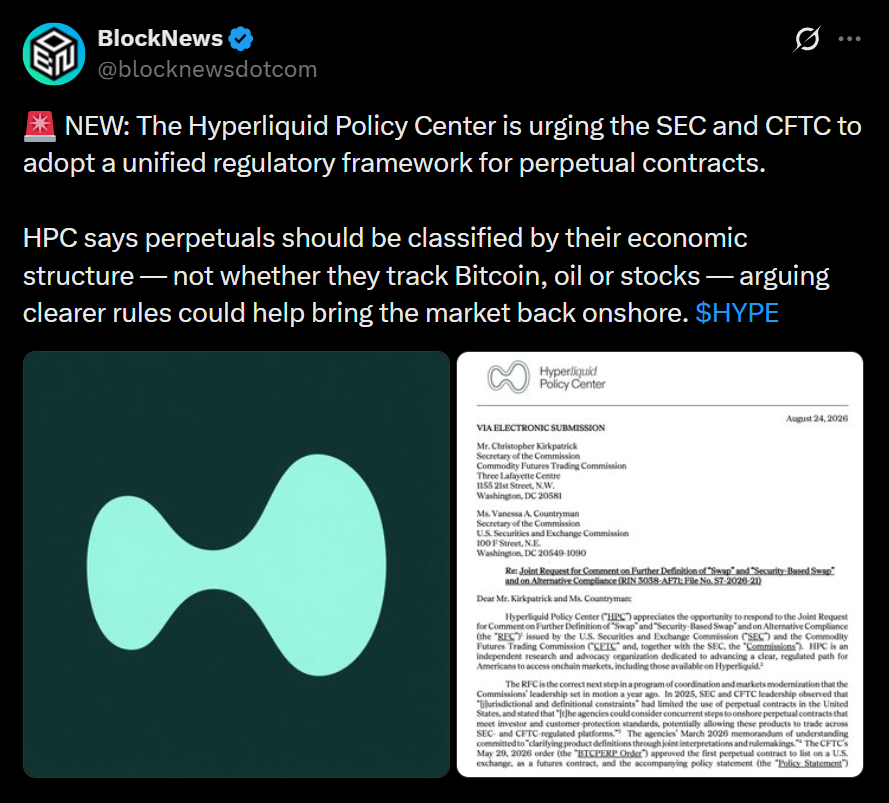
The Hyperliquid Policy Center is calling on the SEC and CFTC to modernize U.S. rules for perpetual contracts as the rapidly growing derivatives market moves closer to American markets.
The group argues that perpetual contracts should be classified according to their economic structure rather than simply by whether the underlying asset is Bitcoin, oil, stocks or another asset.
Hyperliquid Calls for Clearer Rules
The HPC said the existing security futures framework allows both SEC- and CFTC-regulated exchanges to compete within the same product category, but those rules were developed for products that have remained largely inactive for years.
According to the group, modernizing the framework could reduce disputes over regulatory jurisdiction and allow exchanges to compete based on liquidity and execution quality instead.
Hyperliquid already offers perpetual markets linked to crypto, commodities, currencies, stock indexes, individual stocks and ETFs.
Hyperliquid’s Perpetual Market Keeps Growing
Hyperliquid’s HIP-3 markets have generated more than $480 billion in trading volume since launching 10 months ago and currently hold approximately $4 billion in open interest.
More broadly, Hyperliquid processed nearly $3 trillion in notional trading volume during 2025 and has already surpassed $1.5 trillion this year.

However, traditional exchanges including CME and ICE have raised concerns about perpetual platforms and potential market manipulation. CME also sued the CFTC in June following its decision to permit perpetual futures trading in the U.S.
U.S. Expansion Moves Closer
The regulatory push follows President Donald Trump’s comments last week that the CFTC is working to bring Hyperliquid into the U.S. in a “fully compliant and legal fashion.”
HYPE has gained roughly 40% since those remarks.
A clearer SEC-CFTC framework could become an important step toward allowing perpetual markets like Hyperliquid to operate legally in the U.S., though regulators still need to determine how these products fit within existing securities and derivatives laws.