

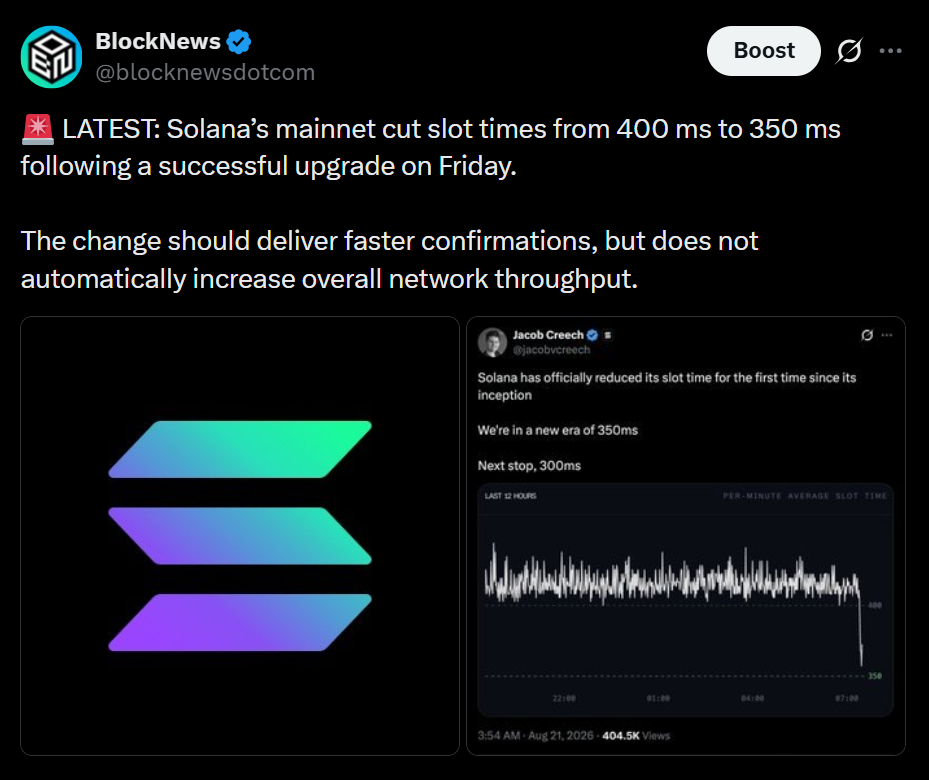
- Solana successfully reduced its target slot time from 400 milliseconds to 350 milliseconds.
- The upgrade is the first stage of a plan to eventually cut slot times to 200 milliseconds.
- Developers will monitor validator performance before activating the next reduction to 300 milliseconds.
Solana completed a major mainnet upgrade on Friday, reducing its target slot time from 400 milliseconds to 350 milliseconds. The change is designed to make transactions confirm faster and improve the overall responsiveness of the network.
The upgrade is the first step under SIMD-0525, a proposal approved in May that lays out a gradual path toward 200-millisecond slots.
Solana Targets Faster Transactions
Slots are short periods during which designated validators can produce blocks. Reducing their duration means confirmation and finalization thresholds measured in slots can be reached faster in real-world time.
The change also shortens Solana epochs. An epoch containing 432,000 slots previously took around 48 hours but should now take roughly 42 hours.
Validators remain responsible for four consecutive slots, meaning their turns now last approximately 1.4 seconds instead of 1.6 seconds.
200 Milliseconds Is the Final Target
Solana developers plan three additional 50-millisecond reductions, taking slot times from 350 ms to 300 ms, then 250 ms and eventually 200 ms.

Each stage will be activated separately. The rollout can be paused if shorter slots cause too many validators to miss their assigned blocks, allowing developers to evaluate network stability before proceeding.
Shorter slots should improve latency, but they do not automatically increase the amount of computational work Solana can process each second.
Solana Continues Major Network Upgrades
The slot-time reduction comes alongside several other infrastructure improvements. Solana previously increased its block compute limit and added Jump Crypto’s Firedancer validator client, improving client diversity and network resilience.
Developers are also working on the Alpenglow overhaul, which aims to dramatically reduce full network finality from roughly 12.8 seconds today.
The next milestone is a reduction to 300-millisecond slots, although developers have not announced an activation date. Network performance at 350 milliseconds will be monitored before the next stage begins.