
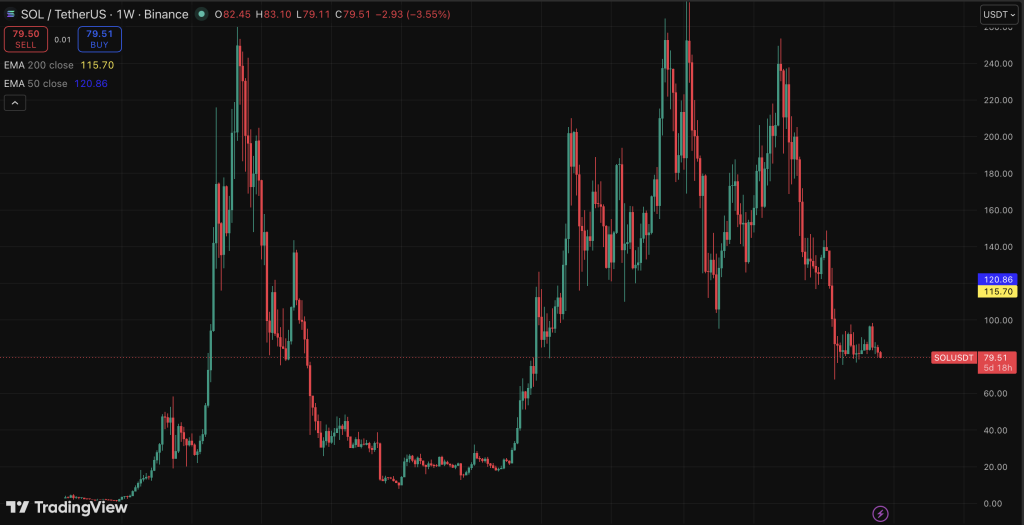
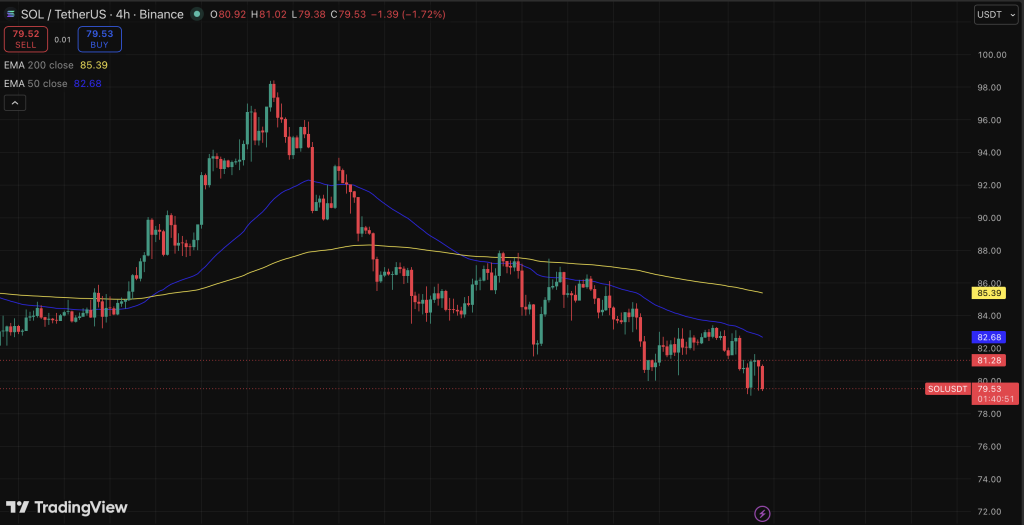
- Solana has fallen nearly 40% in 2026, underperforming both Bitcoin and Ethereum.
- Upcoming upgrades, growing stablecoin usage, and staking ETFs could support future growth.
- Despite strong fundamentals, Solana’s recovery may depend heavily on broader crypto market sentiment.
The cryptocurrency has fallen nearly 40% since the start of the year, lagging behind both Bitcoin and Ethereum. That’s a disappointing performance for a blockchain that, not too long ago, was being talked about as one of Ethereum’s biggest challengers. Sentiment has cooled, prices have pulled back, and investors have become a lot more cautious.
Still, crypto markets have a habit of changing direction when few people expect it. The question now is whether Solana can regain momentum during the second half of the year and potentially reward patient investors.
What Makes Solana Different From Ethereum?
Like Ethereum, Solana operates as a proof-of-stake blockchain that supports smart contracts, decentralized applications, NFTs, and a growing ecosystem of crypto services. But where Solana really tries to separate itself is speed.
The network combines its proof-of-stake architecture with something called Proof of History, a system that timestamps transactions before they are validated. It sounds technical—and it is—but the result is simple enough: faster transaction processing.
Today, Solana can process nearly 1,200 transactions per second in real-world conditions. Ethereum’s Layer-1 network, by comparison, handles roughly 24 transactions per second. Solana’s theoretical maximum throughput sits around 65,000 TPS, while Ethereum’s is significantly lower.
Those performance advantages have attracted developers at a remarkable pace. According to Electric Capital, Solana hosted more than 17,700 developers last year, making it the second-largest developer ecosystem in crypto behind Ethereum’s roughly 31,800 developers.
Solana’s Network Growth Continues to Impress
Even with its recent price struggles, Solana’s blockchain activity remains difficult to ignore.
During the first quarter of 2026, the network processed approximately 25.3 billion transactions. That’s a staggering figure. Ethereum, by comparison, handled around 200 million transactions during the same period.
It’s worth noting that the comparison isn’t perfectly equal because Solana includes validator vote transactions that Ethereum does not. Even so, the scale of activity highlights how heavily the network is being used.
Growth isn’t just coming from developers and users, either. Solana has quietly become one of the most important networks for stablecoin transfers. Thanks to partnerships with major companies like Circle, Visa, PayPal, and Stripe, the blockchain now handles nearly one-third of all stablecoin transaction volume.
That’s a pretty significant position to hold in an industry increasingly focused on payments and real-world utility.
Several Catalysts Could Support SOL This Year
Looking ahead, one of the biggest developments on the horizon is Solana’s upcoming Alpenglow upgrade, expected to arrive during the third quarter of 2026.
The upgrade aims to improve network efficiency even further while increasing Solana’s theoretical throughput to 100,000 transactions per second. If successful, it would strengthen Solana’s lead in blockchain performance and create additional separation from competitors attempting to solve scalability through alternative methods.
Ethereum, for example, continues relying heavily on Layer-2 rollups to improve transaction speeds. Solana’s approach has been different from the start: build speed directly into the core network rather than depending on secondary layers.
Another area generating excitement is tokenized real-world assets. As more financial products move onto blockchain rails, Solana is increasingly becoming a platform of choice for asset tokenization. Potential regulatory developments, particularly surrounding legislation like the proposed CLARITY Act, could provide additional support if the rules ultimately favor stablecoins and tokenized assets.
Meanwhile, Solana staking ETFs have also begun attracting attention. These investment products allow investors to gain exposure to SOL while earning staking rewards, all without managing crypto wallets or navigating exchanges. That simplicity could make Solana more appealing to both retail and institutional investors over time.
Why Solana May Still Face Challenges
Despite all these positive developments, there remains one obstacle that Solana cannot control: the broader market.
Macroeconomic uncertainty continues to weigh on risk assets across the board. Inflation concerns, interest rate expectations, geopolitical tensions, and shifting investor sentiment have all contributed to a more cautious environment for cryptocurrencies.
Even strong projects can struggle when capital flows out of speculative assets.
That’s why Solana’s recovery may ultimately depend less on its technology and more on overall market conditions. The fundamentals appear solid. Developer activity remains healthy. Network usage continues expanding. New upgrades are coming.
But until confidence returns to the wider crypto market, meaningful price appreciation could remain difficult.
For long-term believers, however, the current weakness may simply represent another chapter in a much larger growth story. The technology hasn’t disappeared. Neither has the adoption. What’s missing, at least for now, is the market enthusiasm that once pushed Solana to its highest levels.