

- Babylon Labs proposed integrating native Bitcoin collateral into Aave V4 through its Trustless Bitcoin Vaults protocol.
- The system would allow BTC to remain locked on Bitcoin while enabling lending activity on Ethereum.
- Aave founder Stani Kulechov described the proposal as the first major new Spoke implementation for Aave V4.
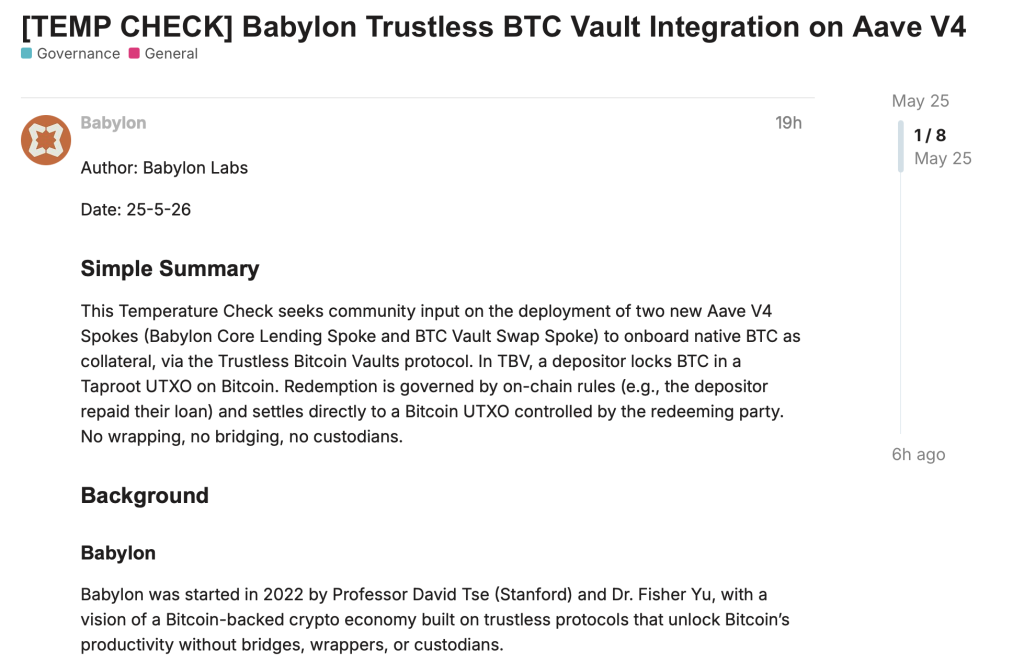
Babylon Labs has officially introduced a new governance proposal that could significantly change how Bitcoin interacts with decentralized finance. In a Temperature Check proposal posted to the Aave governance forum on Monday, the team outlined plans to integrate its Trustless Bitcoin Vaults (TBV) protocol directly into Aave V4.
The proposal focuses on something many Bitcoin holders have wanted for years — using native BTC as collateral inside DeFi without relying on wrapped assets, centralized custodians, or risky blockchain bridges. Instead of converting Bitcoin into synthetic versions on other chains, Babylon’s framework aims to keep BTC locked securely on the Bitcoin network itself while still allowing users to access lending functionality on Ethereum.
If approved, the system would introduce two new Aave V4 “Spokes,” specifically the Babylon Core Lending Spoke and the BTC Vault Swap Spoke. Together, these components would allow users to lock Bitcoin through Taproot-based UTXOs on Bitcoin while interacting with lending markets through Ethereum.
The proposal has already started drawing attention across the DeFi space because trustless Bitcoin integration remains one of the industry’s bigger long-term goals. Bridging Bitcoin into other ecosystems has historically introduced major security risks, so the idea of using BTC without moving it off-chain entirely is naturally generating interest.
How Babylon’s Trustless Bitcoin Vaults Would Work
Under the proposed structure, users would lock BTC directly on the Bitcoin network using Taproot scripts. Once locked, the system would mirror those holdings on Ethereum through a transfer-restricted ERC-20 token known as vaultBTC.
That token would effectively represent the locked Bitcoin while allowing users to use it as collateral inside Aave V4 lending markets. In simple terms, Bitcoin stays secured on Bitcoin, while Ethereum handles the lending activity tied to those positions.
The Babylon Core Lending Spoke would allow borrowers to take loans against their BTC-backed positions using approved assets on Aave. Meanwhile, the BTC Vault Swap Spoke would manage settlement processes if liquidations occur, with liquidation handling denominated through wrapped Bitcoin, or WBTC.
Babylon emphasized heavily that the model preserves Bitcoin’s self-custody principles rather than forcing users to trust centralized bridge operators or custodial intermediaries. According to the proposal, BTC redemption would rely entirely on cryptographic verification methods rather than manual approval systems.
Withdrawals would require valid zero-knowledge proofs confirming specific conditions had been satisfied, including things like loan repayment on the host chain. Invalid withdrawal attempts could then be challenged through a fraud-proof period designed to block unauthorized claims before funds are released.
Aave Founder Calls It First Major New V4 Spoke Proposal
Babylon Labs itself has become one of the more heavily funded Bitcoin-focused infrastructure projects in crypto recently. The protocol, which focuses on native Bitcoin staking and lending systems, has reportedly secured over $100 million in backing from major firms including a16z, Paradigm, and Polychain Capital.
According to Babylon, the platform has already processed more than 100,000 BTC in cumulative deposits, with roughly 51,000 BTC currently staked through the protocol.
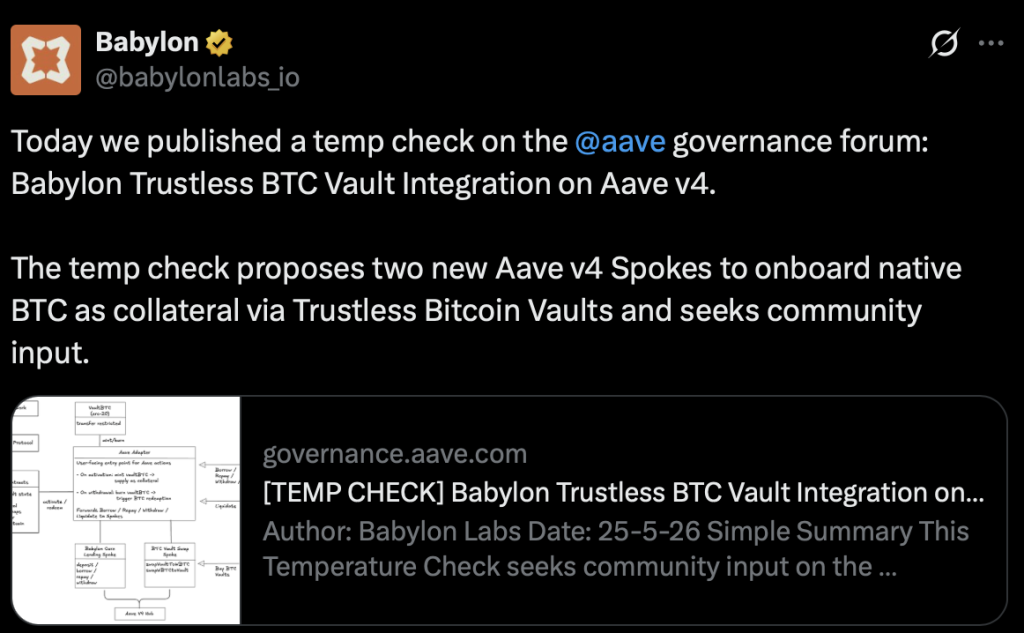
Aave founder Stani Kulechov publicly commented on the proposal shortly after its release, describing it as the first novel Spoke implementation proposal introduced for Aave V4. In a post shared on X, he highlighted the significance of enabling trustless Bitcoin collateral without requiring BTC to ever leave the Bitcoin network itself.
That detail seems to be one of the biggest selling points behind the integration. Bitcoin holders have traditionally faced difficult tradeoffs when entering DeFi — either trust centralized wrappers or move funds through potentially vulnerable bridge systems. Babylon’s model attempts to remove that compromise altogether.
If the proposal advances successfully through governance, it will move next into the Aave Request for Comment stage, often referred to as ARFC. During that phase, the community will evaluate risk models, oracle systems, audit findings, and broader technical considerations before any final implementation proposal reaches a formal Aave Improvement Proposal vote.
Security Reviews Continue as Aave Faces Broader DeFi Pressure
Security reviews for the proposed integration are already underway. Several auditing firms, including Coinspect, Sherlock, Zellic, ABDK, and ZK Security, are currently involved in reviewing different parts of the architecture before further governance progression occurs.
The timing of the proposal is interesting too. Aave and parts of the broader DeFi ecosystem recently faced criticism following fallout connected to the KelpDAO exploit, which renewed concerns around DeFi protocol security and interconnected platform risks.
Against that backdrop, Babylon’s emphasis on trustless architecture and cryptographic verification may resonate strongly with users increasingly focused on minimizing counterparty exposure inside decentralized finance.
Meanwhile, AAVE token itself showed only a modest market reaction following the announcement. At the time of writing, AAVE was trading around $86 after gaining roughly 1% over the previous 24 hours.
For now, the proposal remains in its early governance stages, but if approved, it could become one of the more important attempts yet to connect Bitcoin liquidity directly into Ethereum-based DeFi without sacrificing Bitcoin’s core security model.