

- Cardano’s Leios proposal passed with roughly 84% approval from DReps, unlocking 27.7 million ADA in funding.
- The upgrade aims to significantly expand Cardano’s network capacity and long-term scalability.
- ADA price showed only a mild reaction following the governance vote despite the proposal’s importance.
Cardano’s governance system just approved one of its biggest infrastructure proposals yet, and the decision could shape the network’s long-term future for years ahead. The Leios proposal, submitted by Input Output Global (IOG), officially passed after receiving overwhelming support from delegated representatives, also known as DReps.
According to governance data from Cexplorer, nearly 84% of participating DReps voted in favor of the proposal. That approval unlocks treasury funding worth roughly 27.7 million ADA, allowing the Leios initiative to move fully into its next development phase.
The result marks an important moment for Cardano’s evolving governance structure. It also highlights growing community support for scaling-focused upgrades as the network continues trying to compete with faster and more active blockchain ecosystems. While ADA price action remained relatively calm after the vote, the long-term implications behind Leios are much bigger than a short-term market reaction.
Input Output previously described Leios as one of the key technologies needed to significantly expand Cardano’s throughput and overall network capacity. In simple terms, the goal is to allow Cardano to process far more activity without sacrificing decentralization or making the chain too expensive for regular users.
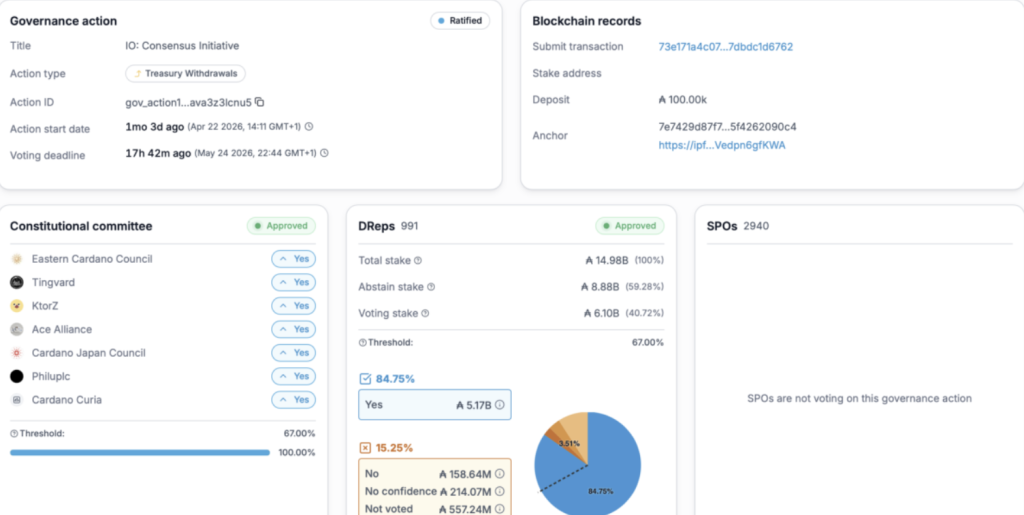
Leios Upgrade Aims To Expand Cardano’s Capacity
The Leios proposal was originally included in a broader group of governance submissions introduced back in April. Among them, Leios quickly became one of the most closely watched because it directly targets scalability, which remains one of the biggest conversations across blockchain development right now.
According to Input Output’s roadmap, the Leios testnet is expected to launch on June 23, 2026. Before reaching that stage, developers already demonstrated an early feature-complete alpha version running inside a dedicated public testing environment.
The treasury allocation approved this week will help continue development beyond the current funding cycle. Work is expected to continue through both the 2026 and 2027 periods as developers gradually move Leios through multiple Software Readiness Levels, specifically levels 5 through 8.
Essentially, the project is transitioning from an advanced prototype into something designed for eventual deployment on Cardano’s live mainnet. That process takes time, especially for infrastructure upgrades tied directly to network performance and consensus systems.
The broader vision behind Leios also connects to Cardano’s longer-term 2030 roadmap. Input Output previously stated that Cardano aims to scale from around 800,000 monthly transactions today to potentially more than 27 million monthly transactions in the future. That’s an enormous jump honestly, and one that would require significant infrastructure improvements underneath the surface.
Input Output Calls Leios Key to Cardano’s Long-Term Growth
Input Output has repeatedly framed Leios as one of the core mechanisms designed to help Cardano reach those higher transaction targets. The company described the upgrade as purpose-built for scaling activity while keeping the network efficient and sustainable over time.
The proposal’s approval suggests many community participants agree with that direction. Scalability upgrades have become increasingly important as blockchain adoption grows across decentralized finance, payments, gaming, tokenization, and broader on-chain applications.
Beyond Leios, several additional governance proposals from Input Output also received approval during the voting process. These included the Cardano Maintenance Initiative, Cardano Upgrades, Higher Assurance Technical Collaboration, Developer Experience Initiative, and improvements tied to Plutus, Cardano’s smart contract platform.
The Plutus proposal itself received a separate treasury request worth around 11.8 million ADA. Its primary focus is improving smart contract efficiency, reducing execution costs, and making applications easier to verify from a security perspective.
Not every proposal managed to pass though. The Pogun initiative, which aimed to build an end-to-end Bitcoin DeFi system, failed to secure enough support from DReps and finished with only 32.4% approval.
ADA Price Reaction Remains Relatively Calm
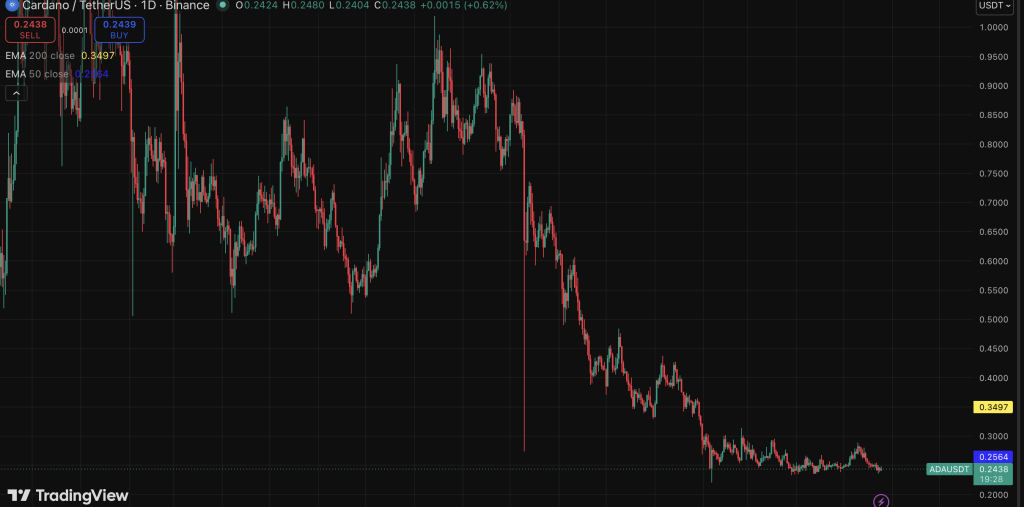
Despite the significance of the governance results, ADA price action has remained fairly muted so far. At the time of writing, Cardano’s native token was trading around $0.24 after posting a modest 1.32% gain over the previous 24 hours.
Zooming out, ADA still appears stuck inside a longer-term consolidation structure. Over the past month, the token has declined only around 2%, though year-to-date performance remains much weaker with ADA still down approximately 66%.
That relatively soft market reaction may reflect broader crypto market conditions rather than disinterest in the proposal itself. Infrastructure-focused developments often take longer to influence price because traders usually wait to see measurable adoption, network growth, or actual performance improvements before aggressively repricing an asset.
For now, Cardano’s governance approval marks another step in the network’s push toward greater scalability and self-managed development. Whether Leios ultimately delivers the kind of growth supporters expect will likely become one of the ecosystem’s biggest storylines over the next few years.