

- SUI price dropped back near $1 after a sharp weekly correction changed market sentiment.
- Analysts continue watching a major weekly support trendline that has held since 2023.
- Sui’s DEX volume surpassed $200 billion, signaling continued ecosystem growth despite weak price action.
SUI price has fallen back toward the $1 region after a steep weekly correction wiped out much of the token’s earlier momentum. The drop shifted market sentiment pretty quickly too. Traders who were aggressively bullish when SUI traded above $5 have suddenly gone quiet now that the price sits near long-term support levels again.
Even with the heavy decline, analysts say this current area remains extremely important for the broader trend. Sui continues holding close to a rising weekly support trendline that has triggered multiple rebounds in the past, while decentralized exchange activity across the network keeps expanding. So although price action looks weak in the short term, some traders believe the larger structure hasn’t completely broken down yet.
At this stage, the broader recovery outlook really depends on whether buyers can defend the $1 support zone and eventually reclaim higher resistance levels. Without that, sentiment could continue deteriorating.
Traders Watch Whether SUI Can Rebuild Momentum
According to analysts from the Sui Community, the latest correction has completely reshaped market psychology. The mood shift has been dramatic. Traders who were confidently calling for higher targets above $5 only weeks ago are now mostly silent while SUI trades near what many consider a major reassessment area.
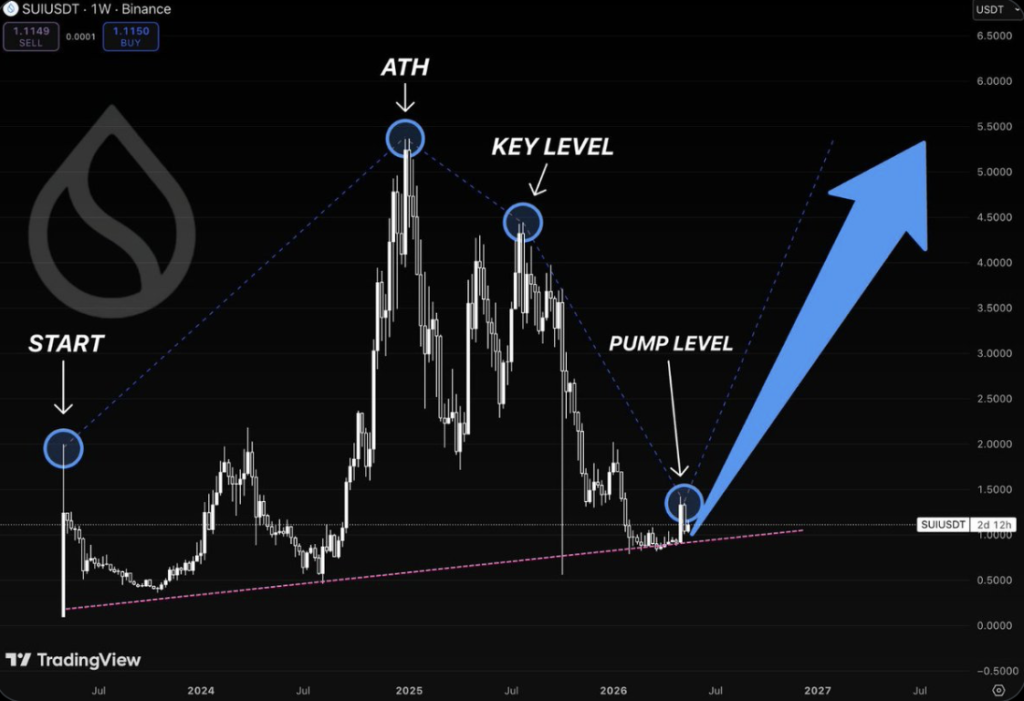
The weekly chart currently shows SUI trading close to $1.00 on Binance, still sitting below several major reclaim levels that bulls need to recover. Analysts identified $2.01 as the first major upside target if buyers regain control of momentum. Above that, the next larger resistance zones appear near $4.43 and eventually $5.35, close to previous cycle highs.
That setup suggests SUI is probably still in the early stages of any potential recovery attempt. A move back toward $2 would likely confirm the first meaningful shift in momentum, while reclaiming the $4 region later on could reopen discussions around previous all-time highs.
But before any of that happens, SUI first needs stability around current levels. If the token loses support near $1, the bullish structure weakens considerably and traders may begin waiting for deeper support zones before stepping back into the market.
Weekly Trendline Keeps Bulls Interested
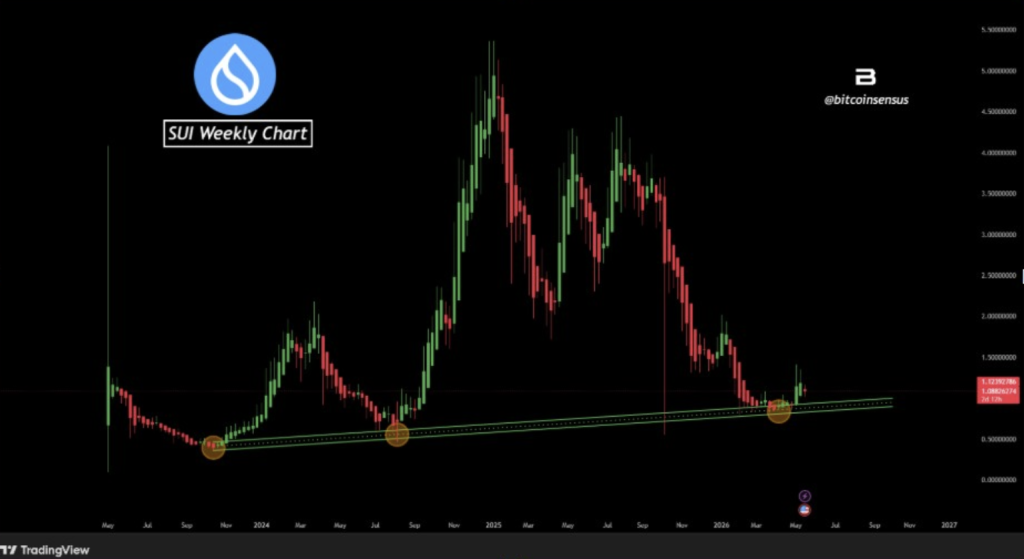
From a longer-term technical perspective, analysts at Bitcoinsensus pointed out that SUI is still respecting a rising weekly support line that has held since 2023. The latest weekly candles show the token reacting near that same trendline area once again, which explains why this zone is getting so much attention right now.
Historically, every major touch of this support line came before a strong upward move. That doesn’t guarantee another rally, obviously, but it does make the current retest pretty important from a technical standpoint. Buyers appear to be trying to stabilize the market near the trendline after the steep collapse from higher levels.
Right now though, the chart still shows more stabilization than actual reversal confirmation. The market hasn’t fully turned bullish again, and traders are still waiting to see whether accumulation builds properly near support.
A weekly close below the rising trendline would likely change the entire setup. In that scenario, SUI could lose one of its strongest long-term technical structures, which may delay any serious recovery attempt toward $2 and beyond.
Sui’s DEX Activity Continues Growing
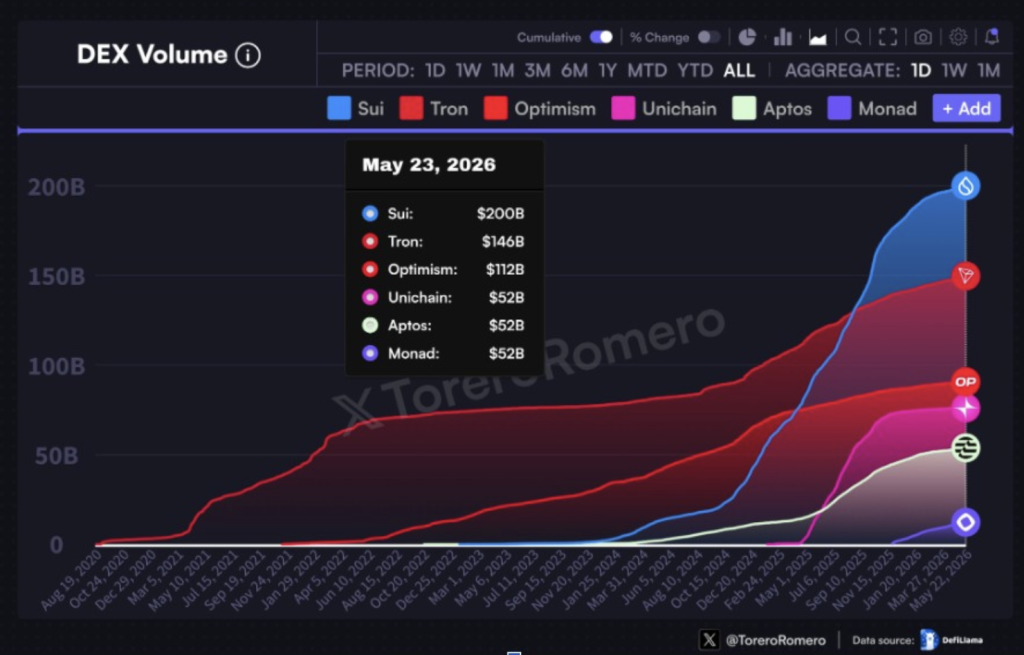
While price action struggles, the network itself continues showing signs of expansion. Analyst ToreroRomero recently highlighted that Sui has now surpassed $200 billion in cumulative DEX volume, according to DeFiLlama data. That places Sui ahead of several major blockchain ecosystems, including Tron and Optimism, in total decentralized exchange activity.
That’s actually a pretty important signal for the broader ecosystem. Rising DEX volume suggests users are still actively trading and using the network despite the weak token price. In many cases, sustained onchain activity matters just as much as short-term price movement when evaluating long-term ecosystem strength.
The data also shows Sui’s DEX volume accelerating sharply between 2025 and 2026, helping position the network among the more active chains across decentralized finance. For bullish traders, that creates a stronger fundamental argument that ecosystem adoption is continuing even while market sentiment cools off.
Still, strong network activity alone doesn’t automatically guarantee a price recovery. SUI still needs consistent demand, healthier liquidity conditions, and broader market support before ecosystem growth can fully translate into a durable uptrend.
Analysts Compare Current Structure to Previous Rally Setup
Another interesting perspective came from analyst Filippix, who compared the current market structure to the base formation that appeared before SUI’s first major rally toward all-time highs. According to the analyst, the token is once again respecting a similar “pump zone” structure that previously acted as a launchpad during 2024.
Back then, SUI spent a long period consolidating quietly before momentum suddenly accelerated and pushed the token toward the $5.35 region. The analyst believes today’s setup shares several similarities with that earlier accumulation phase.
Filippix also argued that most traders usually become bullish near market highs, while stronger opportunities often appear during overlooked accumulation zones where sentiment feels weakest. That idea has started gaining traction among some long-term holders who believe SUI may still be building another large accumulation structure beneath the surface.
If momentum eventually returns from this range, analysts say the path back toward previous highs could reopen over time. For now though, the market still remains in a wait-and-see phase, with the $1 support region acting as the key battleground.