- SGX FX partnered with Chainlink to bring institutional OTC foreign exchange data onto blockchain networks.
- The integration supports tokenized assets, structured products, and decentralized finance applications.
- The move reflects growing institutional interest in tokenization and blockchain-based financial infrastructure.
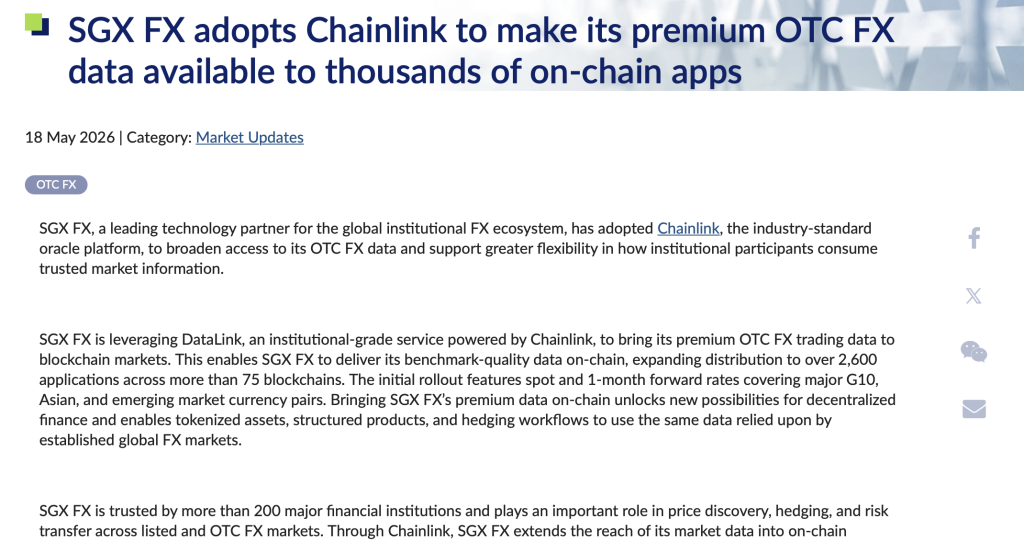
Institutional foreign exchange data is beginning to move deeper into blockchain infrastructure as SGX FX partners with Chainlink to deliver OTC currency pricing feeds directly to on-chain markets. The collaboration introduces selected spot and one-month forward foreign exchange rates through Chainlink’s DataLink service, giving blockchain developers access to institutional-grade FX data that traditionally stayed inside conventional finance systems.
The feed reportedly includes major G10 currencies alongside several Asian and emerging market pairs. According to SGX FX, the goal is to support developers building tokenized financial products, structured assets, hedging tools, and broader real-world asset infrastructure directly on blockchain networks. It’s another example of traditional financial data slowly crossing into decentralized systems as tokenization narratives continue gaining traction globally.
Chainlink DataLink Expands Institutional Market Access
Chainlink’s DataLink service functions as an infrastructure layer designed specifically for institutional data providers looking to distribute financial market information onto blockchain ecosystems. Through the integration, SGX FX data could theoretically become accessible to more than 2,600 decentralized applications operating across over 75 blockchain networks connected through Chainlink infrastructure.
That figure reflects Chainlink’s existing ecosystem reach rather than confirmed adoption of SGX FX feeds themselves, but it still highlights how large blockchain connectivity has become compared to just a few years ago.
Hugh Whelan, head of management and data at SGX FX, said market participants increasingly want flexible access to trusted financial data while maintaining institutional-grade standards. According to Whelan, the Chainlink partnership helps support newer blockchain-based workflows without sacrificing reliability expectations typically required in foreign exchange markets.
Whelan brings fairly deep FX experience into the role as well. Before joining SGX FX last year, he spent over a decade leading EBS Direct at NEX Group and also co-founded FXSpotStream, one of the larger institutional FX aggregation platforms. That background gives additional weight to SGX FX’s move toward blockchain-based infrastructure.
Traditional FX Providers Continue Entering Blockchain Markets
The SGX FX integration isn’t happening in isolation either. Several traditional market data providers have gradually started using oracle networks over the past few years to distribute pricing feeds into decentralized finance systems.
Back in April 2021, dxFeed, a subsidiary of Devexperts, launched its own Chainlink oracle node to support on-chain financial applications. Around the same period, New Change FX also began supplying benchmark and reference FX pricing data through Chainlink infrastructure. Those earlier efforts largely focused on developers building decentralized derivatives platforms, stablecoin ecosystems, and lending markets requiring reliable external pricing information.
Meanwhile, Pyth Network has emerged as another major competitor in the blockchain oracle sector, creating increasing competition around how institutional financial data eventually flows into tokenized markets.
What’s changing now though is scale. Earlier integrations felt more experimental. Today, partnerships increasingly involve larger institutional names and broader tokenization ambitions tied directly to capital markets infrastructure.
Tokenization Push Continues Expanding Across Global Finance
The SGX FX agreement also fits into a much larger trend developing across traditional finance. Over the past year especially, banks, exchanges, and financial infrastructure providers have shown growing interest in tokenized assets and blockchain-based settlement systems.
Chainlink itself has become heavily involved in several institutional tokenization initiatives recently. In August 2025, SBI Group entered a tokenization partnership with Chainlink covering real estate and bond token frameworks targeting institutional clients throughout the Asia-Pacific region. Earlier in March 2025, Abu Dhabi Global Market also signed a memorandum of understanding with Chainlink focused on compliant tokenization structures and blockchain finance standards.
Fernando Vazquez, president of capital markets at Chainlink Labs, described the SGX FX integration as another milestone connecting traditional global markets with on-chain finance systems. Even so, several unanswered questions remain.
SGX FX did not disclose pricing details, revenue-sharing structures, or any confirmed customer adoption tied directly to the new service. Demand for institutional OTC FX data inside decentralized finance also remains somewhat uncertain for now. Most tokenized real-world asset projects today still concentrate heavily on U.S. Treasuries, money market funds, and equities rather than large-scale foreign exchange trading.
Still, the direction seems increasingly clear. Traditional finance infrastructure and blockchain systems are steadily moving closer together, even if the pace remains gradual and uneven at times.