

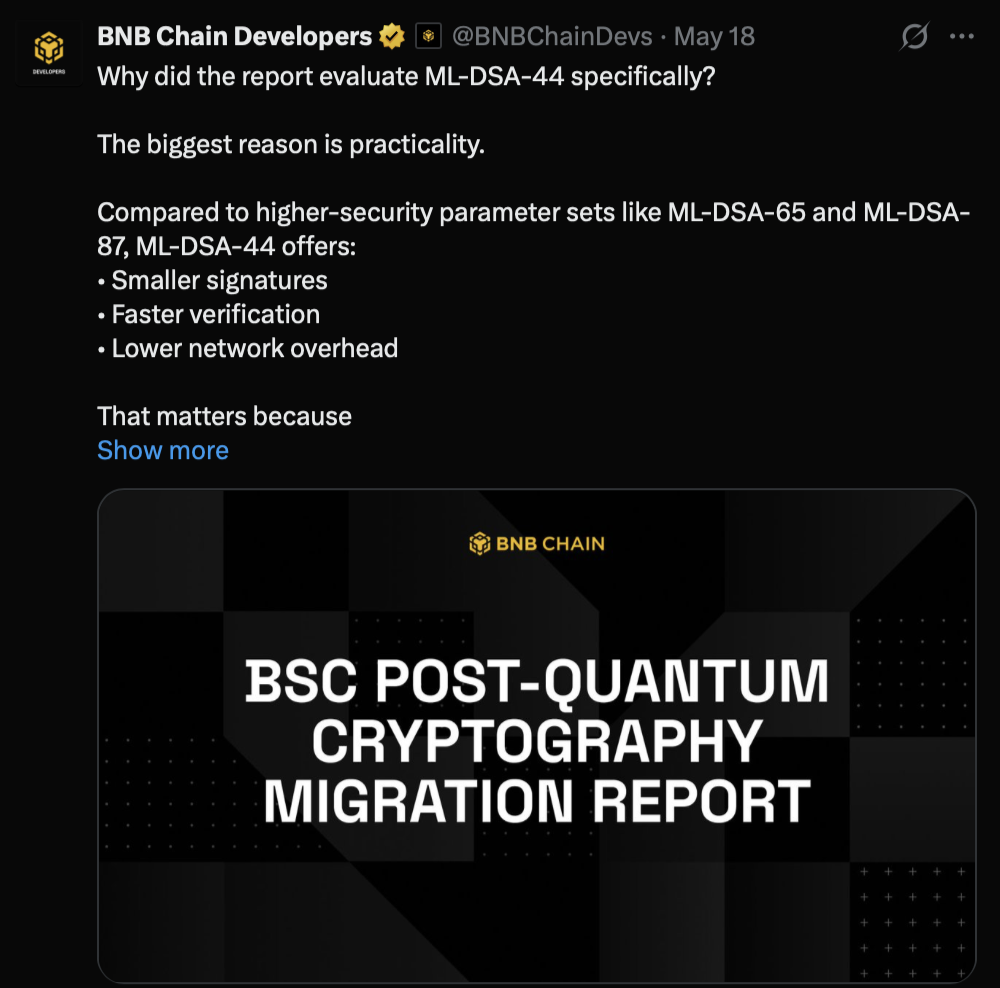
- BNB Chain developers released a new report exploring post-quantum cryptography for future BSC security.
- Testing showed larger transaction sizes reduced throughput, though validator aggregation remained efficient.
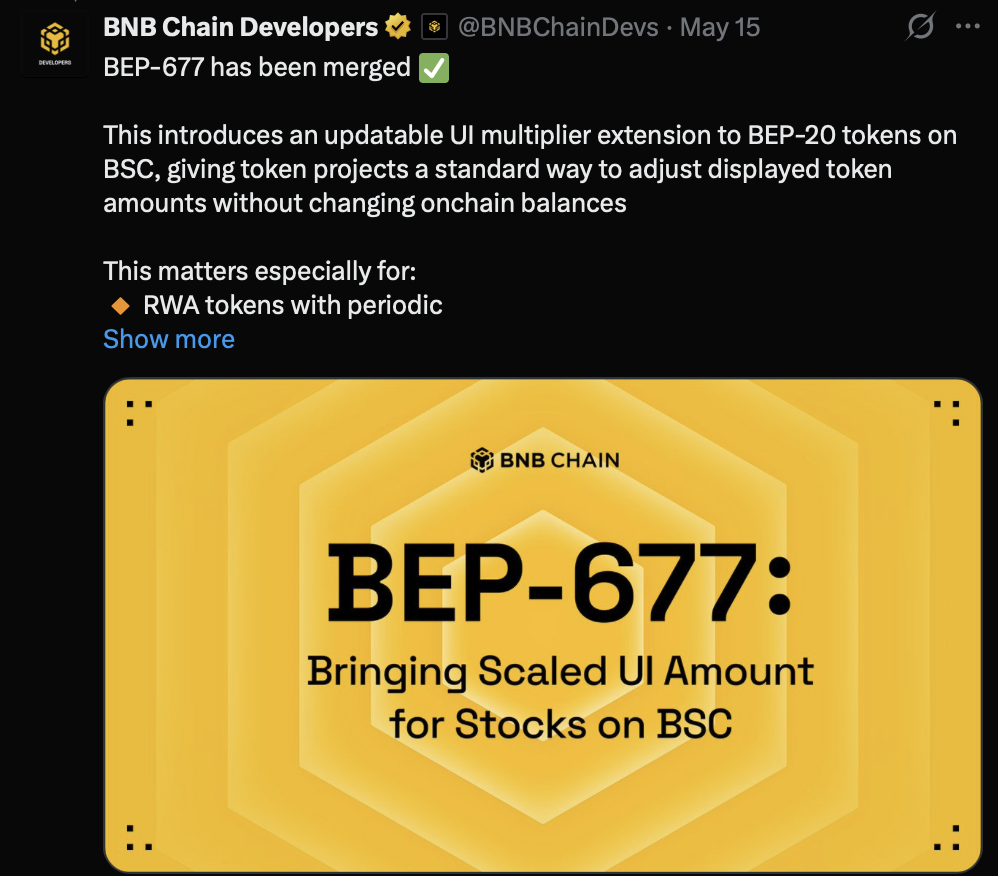
- The new BEP-677 token standard also went live, adding flexible token display adjustments for projects and wallets.
BNB Chain developers have released a fresh technical report focused on post-quantum cryptography for BSC, adding a new layer to the latest Binance Coin news cycle. The report offers an early look at how the network may eventually prepare for security threats linked to future quantum computing technology. While quantum risks are still considered long-term rather than immediate, developers appear to be thinking ahead before those concerns become unavoidable for blockchain infrastructure.
Alongside the post-quantum report, BNB Chain also confirmed a separate ecosystem update involving the integration of the new BEP-677 token standard. Together, the announcements highlight how the network is simultaneously working on long-term security upgrades while continuing to improve token management tools across the BSC ecosystem.
BNB Chain Tests Future Quantum-Resistant Security Models
According to the report, BNB Chain developers explored how BSC could eventually transition away from older cryptographic systems like ECDSA and BLS signatures, both of which may become vulnerable if quantum computing advances far enough in the future. The team stressed that no immediate threat exists today, but preparation becomes much easier before the technology reaches a dangerous stage.
To test the framework, developers experimented with ML-DSA-44 signatures alongside pqSTARK aggregation systems. The objective was relatively straightforward: determine whether BSC could still process transactions efficiently and maintain validator performance after replacing older cryptographic methods with post-quantum alternatives.
The results were mixed, honestly.
ML-DSA-44 was selected partly because it offered smaller signatures and faster verification compared to several competing post-quantum models currently being studied. Even so, transaction data sizes increased dramatically during testing. Average transaction size reportedly jumped from roughly 110 bytes to nearly 2.5 KB, while block sizes expanded toward 2 MB during heavier stress tests.
That increase eventually affected overall throughput across the network.
Larger Block Sizes Create New Performance Challenges
One of the more important findings from the report involved transaction speed under cross-region conditions. Testing showed throughput falling from around 4,973 transactions per second down to roughly 2,997 TPS when post-quantum systems were enabled. Interestingly though, developers explained that verification speed itself wasn’t actually the biggest problem.
Instead, the larger block sizes created delays while transmitting data between regions and validator systems. In other words, the challenge became network efficiency rather than raw cryptographic processing power.
Despite that drawback, validator aggregation performance remained relatively efficient throughout testing. Developers used pqSTARK aggregation to compress six validator signatures totaling roughly 14.5 KB into a proof measuring around 340 bytes. According to the report, that compression helped reduce consensus pressure even while signature sizes increased overall.
Another important detail mentioned in the Binance Coin news update involved wallet compatibility. Developers noted that BSC wallet addresses would remain unchanged under the proposed post-quantum framework, which could make eventual migration easier for users and infrastructure providers later on.
BEP-677 Introduces Flexible Token Display Adjustments
Outside the security discussion, BNB Chain developers also confirmed that BEP-677 has officially been merged into the network. The new standard introduces a UI multiplier extension for BEP-20 tokens, allowing projects to adjust displayed token amounts without modifying the actual on-chain balance underneath.
That may sound minor at first, but it could become surprisingly useful for tokenized real-world assets, interest-bearing products, and projects needing redenomination-style adjustments over time. Instead of forcing users through complicated token swaps or balance migrations, the system simply changes how balances appear on supported wallets and interfaces.
Developers compared the functionality to stock-split style adjustments where the presentation changes without affecting the underlying ownership itself. The goal seems to be improving flexibility while reducing friction for both users and projects managing evolving token structures.
BNB Chain Continues Balancing Speed, Security, and Scalability
The broader significance of these updates extends beyond short-term price action surrounding Binance Coin itself. While traders often focus heavily on charts and market volatility, infrastructure upgrades like these tend to shape long-term confidence around blockchain ecosystems much more quietly over time.
The post-quantum report shows that BNB Chain developers are already thinking several years ahead regarding security architecture, even while quantum computing remains in relatively early stages. Meanwhile, the BEP-677 rollout reflects continued efforts to modernize token standards and simplify asset management across the network.
Competition between major blockchain platforms has become increasingly intense lately, especially as networks race to improve scalability, developer tooling, institutional readiness, and user experience all at once. Through these recent upgrades, BNB Chain appears to be trying to strengthen all four areas simultaneously, though developers openly acknowledged that larger transaction volumes under post-quantum systems could still create future scaling challenges.
For now, the message from BNB Chain seems pretty clear. The ecosystem isn’t only focusing on today’s market conditions, it’s also preparing for where blockchain infrastructure may need to be years from now.