

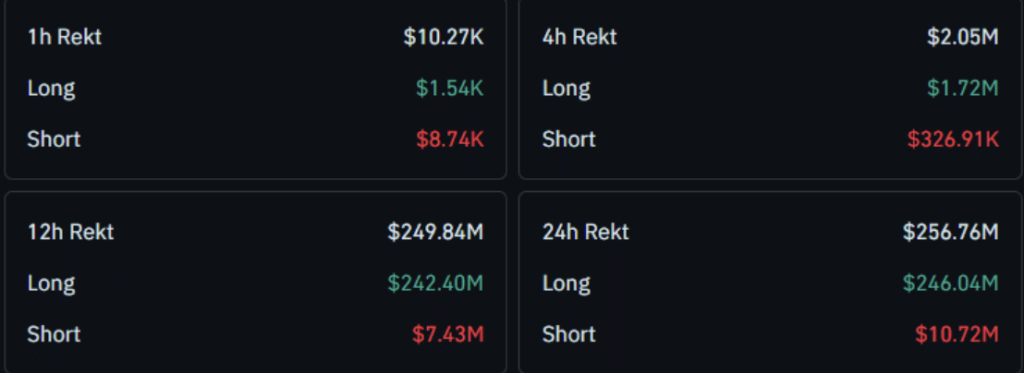
- Ethereum saw nearly $246 million in long liquidations during a sharp volatility spike.
- Lower trading volume weakened the market’s ability to absorb aggressive selling pressure.
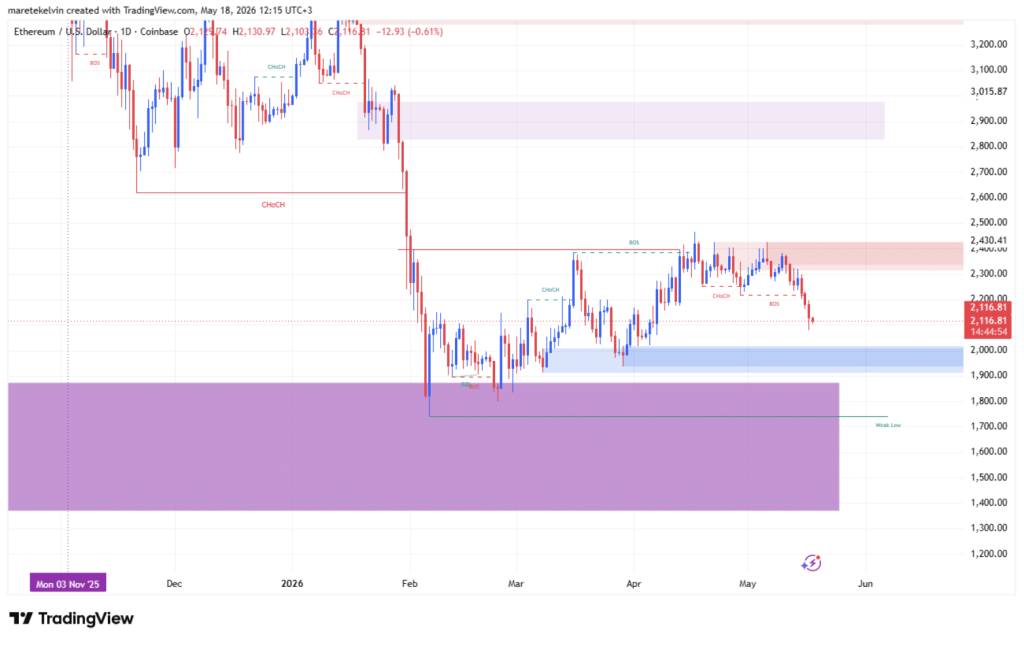
- Traders are now watching whether ETH can successfully defend the critical $2,015 support zone.
Ethereum entered a rough stretch of volatility after a powerful liquidation cascade erased a massive amount of bullish positions across the market. Over the past 24 hours alone, nearly $246 million in long positions were wiped out as leveraged traders got caught on the wrong side of the move. Once liquidations started accelerating, the selling pressure fed into itself pretty quickly, forcing automated sell-offs that pushed ETH even lower in a short period of time.
The broader situation became even more fragile because trading activity weakened during the decline instead of strengthening. Normally, strong volume can help absorb aggressive selling pressure during sharp corrections. This time though, lower participation left the market looking thinner and more vulnerable to sudden downside swings. With fewer buyers stepping in, Ethereum struggled to stabilize as the liquidation wave unfolded.
Liquidations Intensify as Bullish Momentum Breaks Down
The speed of the recent sell-off reflected how quickly market sentiment shifted once Ethereum lost its earlier momentum. When leveraged long positions begin closing rapidly, the market often enters a chain reaction where forced liquidations trigger even more selling. That’s essentially what traders witnessed here. The deeper ETH fell, the more long positions were pushed into liquidation territory.
Lower trading volume made the situation even harder to contain. Buyers stayed relatively cautious during the decline, limiting the market’s ability to slow the downward move or establish a stronger support bounce. In these types of conditions, price action can become extremely reactive because liquidity thins out while volatility expands at the same time.
For now, traders are watching closely to see whether stronger demand eventually returns near important support regions. Without that demand, short-term pressure could continue building underneath the surface.
Ethereum Whale Keeps Buying Despite Heavy Losses
Interestingly, not everyone turned bearish during the correction. One large Ethereum whale reportedly connected to Matrixport actually increased its long exposure while the broader market weakened. According to shared wallet data, the position held roughly 120,000 ETH valued near $254 million, despite carrying more than $17.5 million in unrealized losses during the decline.
That kind of positioning suggests strong long-term conviction even while short-term market conditions remain unstable. Still, increasing leveraged exposure during a falling market also creates additional risk. If Ethereum continues losing support levels, large positions like this could face liquidation pressure themselves, which would only add more volatility back into the market.
Whale activity like this often grabs attention because it can signal confidence from larger players, but it doesn’t guarantee immediate recovery either. Sometimes whales absorb weakness early. Other times they simply get trapped alongside everyone else. Markets can be brutal like that.
Can Ethereum Hold the $2,015 Support Zone?
Ethereum’s next major support area now sits near the $2,015 level, and traders increasingly view that region as the key line determining what happens next. If buyers defend the zone aggressively, ETH could stabilize and potentially attempt a short-term recovery bounce after the recent liquidation flush. That scenario would likely calm market sentiment, at least temporarily.
However, if the reaction around $2,015 remains weak, Ethereum could face a deeper correction before finding a stronger base. In many leverage-driven selloffs, markets often overshoot downside levels briefly before buyers regain confidence again. Right now, ETH still looks caught somewhere between panic unwinding and a broader reset phase.
Importantly, the recent collapse in leveraged positions doesn’t necessarily mean Ethereum’s entire long-term structure has broken down. Many analysts still view the move more as a leverage reset following an extended bullish period rather than the beginning of a full trend collapse. These resets are fairly common after speculative positioning becomes overcrowded.
For the moment, Ethereum remains stuck in that reset environment. The next major move will probably depend on whether buyers return aggressively near support or continue waiting cautiously on the sidelines.