
- Geopolitical tensions highlight weaknesses in traditional global payment systems
- XRP offers a theoretical solution with faster, intermediary-free transactions
- Adoption remains limited, but demand for efficient financial infrastructure is growing
When geopolitical tensions rise, especially in critical areas like the Strait of Hormuz, the cracks in global finance start to show pretty quickly. This region isn’t just another shipping route, it’s a lifeline for global oil flows. So when instability hits, it doesn’t stay contained, it spills into energy markets, trade systems, and even payment networks that keep everything moving.
And in moments like these, one thing becomes obvious. Speed matters. Reliability matters even more. When payments slow down, entire industries feel it, sometimes in ways that aren’t immediately visible, but very real underneath.
XRP Enters the Conversation as an Infrastructure Play
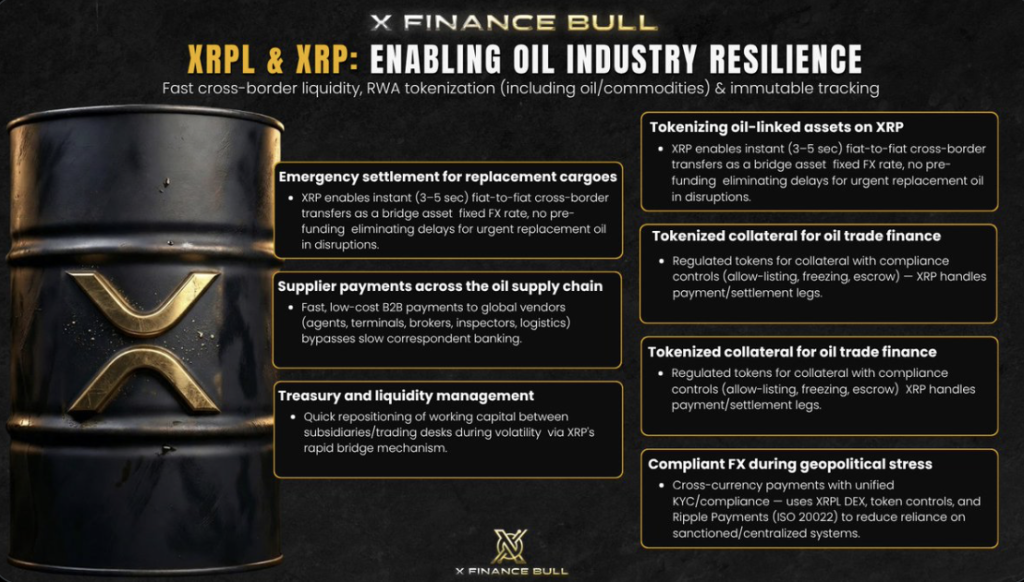
In a recent post, crypto commentator X Finance Bull framed XRP in a slightly different way than usual. Not as a speculative asset chasing price, but as infrastructure, something built to handle stress when systems start breaking down. It’s an interesting angle, especially when you look at industries like oil, where timing and liquidity can make or break operations.
The idea is simple, or at least it sounds simple. If payments can move instantly, without friction, then companies can react faster when things go wrong. But that’s a big “if,” and it depends heavily on whether current systems can even be replaced or upgraded.
Legacy Systems Still Create Friction
Right now, most global oil transactions still rely on traditional banking networks, and those systems… aren’t exactly built for speed. Payments move through multiple intermediaries, often requiring pre-funded accounts, and settlement can take days. That delay might not matter in calm conditions, but during crises, it becomes a real problem.
Sanctions can suddenly block payment routes. Banks can freeze activity without warning. Suppliers end up waiting, sometimes days, for funds to clear. And during that time, shipments stall, decisions get delayed, and risk builds across the supply chain. It’s not efficient, but it’s the system we still rely on.
XRP’s Design Suggests a Faster Alternative
This is where XRP comes in, at least in theory. The XRP Ledger is designed for near-instant settlement, often within seconds, and it removes the need for multiple intermediaries. That alone changes the equation quite a bit.
In a high-pressure scenario, companies could settle payments almost immediately, securing shipments or adjusting logistics without waiting for traditional banking processes. There’s also no need for pre-funded accounts, which means capital isn’t locked up unnecessarily. That kind of flexibility could make a difference, especially in volatile environments.
A Long-Term Idea, Not a Present Reality
But it’s important to be clear here, this is still more of a forward-looking idea than something actively happening today. The oil industry hasn’t adopted XRP at scale, and there are still regulatory hurdles, institutional resistance, and, honestly, inertia slowing things down.
Still, the broader point stands. As geopolitical risks increase, industries will likely demand faster, more resilient financial systems. XRP fits that narrative, at least on paper. Whether it actually becomes part of that future… that’s still uncertain, and probably will be for a while.