

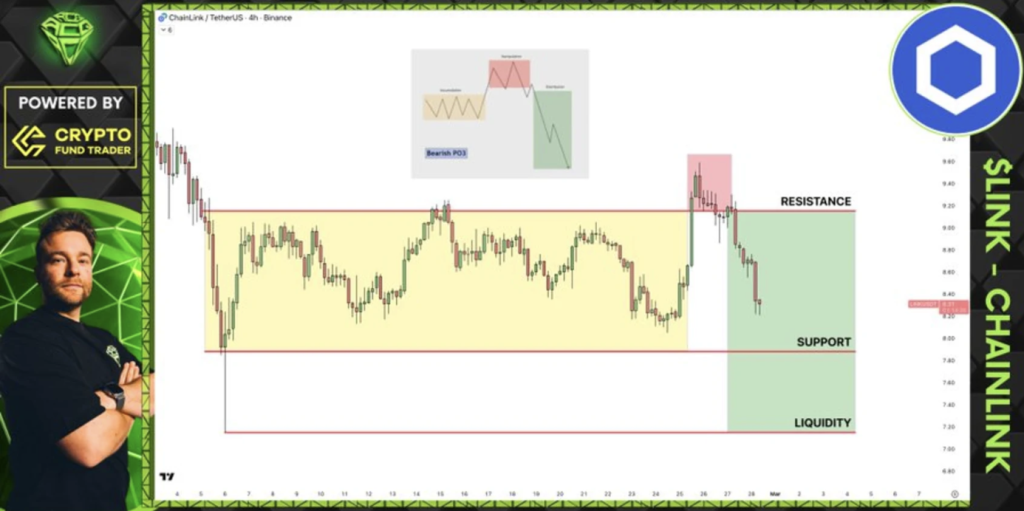
- Chainlink failed to hold above the $9.20 resistance zone, forming lower highs and signaling seller dominance.
- Key support sits near $7.90–$8.00, with potential downside liquidity targets around $7.20.
- Despite short-term weakness, institutional adoption and CCIP growth continue strengthening Chainlink’s long-term infrastructure role.
Chainlink’s positioning feels… delicate right now. On the 4-hour Binance chart, LINK spent weeks drifting inside a tight band, roughly between $7.90–$8.00 support and $9.20–$9.30 resistance. At first glance, it looked like equilibrium. Healthy consolidation. Nothing dramatic.
But over time, that sideways grind started to look less like balance and more like quiet distribution.
An analyst on X, Sjuul, pointed to his “power of 3” framework — a structure that maps accumulation, manipulation, and markdown phases. According to him, LINK may already be transitioning into the markdown stage. The recent breakout attempt above resistance didn’t stick. And that detail matters.
Breakout Failure Shifts Control to Sellers
When LINK pushed above $9.20, momentum traders jumped in. The move looked clean. For a moment.
Then the rejection wicks appeared inside the supply zone. Sellers stepped in hard, defending higher levels with precision. What could’ve been expansion turned into a trap. The breakout failed, and price quickly rolled over.
Lower highs formed almost immediately. Large red candles followed. LINK slipped back below the former breakout area, flipping optimism into caution. Failed breakouts often signal who’s in control — and right now, it isn’t the bulls.
Unless buyers reclaim $9.20 with convincing volume, the short-term structure leans bearish. Anything else may just be noise.
Liquidity Below Could Act Like a Magnet
The most immediate support zone sits around $7.90–$8.00. It has held multiple times before. But repeated testing can weaken a level.
If that floor cracks, attention likely shifts toward $7.20. That area contains equal lows and clusters of prior wick activity — classic liquidity pockets. In downtrends, price often seeks those zones, triggering stop-losses before stabilizing.
Order flow traders understand this dynamic well. Without a strong and sustained bounce, any upward move may simply be a relief rally inside a broader decline. Not a reversal. Just a pause.
Bigger Picture: Infrastructure Momentum Builds
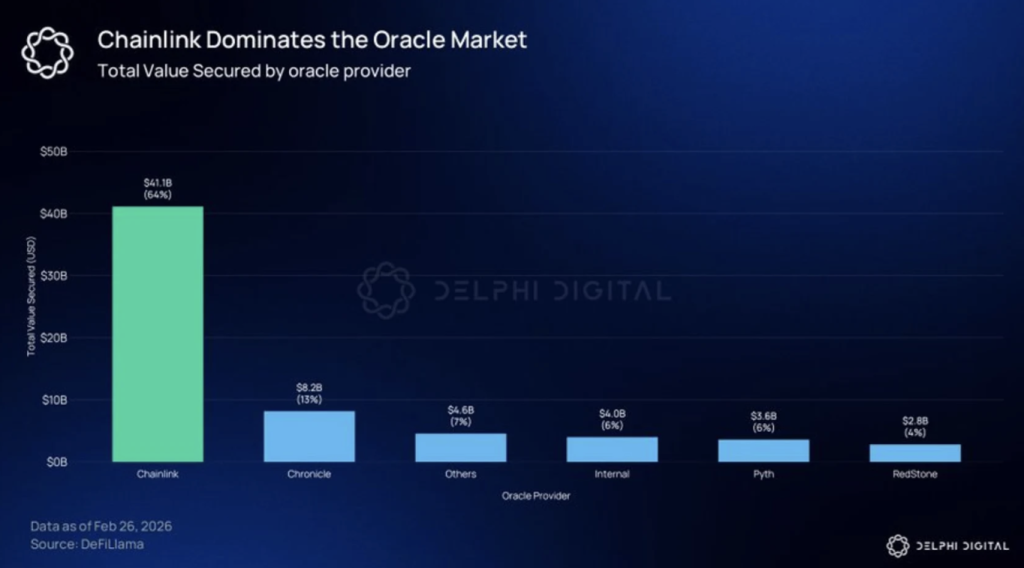
While short-term charts look fragile, the long-term narrative around Chainlink remains structurally strong. According to reports from Delphi Digital, major financial players — including UBS, SWIFT, Mastercard, and JPMorgan — are actively exploring or implementing oracle-based systems.
That’s not speculative hype. That’s infrastructure development.
Projects involving tokenized equities data streams, confidential computing models, and secure execution environments are positioning Chainlink as a foundational layer for tokenized finance. Institutional capital tends to follow systems that prioritize compliance and data integrity.
Meanwhile, Chainlink’s Cross-Chain Interoperability Protocol (CCIP) has expanded significantly, reportedly increasing volume nearly sevenfold over the past year. Adoption by platforms like Coinbase for bridging wrapped assets reinforces that growth.
So in the short term, LINK looks technically pressured. In the long term, it’s embedding itself deeper into financial rails. Markets can stay disconnected from fundamentals for a while. But structure, eventually, tends to matter.