
- Bitcoin surged to $68,000 within hours of reports confirming Iran’s Supreme Leader was killed in airstrikes.
- Markets appear to be pricing in potential de-escalation despite ongoing military exchanges.
- Oil price reactions and broader risk sentiment will determine whether the crypto rebound holds.
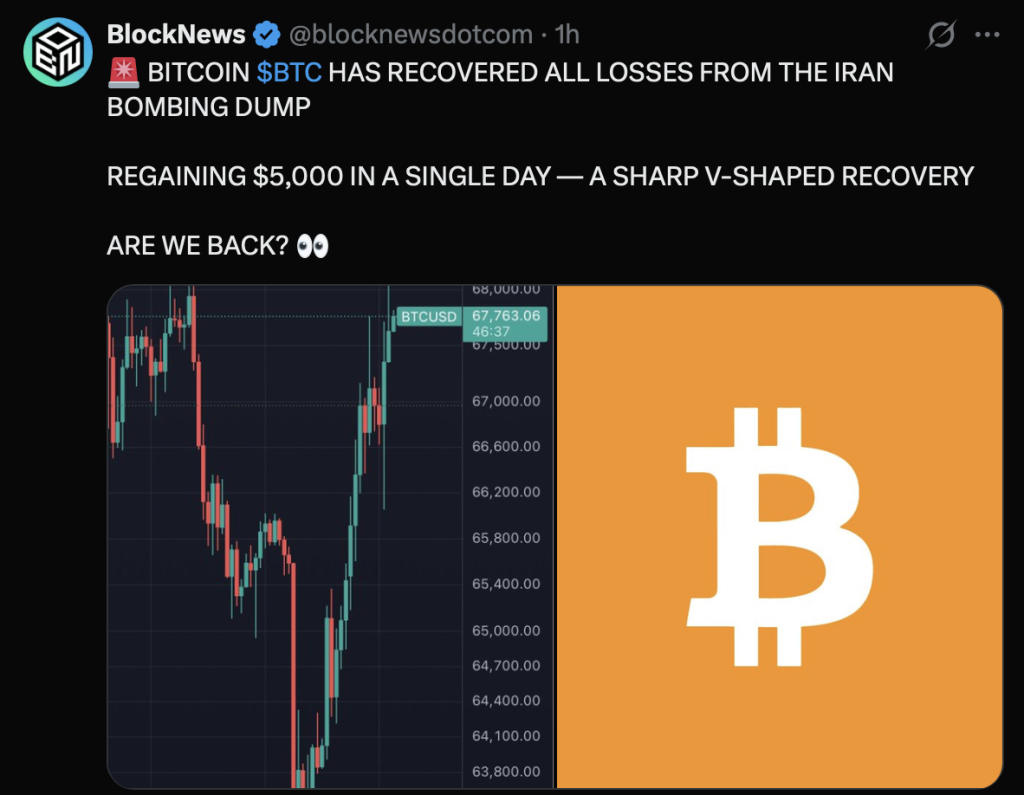
Bitcoin didn’t hesitate. Early Sunday, the price snapped back to $68,000, wiping out nearly all of Saturday’s war-driven losses in just a few hours. The trigger was dramatic: Iranian state TV confirmed that Supreme Leader Ayatollah Ali Khamenei had been killed in coordinated U.S. and Israeli airstrikes. Thin liquidity, one major headline, and suddenly the market was moving like it had somewhere urgent to be.
The jump from roughly $64,000 to $68,000 translated into about an $80 billion increase in market cap. And this happened before oil futures opened, before equity markets had a say, before anyone could really process what comes next. Crypto moved first. It usually does.
Power Vacuum and Political Uncertainty
Khamenei wasn’t a ceremonial figure. He held ultimate authority over Iran’s military, foreign policy, and nuclear strategy — the final decision-maker in moments exactly like this. Under Iran’s constitution, leadership temporarily shifts to a council made up of the president, the judiciary chief, and a Guardian Council jurist until the Assembly of Experts names a successor. On paper, that sounds structured. In reality, transitions like this can get complicated, fast.
At the same time, U.S. President Donald Trump publicly urged Iranians to overthrow the regime, calling it “probably your only chance for generations.” Tehran continues firing missiles toward Israel, while Israeli strikes remain ongoing. Trump also stated U.S. attacks would continue as long as necessary. Whether mourning protocols slow operations or escalate tensions is still unclear — and markets hate unclear.
Why Bitcoin Rallied Anyway
Despite the chaos, Bitcoin rallied before answers emerged. The working assumption across risk markets appears to be that a leadership vacuum could increase the probability of ceasefire negotiations rather than prolonged escalation. In other words, traders may be pricing in de-escalation, not expansion. It’s a fragile bet, but it’s there.
Crypto often reacts to shifts in perceived global stability faster than traditional assets. When uncertainty looks like it might resolve — even partially — capital rotates back into higher-risk assets. That seems to be the logic behind Sunday’s bounce, though it’s still early.
Oil, Inflation, and the Bigger Risk
Iran sits at the center of a region responsible for roughly a third of global crude exports. If markets interpret Khamenei’s death as increasing the risk of regime destabilization or supply disruption, oil prices could spike sharply. That would complicate inflation expectations and tighten financial conditions worldwide. And historically, that kind of macro pressure weighs on crypto.
However, if succession mechanisms hold and broader war is avoided, risk assets may continue to find support. Oil and equity futures will offer the next clues. For now, Bitcoin’s rebound reflects optimism — or maybe just relief — but it’s balanced on a razor’s edge. One new headline could shift the tone all over again.