

- Bitcoin has fallen toward $65,000, but major analysts still project long-term targets of $500,000 or higher.
- Institutional adoption through spot ETFs is viewed as the key driver of future price growth and reduced volatility.
- Comparisons to gold’s $36 trillion market cap suggest Bitcoin still has massive upside if it captures store-of-value demand.
Bitcoin hasn’t exactly had a smooth ride this year. The world’s largest cryptocurrency is still sitting on the throne, technically, but the shine feels a bit dull right now. Prices recently slipped toward $65,000, dragging its total market cap down to roughly $1.3 trillion. For longtime holders, that kind of pullback stings… even if they’ve seen worse before.
Still, not everyone on Wall Street is waving the white flag. Geoff Kendrick, who leads digital asset research at Standard Chartered, thinks the pain may not be fully over in the short term. He noted that crypto ETF holdings have been shrinking, with average Bitcoin ETF exposure down about 25%, and he warned that more downside could show up in the coming months. In other words, volatility isn’t done with us just yet.
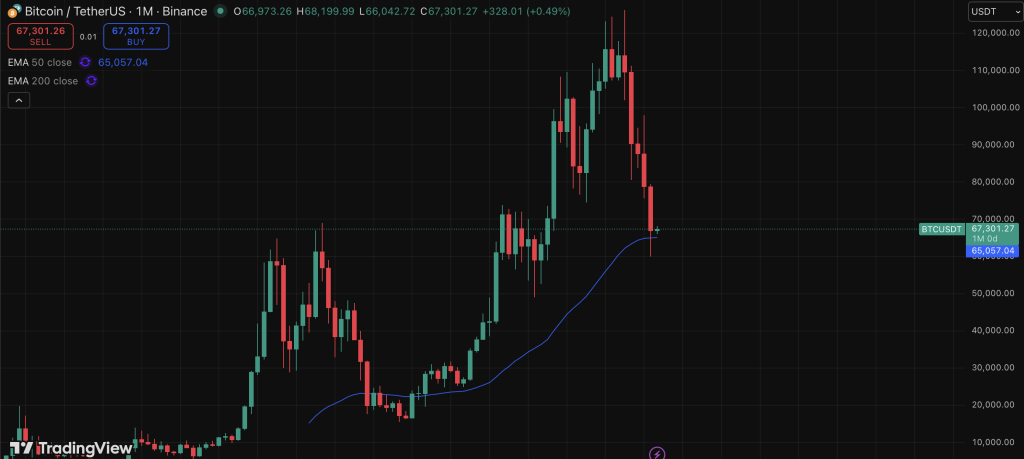
Short-Term Pressure, Long-Term Conviction
Kendrick’s near-term caution doesn’t cancel out his long-term optimism, though. He still believes Bitcoin can reclaim $100,000 this year as the asset class matures and investor participation broadens. And looking further out, he’s holding firm to a bold $500,000 price target by 2030. His reasoning? Institutional investors and ETFs, now more embedded in the market structure, could soften future crashes and reduce the severity of drawdowns.
He’s not alone in that camp. Ark Invest, led by Cathie Wood, has floated an even more aggressive projection: $710,000 per Bitcoin by 2030 in its base case. In more conservative scenarios, Ark sees $300,000 as achievable, while a particularly bullish environment could push Bitcoin as high as $1.5 million. Their thesis leans heavily on institutional flows, especially through spot ETFs, which they see as a powerful long-term demand engine.
The Digital Gold Argument
But let’s step back for a second. What would actually justify a $500,000 Bitcoin price? The simplest comparison is gold. For centuries, gold has functioned as a store of value — not because it generates cash flow or fuels massive industrial demand, but because society collectively agrees it holds worth. Real estate and art play similar roles, but gold is still the benchmark.
Bitcoin, in many ways, mirrors that narrative in digital form. Its supply is capped. No central authority can inflate it. And over time, the issuance schedule tightens further. That scarcity, combined with growing social acceptance, has led many to label it “digital gold.” Right now, gold’s market cap sits near $36 trillion, while Bitcoin hovers around $1.3 trillion after the recent correction. If Bitcoin were to reach parity with gold, its price would land somewhere around $1.7 million per coin. Suddenly, $500,000 doesn’t sound so outrageous.
A Big If, But Not Impossible
Of course, value parity with gold isn’t guaranteed. It could take decades, or it might never fully materialize. Markets evolve, narratives shift, and regulatory landscapes can complicate even the most compelling investment thesis. Still, when you strip Bitcoin’s valuation down to its store-of-value potential alone — ignoring payments, smart contracts, or broader ecosystem growth — the math behind a $500,000 target starts to feel, well… plausible.
For now, investors are stuck balancing short-term turbulence with long-term conviction. ETF outflows and price swings may dominate headlines in the coming months, and there could be more bumps ahead. But if institutional adoption continues to expand and the digital gold narrative strengthens, Bitcoin’s story may be far from finished. It’s a volatile asset, no doubt, but writing it off entirely might be premature.