

- Ethereum rebounded nearly 4% from $1,840 as exchange inflows collapsed by almost 90%, reducing selling pressure.
- Bearish derivatives sentiment increased without major new short positions, creating short squeeze potential.
- Long-term holders have resumed accumulation, with $1,920 and $2,060 acting as key resistance levels ahead.
Ethereum is starting to breathe again. After dipping near $1,840, ETH has climbed almost 4%, a modest bounce on paper, but one that feels different. Buyers are showing up. Not loudly, not euphorically. Just… steadily.
This rebound didn’t appear out of nowhere. The setup has been forming for weeks beneath the surface. Selling pressure has dropped sharply. Derivatives traders have flipped aggressively bearish, but without piling into new positions. Meanwhile, long-term holders, who had been selling for weeks, have quietly turned back into buyers. That mix matters.
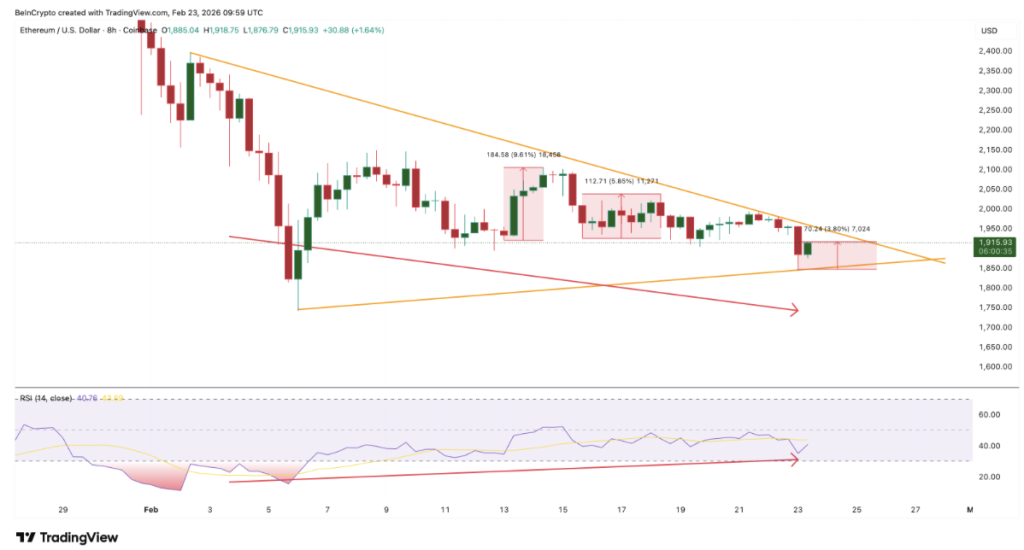
Bullish Divergence Signals Momentum Shift
On the short-term chart, Ethereum has been compressing inside a symmetrical triangle. It’s a classic indecision pattern. Buyers and sellers tugging at each other, waiting for resolution.
But there’s more underneath.
Between early February and February 23, ETH printed lower lows. At the same time, the Relative Strength Index printed higher lows. That’s bullish divergence. It suggests downside momentum is fading even though price continues slipping.
This isn’t the first time it’s worked recently. A similar divergence between February 3 and February 13 sparked a nearly 10% bounce. Another one led to a 6% move higher. Now, the 4% rebound from $1,840 suggests buyers are reacting again. Technical signals alone don’t guarantee continuation, but they’re rarely meaningless.
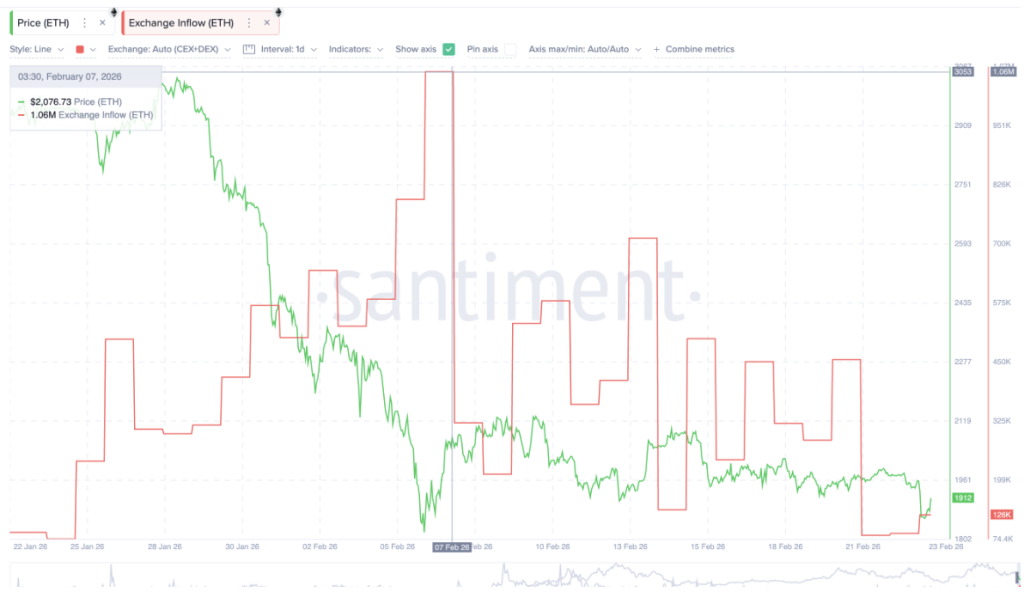
Selling Pressure Collapses While Price Fell
The most striking shift comes from exchange inflows. On February 7, exchange inflows peaked near 1.06 million ETH. That’s heavy potential sell pressure. Since then, inflows have collapsed to roughly 126,000 ETH. Nearly a 90% drop.
Here’s the twist. During that same period, Ethereum’s price still fell about 14%. Normally, price declines when selling pressure increases. This time, price declined while exchange inflows dried up.
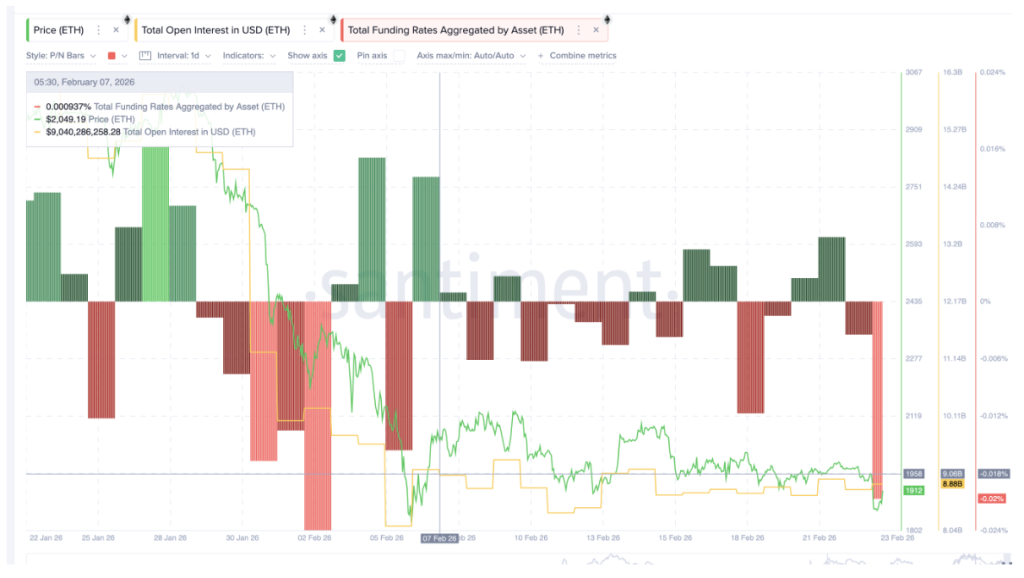
That suggests the weakness wasn’t coming from aggressive spot sellers. Instead, derivatives markets appear to have driven the move. Funding rates flipped deeply negative, around -0.02%, showing that short sellers are now paying to hold their positions.
Yet open interest barely changed, slipping only slightly from $9.06 billion to $8.88 billion. That’s key. It means new short positions aren’t flooding in. Instead, existing traders have turned bearish, and long positions likely closed out.
This kind of imbalance can be fragile. When sentiment leans heavily bearish without a surge in new shorts, the market becomes vulnerable to a squeeze. If price continues rising, short sellers may be forced to close positions, pushing ETH higher.
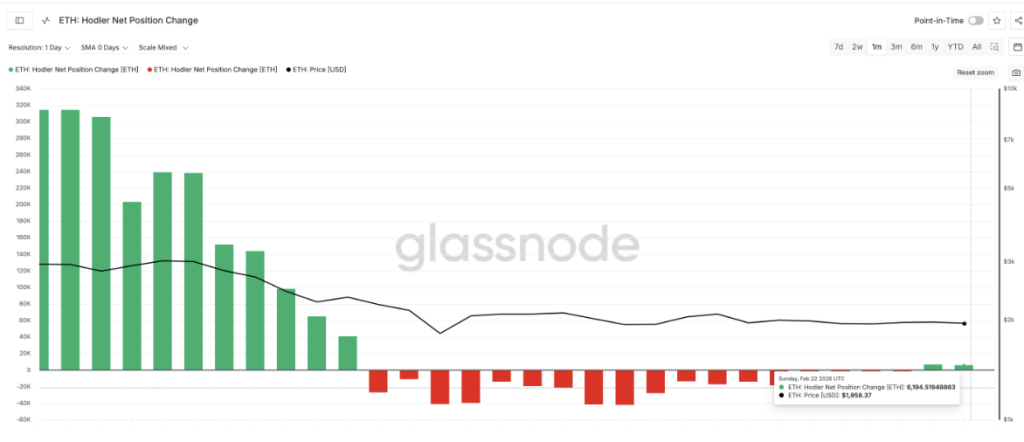
Long-Term Holders Step Back In
There’s another piece of the puzzle. The Hodler Net Position Change metric had been negative from February 3 to February 20, signaling sustained selling from long-term investors. At one point, over 41,000 ETH was sold on a net basis.
That trend has now flipped.
Over the past two days, the metric turned positive, showing more than 6,000 ETH accumulated. Long-term holders are buying again. Quietly. Historically, this behavior tends to show up near local bottoms, when experienced participants begin positioning before broader recovery phases unfold.
Key Levels That Could Define the Move
Ethereum now faces clear resistance zones. The first sits near $1,920. A break above that would reinforce short-term momentum. Above that lies $2,020, followed by a more significant barrier near $2,060.
If ETH clears $2,060 convincingly, the bounce could accelerate toward $2,200 and possibly $2,420. That’s where momentum could start feeding on itself.
On the downside, $1,840 remains critical support. Lose that level, and the bullish structure weakens quickly. The next target below would sit around $1,740.
For now, Ethereum’s move feels more structured than a simple relief rally. Exchange selling pressure has nearly vanished. Derivatives sentiment is stretched bearish without heavy conviction. Long-term holders have started accumulating again.
It’s not a guarantee of a full reversal. But it’s no longer random noise either. The next breakout level will likely decide whether this is the start of something larger, or just another pause in a broader trend.