

- Ethereum’s Fusaka upgrade pushed fees lower and activity higher, but analysts doubt the growth will last
- Layer 2 expansion and competition from faster chains are pulling usage away from Ethereum’s base layer
- Weak fee generation and rising supply continue to pressure ETH despite tokenization optimism
Ethereum’s Fusaka upgrade, rolled out last December, clearly changed the short-term dynamics of the network. Fees dropped to fresh lows, transactions spiked, and active addresses climbed sharply, giving the ecosystem a much-needed jolt of energy. Still, JPMorgan analysts led by Nikolaos Panigirtzoglou are warning that this burst of activity may not be as durable as it looks.
In a Wednesday note, the bank pointed out that both Fusaka and the earlier Pectra upgrade from May 2025 helped lift activity over the past year, but history suggests these boosts tend to fade. Previous Ethereum upgrades sparked similar excitement, only for usage to cool once the initial wave passed. In other words, the pattern feels familiar, maybe a little too familiar.
Recent data shows weekly active addresses and daily transactions hitting record highs after a steady month-long climb. Some market watchers, however, have raised concerns that part of this growth could be inflated by address poisoning or other artificial activity rather than genuine user adoption, which muddies the signal.
Why Ethereum Struggles to Sustain Network Growth
Momentum picked up shortly after Fusaka went live, largely because the upgrade improved throughput for Layer 2 networks. Features like Peer Data Availability Sampling, higher gas limits, and expanded blobspace made it easier and cheaper for L2s to scale. Ironically, that success may be part of the problem, as more activity is now happening off the Layer 1 itself.
JPMorgan also highlighted intensifying competition from rival blockchains. Networks like Solana have taken meaningful market share by offering higher throughput and consistently lower fees, pulling both users and developers away from Ethereum. Over time, those small migrations add up, especially when costs matter.
Speculative activity has also cooled. Past cycles were fueled by memecoins, NFTs, and ICOs, all of which drove congestion and fee generation on Ethereum. Much of that activity has either faded or shifted to other chains, leaving a noticeable gap in demand. On top of that, liquidity is becoming fragmented as application-specific chains gain traction, draining volume and revenue from Ethereum’s base layer.
This shift has real consequences. With fewer fees being generated, less ETH is burned, increasing circulating supply and putting extra pressure on prices. JPMorgan argues that this dynamic helps explain why ETH has struggled to regain strong upward momentum, even as network metrics look healthy on the surface.
Tokenization Hopes and a Technically Fragile Price Setup
Not everyone is pessimistic. BlackRock, in its 2026 thematic outlook, suggested Ethereum could be well positioned to benefit from the tokenization boom, noting that it currently holds around 65% of the tokenized assets market. If that trend accelerates, it could provide a more sustainable source of demand than short-lived speculative cycles.
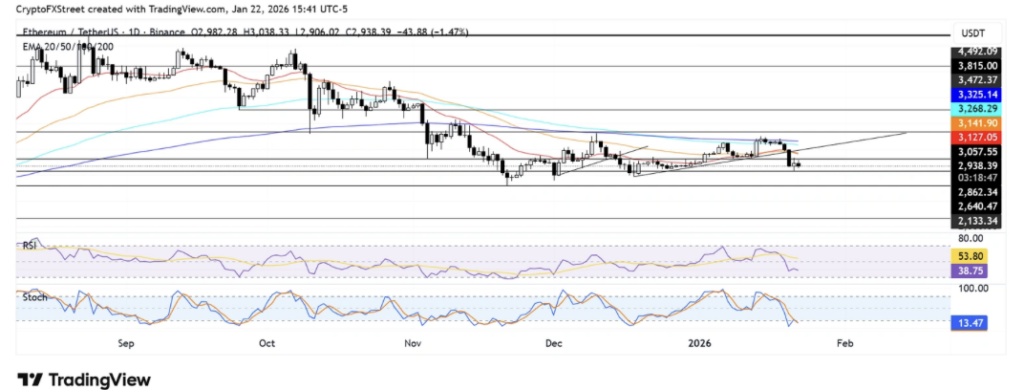
From a market perspective, ETH remains in a delicate spot. Over the past 24 hours, futures liquidations reached roughly $156.5 million, with short positions making up the majority. After sliding for three straight days, ETH bounced near the $2,860 support level, but the rebound stalled quickly after being rejected close to $3,060.
If ETH can hold $2,860 again, bulls may get another shot at pushing above $3,060 and testing the 20-day EMA. Failure to do so could mean more sideways consolidation, similar to what played out late last December. On the downside, a break below $2,860 opens the door to support around $2,640.
Momentum indicators aren’t offering much comfort yet. The RSI remains below neutral, and the Stochastic Oscillator is still stuck in oversold territory, suggesting bearish pressure hasn’t fully let up. For now, Ethereum’s fundamentals and price action both seem caught in a waiting game.