- World Liberty plans to launch World Swap, a forex platform built around USD1
- The USD1 stablecoin now holds roughly $5.3B in market cap
- The move positions the firm inside global remittances and FX settlement
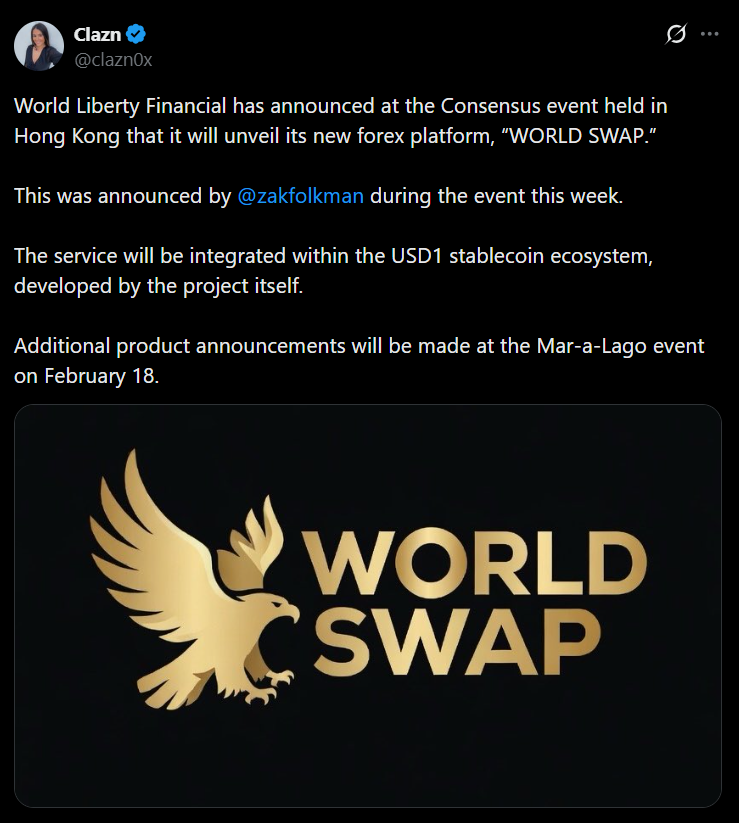
World Liberty Financial is setting its sights on the global foreign exchange market, a sector that moves trillions of dollars daily and remains the most liquid financial market in the world. At Consensus Hong Kong, co-founder Zak Folkman revealed plans to launch World Swap, a forex platform centered around the firm’s USD1 stablecoin ecosystem.
That ambition is not small. Forex isn’t just another vertical. It’s the backbone of cross-border trade, remittances, and international banking. For a crypto-native platform to enter that arena signals confidence that stablecoins are ready to compete beyond speculative trading.
USD1 Is Growing Faster Than Expected
This expansion comes just weeks after World Liberty launched its lending and borrowing platform, which offers users onchain yield and liquidity. Leadership has positioned those features as a way to drive deeper USD1 adoption, making the stablecoin more than just a transfer tool.
The strategy appears to be working, at least in terms of scale. USD1 has grown to roughly $5.3 billion in market value, gaining about $1.8 billion in a short span. That places it fifth among stablecoins by market capitalization, according to CoinGecko. Growth at that pace suggests the ecosystem is gaining traction, not just attention.
World Swap Is About Cutting Out Friction
Folkman said World Swap will allow users to connect directly to global bank accounts and debit cards, aiming to reduce complexity and lower fees compared to traditional remittance services. If executed well, that could challenge legacy FX providers that rely on slow settlement layers and multiple intermediaries.
The pitch is simple. Use a stablecoin as the settlement layer, streamline cross-border transfers, and compress fees that eat into remittance flows. For users in emerging markets or high-friction corridors, even modest savings can be meaningful.
Stablecoins Are Expanding Beyond Crypto Trading
The timing aligns with a broader shift. Blockchain-based solutions are gaining traction in global remittances, as users increasingly look for faster, cheaper international money transfers. Stablecoins, once viewed primarily as trading tools, are evolving into payment rails and cross-border liquidity bridges.

World Liberty’s strategy also includes regulatory engagement. Last month, Pakistan and SC Financial Technologies, affiliated with World Liberty, signed a memorandum of understanding to explore integrating USD1 into Pakistan’s regulated financial system. The focus includes digital finance infrastructure and cross-border payments expertise.
Conclusion
World Liberty isn’t just launching another crypto product. By targeting the trillion-dollar forex market with USD1 at the center, it’s positioning itself inside one of the largest financial sectors on earth. Whether World Swap can compete with entrenched FX systems remains to be seen, but the ambition is clear. Stablecoins are no longer just about crypto liquidity. They’re becoming instruments for global money movement at scale.