- Stellar’s DTCC partnership triggered a sharp XLM rally and sparked renewed debate among XRP holders.
- X Finance Bull argues XRP and XLM serve different roles within the same payments and settlement thesis.
- Many investors believe holding both assets may be a stronger long-term strategy than rotating based on short-term headlines.
The recent partnership announcement between the Depository Trust & Clearing Corporation (DTCC) and the Stellar Development Foundation sparked a strong reaction across the crypto market. While XLM surged more than 14% following the news, some investors wasted little time rotating out of XRP and into Stellar, hoping to capitalize on the momentum.
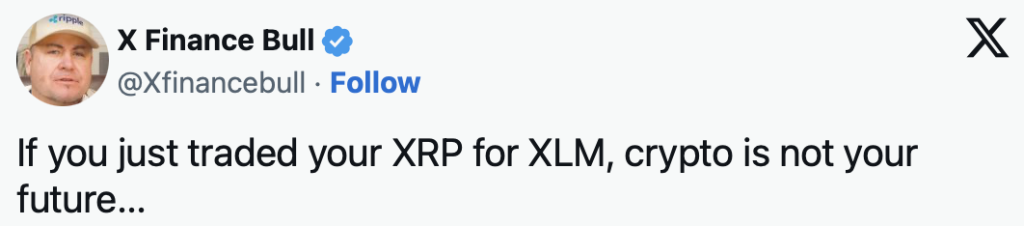
That move caught the attention of crypto commentator X Finance Bull (@Xfinancebull), who offered a blunt take on the situation. In a post that quickly gained traction, he argued that investors abandoning XRP for XLM based on a single headline may be missing the bigger picture entirely. According to him, chasing short-term pumps without understanding the broader thesis behind these assets is rarely a winning strategy.
The excitement began on May 27 when DTCC revealed plans to integrate its tokenized securities infrastructure with the Stellar blockchain by the first half of 2027. The initiative is expected to support tokenized versions of Russell 1000 stocks, ETFs, and U.S. Treasury products. Naturally, the announcement fueled optimism around Stellar and helped push XLM sharply higher.
XRP and XLM Serve Different Roles in the Same Financial Evolution
As discussions heated up online, X Finance Bull spent time responding to investors who questioned whether XRP still deserved a place in their portfolios. His core argument remained consistent throughout the conversation.
When one user suggested swapping XRP for Litecoin instead, he acknowledged Litecoin’s long-standing presence in the market but emphasized that his focus remains on blockchain networks designed for institutional settlement and global payment infrastructure. In his view, XRP and XLM belong to that category, even if they approach the opportunity from slightly different angles.
He also pushed back against the growing narrative that investors must choose one over the other. According to him, XRP and XLM represent separate lanes within the same broader payments story. Stellar focuses heavily on accessibility and network growth, while XRP is positioned around deeper liquidity and institutional-grade settlement. Because of that, he sees owning both assets as a perfectly reasonable approach.
Perhaps his most repeated point was simple: a short-term price rally does not invalidate a long-term investment thesis. Investors who jump between assets based solely on headlines may end up missing the larger trend unfolding beneath the surface.
DTCC’s Multi-Chain Strategy Changes the Narrative
Another detail often overlooked in the excitement is DTCC’s broader blockchain strategy. While the Stellar partnership grabbed headlines, Stellar is not the organization’s exclusive blockchain partner.
That distinction matters.
Many traders interpreted the announcement as a winner-takes-all moment, assuming Stellar had somehow secured a dominant position over competing networks. However, DTCC has repeatedly explored multiple blockchain solutions as it develops tokenized asset infrastructure. The strategy appears focused on interoperability and flexibility rather than committing entirely to a single chain.
For supporters of XRP, that weakens the argument that one positive development for Stellar automatically translates into a negative outcome for Ripple’s ecosystem. The two networks may ultimately benefit from the same long-term shift toward blockchain-based financial infrastructure.
The XRP Community Backs a Long-Term Approach
The response from the XRP community was largely supportive of X Finance Bull’s comments. Many investors noted that they already hold both XRP and XLM and see no reason to choose one over the other.
Others highlighted the importance of profit-taking without abandoning long-term conviction. X Finance Bull agreed that locking in gains can be sensible, but he drew a distinction between managing risk and completely discarding a broader investment thesis because another asset experiences a temporary surge.
One user argued that XLM offered greater upside potential. In response, he reiterated that XRP remains one of the strongest liquidity plays in the digital asset sector, particularly if institutional settlement volume grows as many expect over the coming years.
Conviction Matters More Than Chasing Headlines
At the center of the debate is a larger question about investor behavior. Are market participants building positions based on long-term conviction, or are they simply rotating capital toward whichever asset is trending at the moment?
For X Finance Bull, the answer seems obvious. Investors who genuinely understand the payment rail narrative behind both XRP and XLM recognize that the two assets can coexist and potentially thrive together.
Selling one solely because the other receives a favorable headline may generate a short-term trade, but it does not necessarily reflect a strong understanding of the broader market transformation taking place. As blockchain adoption expands and tokenized finance gains momentum, both XRP and XLM may have important roles to play.