
- The SEC has ended its Zcash Foundation probe with no enforcement action.
- The investigation was part of a wider review of crypto asset offerings.
- The outcome offers a positive signal for privacy-focused crypto projects.
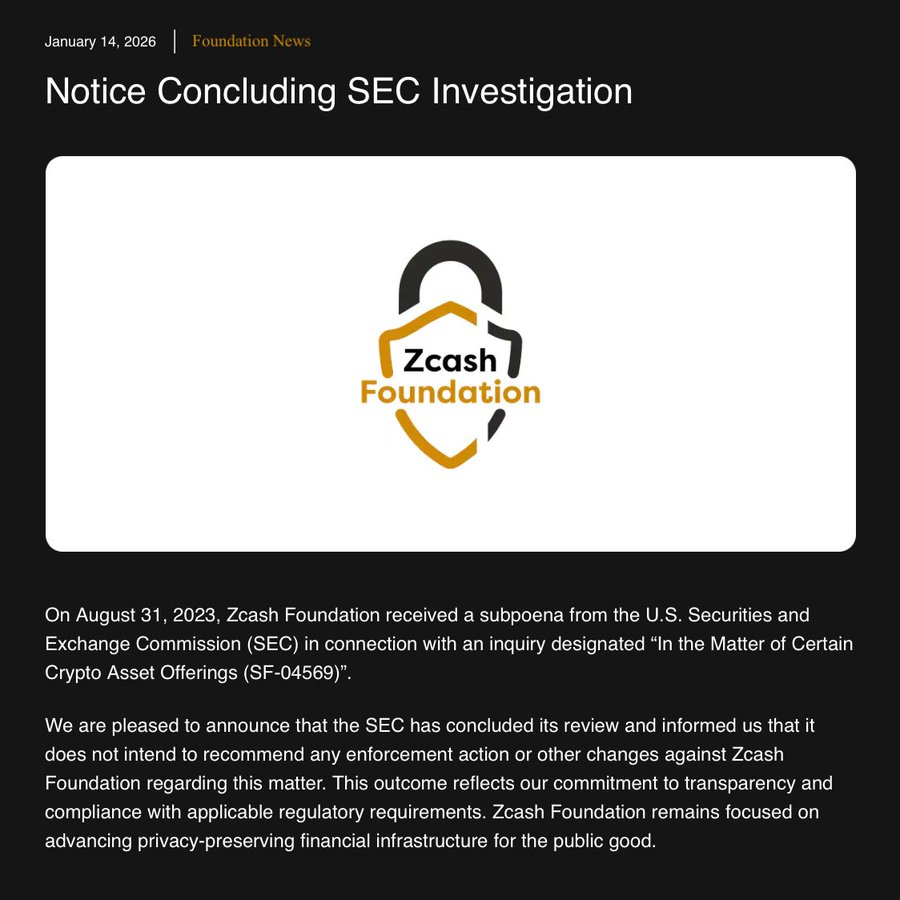
The US Securities and Exchange Commission has officially ended its review of a 2023 subpoena involving the Zcash Foundation and will not recommend any enforcement action. The foundation confirmed the outcome in a written statement, putting a quiet but meaningful close to an investigation that had lingered for more than a year. For a project operating at the intersection of privacy and regulation, the decision carries weight well beyond Zcash itself.
What the Investigation Was About
The subpoena was tied to a broader SEC probe titled “In the Matter of Certain Crypto Asset Offerings,” which examined whether digital asset issuers had violated securities laws. While details of the inquiry were limited, it placed Zcash under the same regulatory microscope that has hovered over many crypto projects in recent years. The SEC’s decision to step away without action suggests the foundation’s structure and conduct did not meet the threshold for enforcement.
Why This Outcome Stands Out
The Zcash Foundation said the result reflects its long-standing commitment to transparency and regulatory compliance. That’s notable given Zcash’s role as one of the most prominent privacy-focused cryptocurrencies. Privacy coins often draw heightened scrutiny, especially as regulators globally debate how anonymity tools fit within anti-money-laundering and financial surveillance frameworks. Clearing an SEC review without penalties helps ease one layer of uncertainty that has weighed on the sector.
Privacy Coins Remain Under Pressure
While this chapter has closed, the broader debate is far from settled. Throughout 2025 and into 2026, privacy-focused projects have faced increasing attention as regulators try to balance individual privacy rights with enforcement obligations. Zcash’s experience highlights that compliance and privacy don’t have to be mutually exclusive, though the line remains thin. For now, the SEC’s decision gives privacy advocates a rare regulatory win in an otherwise cautious environment.