
- Institutional adoption is increasingly happening through partnerships, not direct capital inflows
- BNY Mellon’s tokenized deposits position Ripple at the center of a potential digital cash shift
- XRP ETF growth suggests institutions are betting on Ripple’s infrastructure, not just price movement
Institutional adoption doesn’t always arrive as a clean spike in capital inflows, and lately it hasn’t. More often, it shows up quietly through partnerships and infrastructure decisions that matter long term, even if they don’t move markets overnight. Large financial institutions are increasingly using blockchain for practical reasons, things like cross-border payments or everyday settlement, rather than speculative exposure. It’s less flashy, but arguably more meaningful.
BNY Mellon Steps Into Tokenized Cash
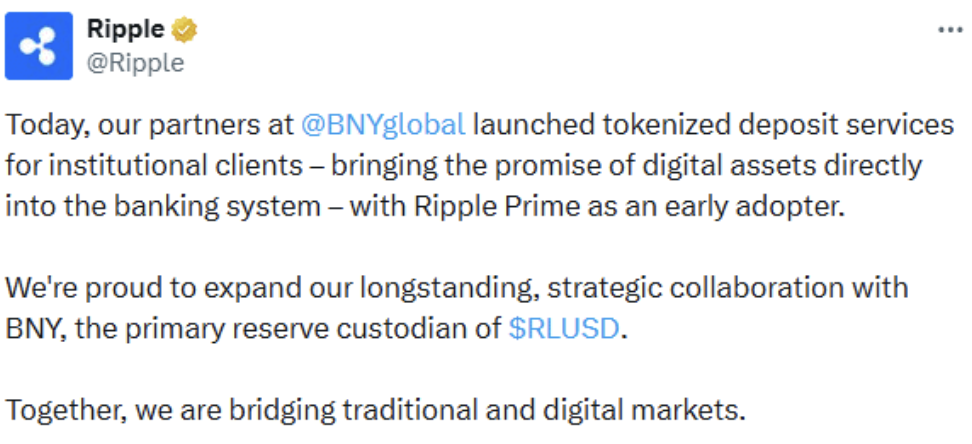
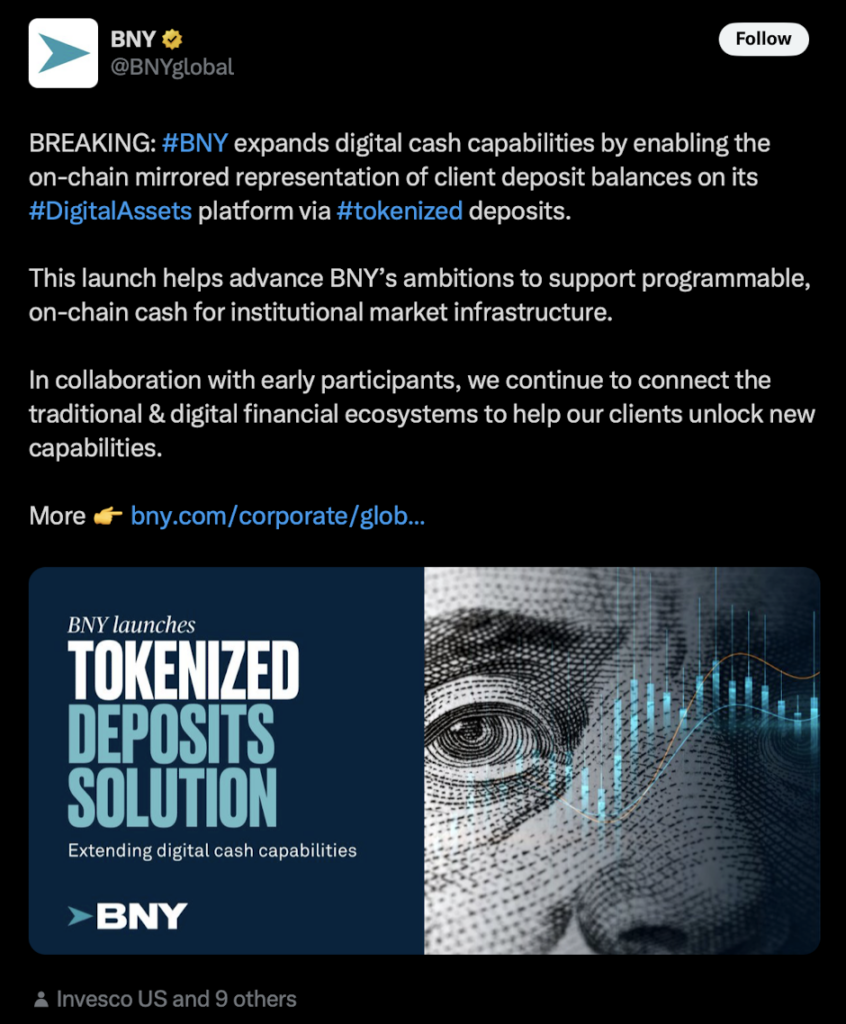
That shift became clearer when BNY Mellon, a global bank overseeing roughly $50 trillion in assets, launched tokenized deposits for institutional clients. These are essentially digital representations of cash, built to move faster and settle more efficiently than traditional fiat rails. What caught attention was Ripple Prime being selected as an early adopter, a move that suggests more than just experimentation. It signals trust, and probably months of behind-the-scenes evaluation.
More Than an XRPL Boost
Zooming out, this isn’t just a positive headline for the XRPL ecosystem. Many market participants see it as an early chapter in a broader “digital dollar” transition, one where institutions don’t need to park funds in stablecoins or idle fiat accounts. Instead, capital exists as digital cash that can move instantly, at any hour, without friction. Ripple now finds itself sitting right in the middle of that shift, which naturally raises questions about how far its institutional footprint can extend from here.
Ripple’s Role Is Quietly Expanding
BNY’s move also fits into a wider trend across global finance. As the early hype around CBDCs fades, banks seem to be choosing more pragmatic paths toward digitization, and tokenized deposits may be one of them. In that context, Ripple being chosen early carries weight. Add to that the fact that XRP ETFs have already crossed $1 billion in assets under management, and a pattern starts to form, even if it’s still early.
Institutions Are Betting on Infrastructure, Not Just Price
XRP’s price action helps frame this properly. Despite ending 2025 down about 12% and moving through a broader market pullback, XRP ETFs have still attracted significant assets since launching in November. That suggests institutions aren’t chasing short-term upside. They’re positioning around Ripple as a company and an infrastructure provider, with the BNY partnership acting as a quiet vote of confidence. Taken together, it points to a 2026 cycle that looks increasingly driven by fundamentals, not hype, and anchored in Ripple’s role within the emerging tokenized cash ecosystem.