
- Middle East tensions are pushing oil prices higher
- Higher oil risks sticky inflation and delayed rate cuts
- Crypto continues trading like a high-beta risk asset
When shipping routes near the Strait of Hormuz face disruption, oil markets react immediately. Roughly one fifth of global oil supply moves through that narrow corridor, so traders don’t wait for official confirmation before repricing risk. Brent crude jumping above $82 in a single session isn’t hysteria, it’s probability being recalculated in real time.
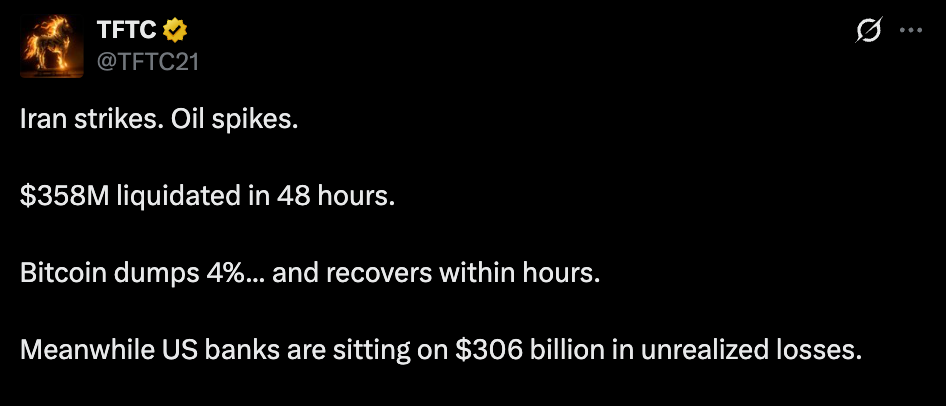
Energy markets tend to move ahead of politics. The mere possibility of sustained disruption can open the path toward $100 oil. That doesn’t require missiles to land on infrastructure. It only requires uncertainty, and right now uncertainty is abundant.
Oil Keeps Inflation Sticky
Higher oil doesn’t stay contained in energy charts. It bleeds into transportation, manufacturing, logistics, and eventually consumer prices. Households feel it at the pump first, long before it fully shows up in CPI reports, but it gets there eventually.
For central banks that were cautiously hinting at easing, that’s a problem. Inflation doesn’t need to surge again to complicate policy. It simply needs to stop declining. If energy prices remain elevated, rate cuts become harder to justify, and patience replaces pivot talk.
Why Crypto Feels It Immediately
This is where Bitcoin and broader crypto markets get squeezed. In theory, digital assets are sometimes framed as crisis hedges. In practice, they still behave like high-beta risk assets. When rate cuts get pushed further out, liquidity tightens and capital rotates toward perceived safety or yield.
Crypto tends to react early when risk sentiment shifts. Not because the underlying technology suddenly weakens, but because macro conditions deteriorate. As liquidity expectations cool, leveraged positions unwind and volatility accelerates. It’s less about blockchain fundamentals and more about capital flows.
The Uncomfortable Macro Equation
The chain reaction is straightforward, even if it’s uncomfortable. War risk lifts oil. Higher oil props up inflation. Sticky inflation delays rate cuts. Delayed cuts pressure crypto valuations. No crypto-specific scandal is required for prices to wobble, macro gravity is enough.
Until energy markets stabilize or central bank policy paths become clearer, digital assets remain embedded inside this global equation. Crypto doesn’t trade in isolation. It trades inside the same financial system influenced by oil, rates, and geopolitical risk, whether investors like it or not.