

- MSTR shares rose 10% as Bitcoin rebounded, with Strategy adding over 1,100 BTC to its treasury despite market volatility.
- The company now holds more than 714,000 BTC, maintaining a long-term accumulation strategy even amid multi-billion-dollar unrealized losses.
- Analysts are watching the $69,000 CME gap and the $70,000 level, which could determine whether Bitcoin extends toward $75,000 or revisits lower support.
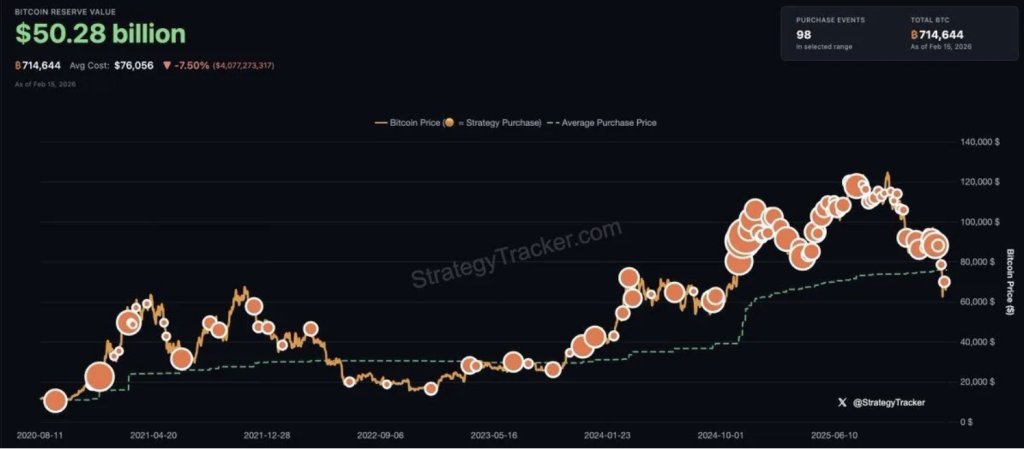
MSTR shares jumped 10% on Sunday, moving almost in lockstep with Bitcoin’s rebound. As BTC clawed its way back toward the high-$60,000 range, investors piled back into Strategy’s stock, clearly treating it as a leveraged Bitcoin proxy once again. The timing wasn’t random either. The company disclosed another Bitcoin purchase, adding more than 1,100 BTC to its treasury at an average price of $78,815 per coin, a roughly $90 million commitment despite the choppy market backdrop.
Bitcoin itself was trading near $68,960 after bouncing from recent lows, and that recovery helped ease some of the pressure surrounding Strategy’s balance sheet. Michael Saylor, the company’s Executive Chairman, has continued to defend the long-term accumulation model, even as the firm sits on a reported $5.1 billion unrealized loss tied to its holdings. For Saylor, volatility is noise. The mission, at least publicly, hasn’t changed.
Strategy Doubles Down on Its Bitcoin Bet
With the latest purchase of 1,142 BTC, Strategy’s total holdings now exceed 714,644 BTC. At current prices, that stash is worth roughly $49.36 billion, making the company one of the largest corporate holders of Bitcoin in the world, by a wide margin. It’s not a casual allocation. It’s the balance sheet.
Despite the unrealized losses, Saylor has been clear that selling into downturns is not part of the plan. The firm intends to keep acquiring Bitcoin quarter after quarter, leaning into weakness rather than retreating from it. That conviction has defined Strategy’s identity over the past few years, even as critics question the volatility it introduces to earnings.
In a brief post on X, Saylor teased the latest purchase with a cryptic “99>98,” a subtle nod to the company increasing its reserves yet again. The message directed followers to Strategy’s public Bitcoin tracker, reinforcing the idea that accumulation is ongoing, transparent, and intentional. It’s part branding, part signal.
Earnings Volatility Reflects Bitcoin Exposure
Strategy’s most recent earnings report underscored the risks that come with such a Bitcoin-heavy balance sheet. The company posted a significant quarterly loss, largely due to mark-to-market accounting adjustments tied to BTC’s price swings. When Bitcoin dips, the accounting reflects it immediately, even if the coins haven’t been sold.
Saylor was quick to clarify that these losses are unrealized. In other words, they exist on paper, not in executed trades. That distinction matters for long-term holders, though it doesn’t always calm short-term investors who see multi-billion-dollar swings in reported results.
Traditional business performance is still subject to regular market forces, but Bitcoin exposure adds another layer of volatility, and upside. If BTC rallies meaningfully, the leverage cuts the other way. “We’re in it for the long haul,” Saylor reiterated, emphasizing that downturns are opportunities to accumulate, not retreat.
Bitcoin as a U.S. Strategic Asset
In a recent Fox News interview, Saylor broadened the conversation beyond corporate strategy. He argued that the United States should treat Bitcoin as a strategic asset, similar to how it once approached gold reserves. In his view, proactive Bitcoin accumulation and supportive legislation would ensure innovation and capital stay within U.S. borders.
Saylor framed Bitcoin not just as a speculative instrument, but as a geopolitical asset. If the U.S. hesitates, he warned, other nations may shape the regulatory framework and financial infrastructure around Bitcoin instead. Early action, according to Saylor, could secure long-term economic influence.
Whether policymakers agree remains to be seen, but his messaging has been consistent: Bitcoin is no longer fringe. It’s foundational, or at least that’s the thesis.
Market Reactions and CME Gap Watch
Meanwhile, concerns about Strategy facing liquidation risks have been pushed back by Bitcoin advocate Pierre Rochard, who dismissed those claims as overstated. As BTC recovered alongside MSTR stock, broader fears appeared to cool, at least temporarily.
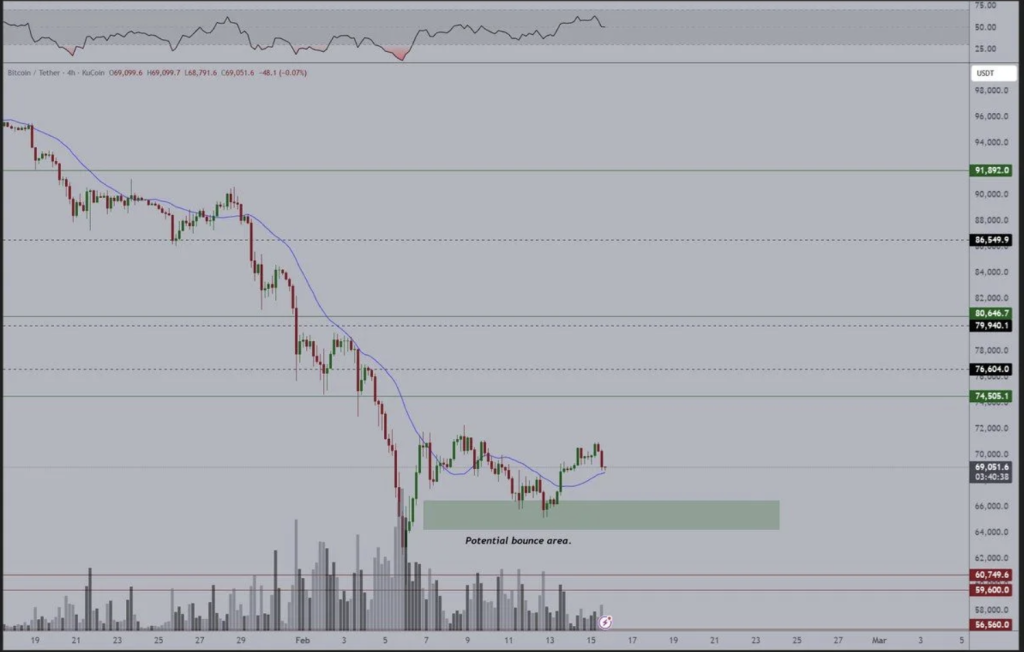
Crypto analyst Anıl noted that Bitcoin’s weekly CME close hovered around $68,980, suggesting it’s normal for price to gravitate near that level to avoid opening new gaps. The recent move toward the $70,000–$71,000 range left a CME gap near $69,000, which some traders see as a magnet.
Michael Van De Poppe added that with the CME gap sitting around $69,000, short-term price action may continue oscillating near that zone. However, if Bitcoin can decisively hold above $70,000 once traditional markets reopen, momentum could build toward $75,000. On the other hand, failure to maintain those levels may invite a retest of lower support. That’s the balance right now, optimism with a cautious undertone.