
- MoonPay launched a Mastercard debit card that lets AI agents spend stablecoins directly
- No custodial accounts — funds stay in self-custody wallets until the moment of payment
- AI agents can now complete real-world transactions without human intervention
The idea of an AI going shopping sounds like a joke until you realize the infrastructure now exists for it to actually happen.
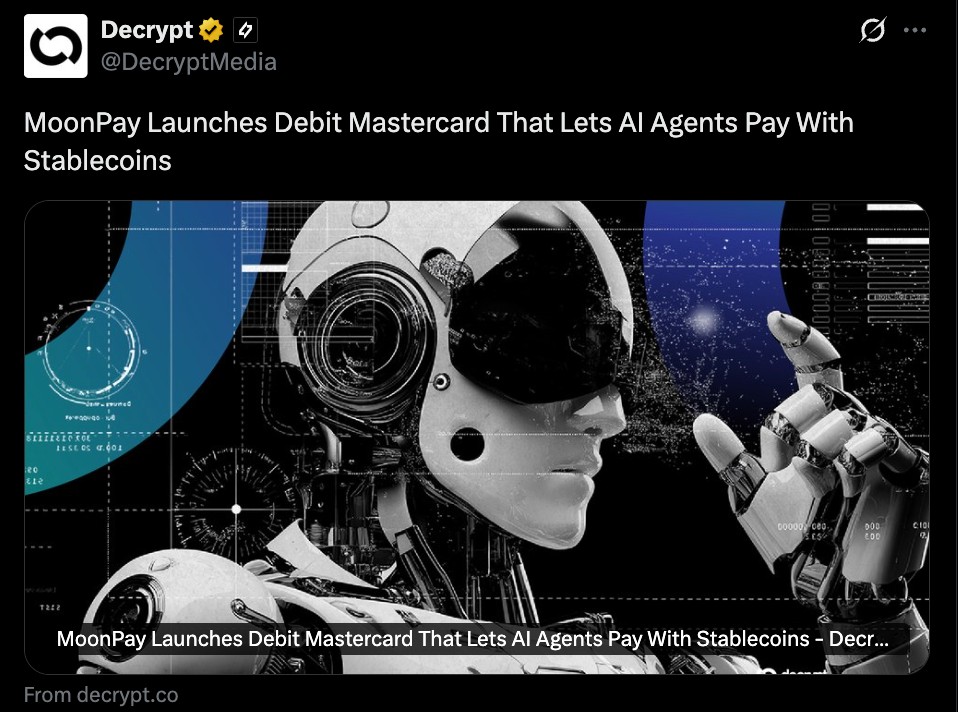
MoonPay’s new MoonAgents Card is essentially a bridge between crypto wallets and the real economy, letting autonomous AI agents spend stablecoins at any Mastercard-supported merchant. No manual checkout, no wallet-to-bank friction, just conversion at the point of sale.
The Missing Piece Just Got Solved
AI agents have already been managing assets, trading, and moving funds on-chain for a while now. But they’ve been stuck when it comes to real-world transactions.
You can’t exactly plug a crypto wallet into a typical checkout page, and that’s been the bottleneck.
How the System Actually Works
The card converts crypto into fiat at the exact moment of purchase, which means funds don’t need to sit in a custodial account beforehand.
That detail matters more than it sounds. It keeps control in the user’s hands while still allowing seamless payments.
Why Self-Custody Changes the Equation
Most payment systems that touch crypto still rely on holding user funds somewhere in the middle.
This setup removes that layer entirely, letting transactions happen directly from an on-chain wallet. It’s cleaner, faster, and arguably closer to what crypto was supposed to be in the first place.
This Isn’t Just a Fintech Feature
The bigger shift here is economic autonomy for AI.
An agent that can analyze data, execute trades, and now pay for services without human input isn’t just a tool anymore. It’s something closer to an independent economic actor, even if it still operates under user-defined limits.
The Mastercard Angle Matters
This isn’t a niche crypto integration limited to a handful of merchants.

Mastercard’s network is global, which means AI agents now have access to a payment layer that already works almost everywhere online. That’s scale from day one.
Where This Is Headed
Right now, the rollout is limited to certain regions, but expansion is already planned.
As access widens, the concept of AI handling subscriptions, APIs, and even operational expenses starts to feel less theoretical and more like standard workflow.
Control Still Stays With the User
For all the talk of autonomous agents, the human still holds the off switch.
Users can revoke spending access at any time, which keeps the system grounded in user control rather than handing full autonomy to software.
A Quiet Infrastructure Shift
This doesn’t feel like a loud, headline-grabbing moment, but it probably should.
Giving AI agents the ability to transact in the real world closes a loop that’s been open for years. And once that loop is closed, the next wave of applications tends to show up faster than expected.