
- Morgan Stanley says holding Bitcoin on bank balance sheets is “not out of the question”
- Regulatory barriers like Basel rules remain the biggest obstacle
- Institutional adoption is already underway, this would just be the next step
When a senior Wall Street executive says something is “not out of the question,” it usually means the conversation has already moved further than people think.
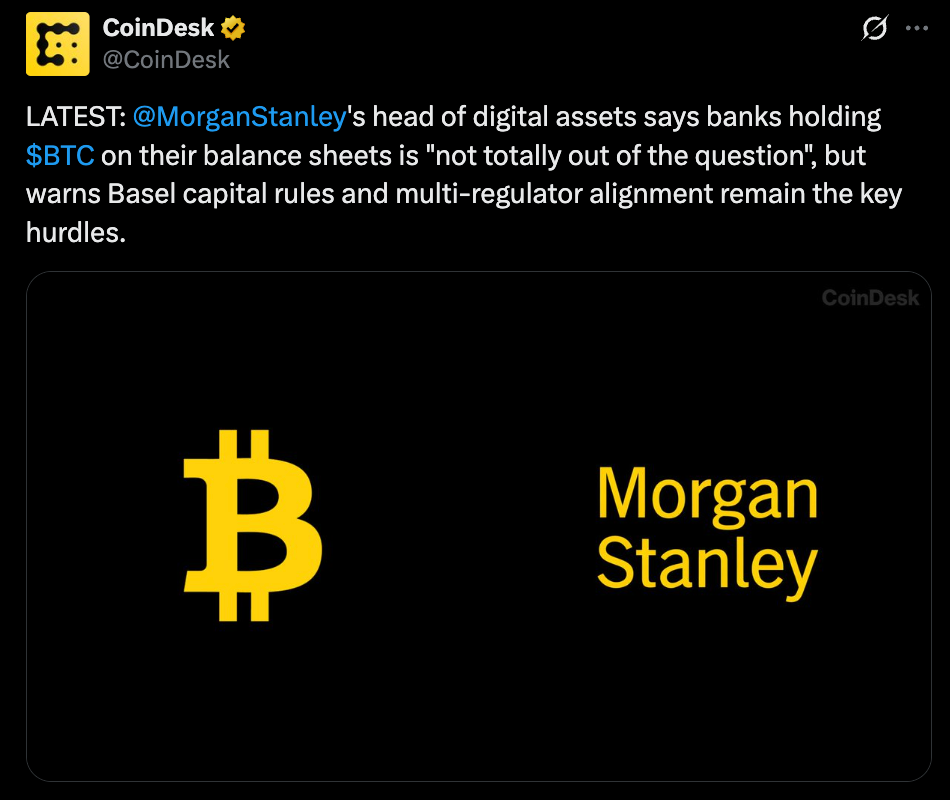
Morgan Stanley’s head of digital assets didn’t just float an idea, she acknowledged a direction. And in institutional language, that’s about as close as you get to signaling intent without making a commitment.
This Isn’t a Hypothetical Anymore
Morgan Stanley isn’t new to Bitcoin exposure. It already offers crypto products, launched its own Bitcoin ETP, and has formally recommended small allocations to clients.
So the idea of holding Bitcoin directly on its own balance sheet isn’t a leap, it’s an extension of what’s already happening.
The Real Barrier Is Regulation
The biggest blocker isn’t demand or interest, it’s regulation. Current Basel rules treat Bitcoin as a high-risk asset, assigning it a very heavy capital requirement.
That makes it expensive for banks to hold directly, even if they want to.
Why Basel Matters So Much
Under the current framework, banks need to hold significantly more capital against Bitcoin exposure compared to traditional assets.
If those rules change, even slightly, the economics shift quickly. What looks unattractive today could become viable almost overnight.
The Multi-Regulator Problem
It’s not just one rulebook either. Any move like this requires alignment across multiple regulators, central banks, deposit insurance bodies, and international supervisors.
That kind of coordination takes time, but it also shows how seriously the idea is being considered.
The Market Is Already Moving
While balance sheet adoption is still pending, the broader institutional trend is clear. Products are launching, allocations are increasing, and investor demand continues to build.

In many ways, the groundwork is already done.
What Changes If Banks Start Holding Bitcoin
If large banks begin holding Bitcoin directly, it changes perception as much as it changes demand.
Bitcoin moves from being something banks offer to clients to something they hold alongside traditional assets, which carries a very different signal.
Still Early, According to the Inside
One of the more interesting takeaways is how early institutions still believe this market is.
When someone at that level says allocations are still small, it suggests they see room for significant growth rather than saturation.
A Signal Without a Headline
No official announcement has been made, and nothing is guaranteed. But the language has shifted, and that matters.
In traditional finance, big changes rarely start with bold statements. They start with careful phrasing that signals direction before action follows.
And right now, that direction seems to be pointing toward a future where Bitcoin on bank balance sheets isn’t unusual, it’s just another line item.