

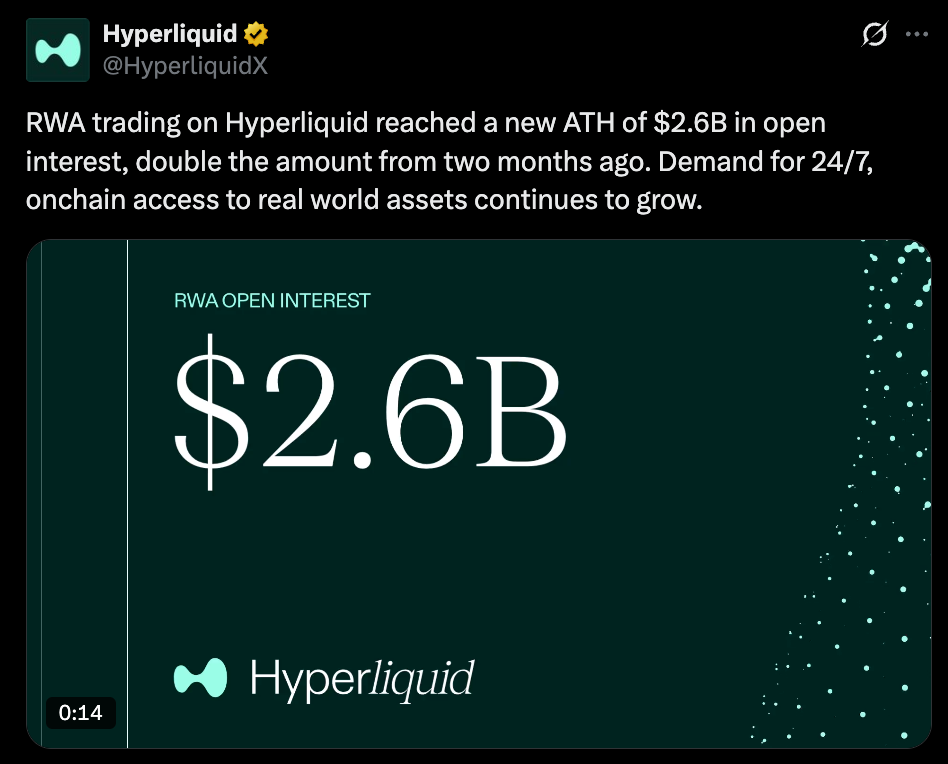
- Hyperliquid’s real-world asset open interest surged to a new all-time high of $2.6 billion
- The platform now offers 24/7 perpetual trading for assets like gold, oil, equities, and indices
- Six of Hyperliquid’s ten most-traded assets are now tied to traditional financial markets
Hyperliquid’s real-world asset market has doubled in size within just two months, with open interest climbing from roughly $1.3 billion to a new all-time high of $2.6 billion. The rapid growth is drawing attention because the platform is no longer operating purely as a crypto-native derivatives exchange anymore.
According to recent platform data, six of Hyperliquid’s ten most actively traded assets are now linked to traditional financial markets, including commodities, stock indices, and equities. Oil perpetuals have also become one of the platform’s most heavily traded products behind only BTC, ETH, and HYPE itself.
TradFi Assets Are Moving On-Chain
One major advantage driving adoption is Hyperliquid’s ability to offer 24/7 perpetual futures trading on assets that traditional markets still restrict to limited hours. Traders can now gain exposure to products like gold, oil, and major equity indices at any time globally without relying on centralized brokerage systems.
That accessibility is becoming increasingly attractive as decentralized finance platforms continue improving execution speed, liquidity, and trading infrastructure. For many users, the ability to trade real-world assets continuously without market closures is becoming a major competitive advantage over legacy financial exchanges.

The HYPE Flywheel Keeps Growing
The platform’s expansion is also directly impacting the Hyperliquid ecosystem itself. Under the HIP-3 market structure, users must lock HYPE tokens in order to launch new markets, meaning growing RWA activity increases token lockups while platform trading fees contribute toward buyback mechanisms benefiting HYPE holders.
Some analysts believe the system is creating a powerful feedback loop as higher trading activity drives more ecosystem participation. BitMEX co-founder Arthur Hayes recently suggested HYPE could potentially reach $150 if Hyperliquid continues gaining market share across the broader futures trading sector.
DeFi Is Expanding Beyond Crypto
The broader significance of Hyperliquid’s growth may be what it says about decentralized finance overall. Platforms originally designed around crypto speculation are increasingly beginning to absorb traditional financial products directly onto blockchain infrastructure.
What once sounded unrealistic, decentralized exchanges competing seriously with centralized derivatives markets, is now starting to happen in real time. And with billions already flowing through on-chain RWA markets, the gap between traditional finance and DeFi appears to be shrinking much faster than many expected.