
- Iran reportedly backed a Bitcoin-settled maritime insurance platform tied to the Strait of Hormuz
- The system would allow cargo insurance and transit-related payments using Bitcoin
- Analysts warn sanctions risks and blockchain traceability could limit large-scale adoption
Iran’s Revolutionary Guard Corps has reportedly promoted Hormuz Safe, a Bitcoin-based maritime insurance platform designed for ships moving through the Strait of Hormuz. According to state-affiliated reports, the system would allow cargo insurance policies and financial responsibility certificates to be settled directly in Bitcoin for vessels operating across the Persian Gulf and nearby waterways.
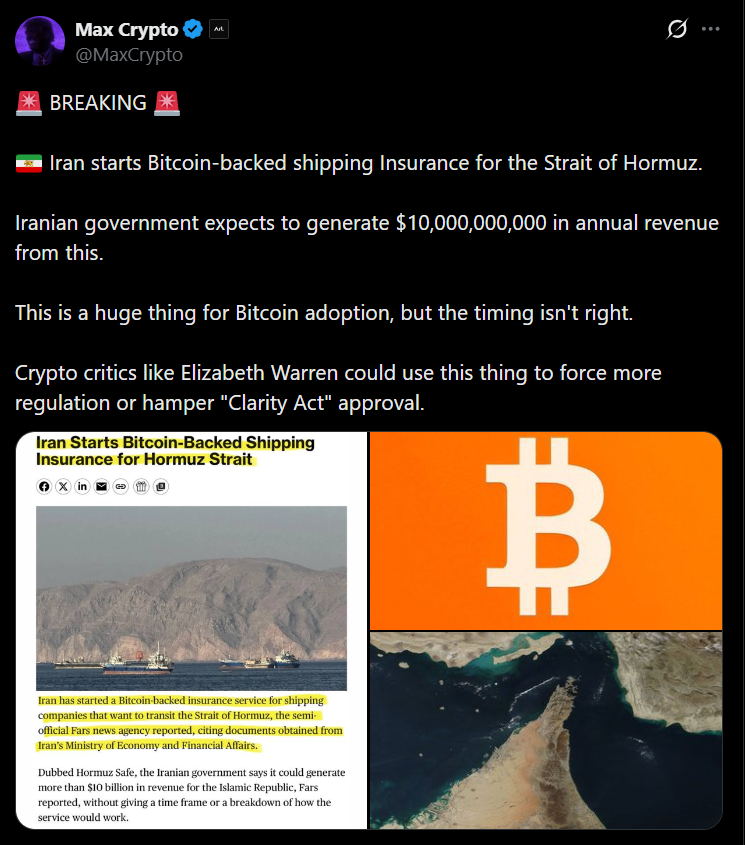
The proposal is part of a broader strategy reportedly explored by Iran’s Economy Ministry to generate new revenue streams tied to one of the world’s most strategically important oil transit routes. Reports suggest the framework could potentially create more than $10 billion in economic activity if fully implemented.
Bitcoin Is Being Positioned as a Sanctions Workaround
The platform reportedly offers “cryptographically verifiable” insurance coverage with Bitcoin-based settlement designed to bypass some traditional banking restrictions tied to international sanctions. Earlier reports also suggested Iranian officials explored requiring Bitcoin payments from oil tankers seeking passage through the Strait of Hormuz.
The idea reflects a growing interest among sanctioned states in using crypto infrastructure to reduce reliance on conventional financial systems that remain heavily influenced by U.S. and European regulators.
However, analysts say scaling such systems beyond niche or sanctioned trade environments would be extremely difficult due to legal, liquidity, and compliance challenges.
Blockchain Transparency Creates Its Own Risks
Despite Bitcoin’s ability to move outside traditional banking rails, experts note that blockchain transparency may actually make Iran-linked activity easier to monitor in some cases. Transactions on Bitcoin’s public ledger remain traceable, allowing blockchain analytics firms to flag wallets and track fund movements tied to sanctioned entities.
Analysts also warned that any global shipping company openly interacting with an Iran-linked Bitcoin settlement platform could face severe sanctions exposure or risk being cut off from mainstream financial infrastructure entirely.
Crypto and Geopolitics Are Becoming More Connected
The reports arrive as tensions around the Strait of Hormuz continue drawing global attention due to its importance for oil transportation and geopolitical stability. Prediction markets currently place relatively low odds on a full closure of the route, though traders continue monitoring developments closely.
At the same time, regulators and law enforcement agencies are increasing scrutiny on state-linked digital infrastructure tied to sanctions evasion, propaganda networks, and crypto-based financial systems.
For now, Hormuz Safe highlights how Bitcoin and blockchain infrastructure are increasingly intersecting with geopolitical strategy, sanctions policy, and global trade routes in ways that would have sounded almost impossible just a few years ago.