
- ICE CEO Jeffrey Sprecher described Hyperliquid as “bigger than NASDAQ” during a recent Bernstein conference.
- The decentralized trading platform now dominates more than 70% of the perpetual futures DEX market.
- Growing institutional interest highlights how crypto-native exchanges are beginning to challenge traditional financial infrastructure.
The gap between traditional finance and decentralized trading continues to narrow, and Hyperliquid may be one of the clearest examples yet. During a recent Bernstein conference, Intercontinental Exchange (ICE) founder and CEO Jeffrey Sprecher surprised many attendees when he praised the crypto-native trading platform and revealed that his team had met with its founders several times. For a company that owns the New York Stock Exchange and operates some of the world’s largest regulated markets, the comments carried significant weight.
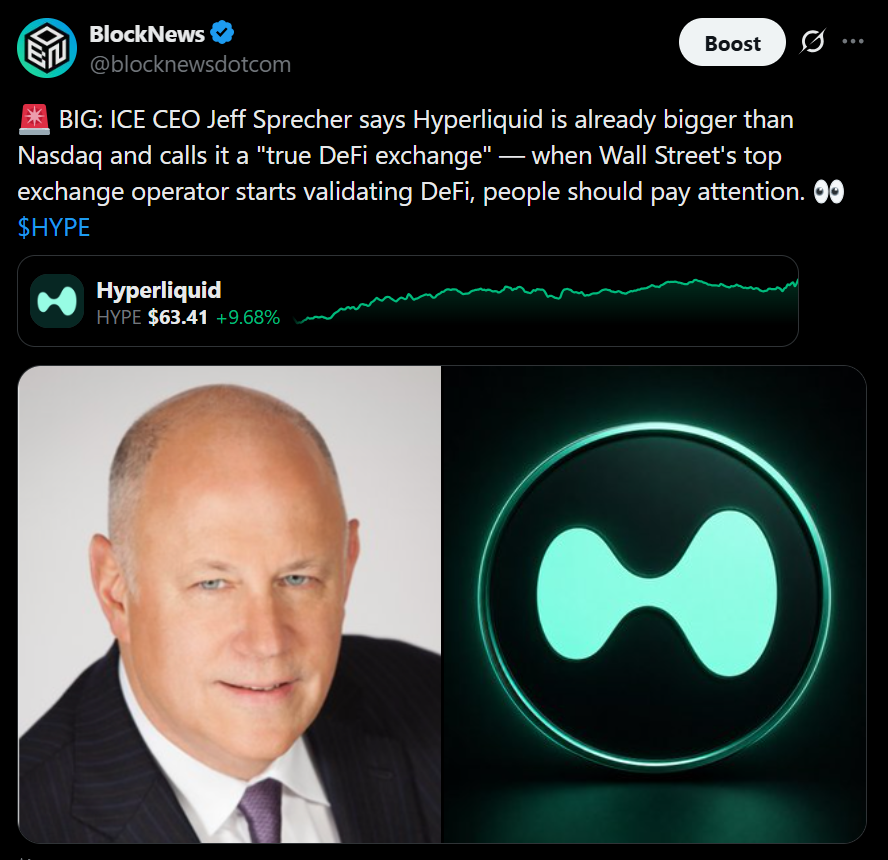
Sprecher’s remarks suggested that major financial institutions are no longer dismissing decentralized exchanges as experimental projects operating on the fringes of finance. Instead, platforms like Hyperliquid are increasingly being viewed as serious competitors capable of attracting meaningful trading volume and market activity.
Why Hyperliquid Caught Wall Street’s Attention
Speaking with Bernstein analyst Chinedu Bolu, Sprecher highlighted the scale of Hyperliquid’s operations despite its relatively small team. He described the project as “bigger than NASDAQ” and noted that only around 11 people are directly involved in building the core platform. While the comparison does not hold when looking at market value, it reflects the impressive amount of activity Hyperliquid has managed to attract in a relatively short period.
Hyperliquid’s HYPE token currently carries a market capitalization of roughly $15 billion, far below Nasdaq’s valuation. However, when measuring daily perpetual futures trading activity, the decentralized exchange processes billions of dollars in volume and controls more than 70% of the decentralized perpetual futures market. That level of dominance has become difficult for traditional financial firms to ignore.
A Small Team Powering a Massive Platform
The reference to “11 people” specifically points to Hyperliquid Labs, the project’s core development group. Beyond that team, the broader ecosystem includes independent contributors and validators responsible for operating the underlying Layer 1 blockchain.
This structure highlights one of crypto‘s most unique characteristics. Unlike traditional exchanges that often require thousands of employees and massive operational overhead, decentralized networks can scale through distributed participation. Hyperliquid’s rapid growth demonstrates how lean teams can build platforms that rival established financial infrastructure in certain market segments.
Weekend Oil Trading Raises New Questions
One factor that particularly caught ICE’s attention was Hyperliquid’s growing role in commodity trading. Sprecher noted that traders have been using the platform to gain exposure to oil markets during weekends when many traditional exchanges are closed. Activity reportedly increased during recent periods of geopolitical tension in the Middle East, when market-moving developments occurred outside normal trading hours.

Analysts at JPMorgan have observed similar behavior, pointing to non-crypto traders using Hyperliquid’s around-the-clock markets for exposure to energy prices. Traditional exchanges operate within defined trading schedules, but decentralized platforms remain open 24 hours a day, seven days a week. That availability is becoming increasingly attractive in a world where major events can unfold at any moment.
Regulation May Be the Next Battleground
Despite its growth, Hyperliquid operates in a regulatory gray area compared with established U.S. exchanges. Under current American law, perpetual futures contracts are generally classified as swaps and fall under regulations introduced through the Dodd-Frank Act following the 2008 financial crisis. These rules impose reporting, registration, and margin requirements on regulated venues such as ICE.
Hyperliquid, meanwhile, operates offshore and outside many of those regulatory frameworks. Sprecher openly questioned whether traditional exchanges should be restricted from offering similar products while offshore competitors continue gaining market share. He suggested policymakers may soon face a choice between creating a new regulatory category for perpetual futures or requiring overseas venues to comply with existing rules.
As regulators continue debating the future of digital asset markets, Hyperliquid’s rapid rise is becoming increasingly difficult to overlook. What began as a crypto-native trading platform is now attracting attention from some of the biggest names in global finance. Whether that leads to greater adoption, tighter regulation, or both remains one of the most important stories to watch in the months ahead.