

- Ethereum crypto price dropped 36% in 2026 as DEX volumes and fee revenue declined sharply.
- Despite weaker trading activity, Ethereum maintains dominance in DeFi TVL and tokenized real-world assets.
- Key resistance stands near $2,100, while $1,800 remains the next major support zone.
Ether traded near $1,963 after tumbling 36% in 2026, a sharp reset that forced traders to rethink growth assumptions that once felt almost automatic. The pullback dragged price action toward the $1,900 zone, where momentum noticeably faded and buyers hesitated. While the broader crypto market also corrected, Ethereum’s decline felt heavier, almost personal to the asset.
Part of the pressure came from slowing on-chain activity and thinning fee generation, which dulled the growth narrative that had powered earlier rallies. As the $3,000 level drifted further out of sight, frustration built among holders who expected stronger relative performance. Critics were quick to argue that Ethereum had lost ground to faster, cheaper networks, though the structural data hinted at something more layered than a simple loss of relevance.
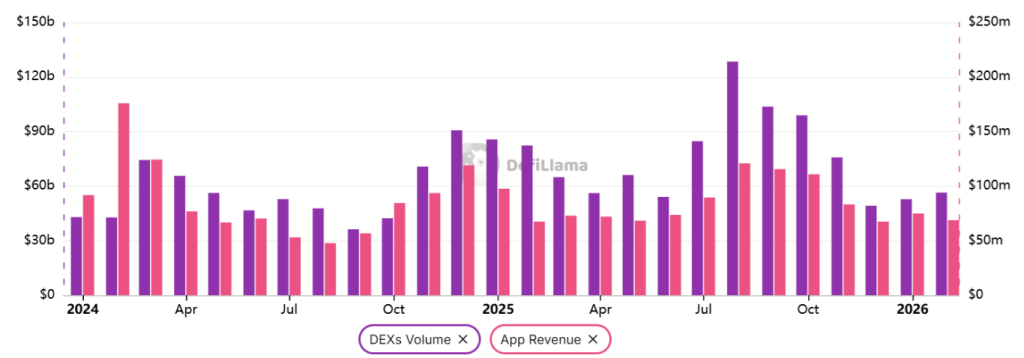
DEX Volumes Contract While Capital Rotates
TradingView data showed Ether underperformed total crypto market capitalization by roughly 9% in the first two months of the year. That gap suggested asset-specific weakness rather than a purely macro-driven retreat. Capital wasn’t fleeing crypto altogether, it was rotating within it, searching for sharper narratives.
DeFiLlama figures revealed Ethereum’s decentralized exchange volumes dropped 55% over six months, sliding to $56.5 billion in February 2026 from $128.5 billion in August 2025. During that same stretch, Solana processed $95.5 billion in monthly trades after previously peaking at $120.6 billion. Lower throughput translated into softer fee revenue and weaker decentralized application income, reducing short-term incentives to aggressively accumulate Ether, even if long-term conviction remained intact.
Ethereum Retains DeFi and Real-World Asset Dominance
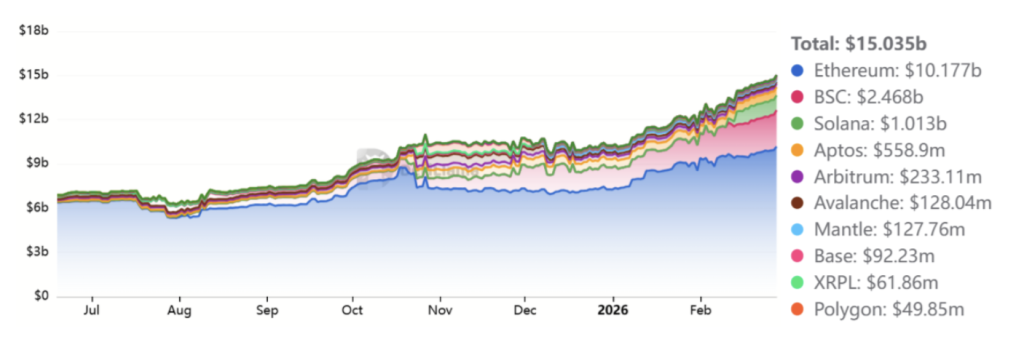
Despite the slowdown in trading metrics, Ethereum still controlled 57% of total value locked, about $52.4 billion according to DeFiLlama. When Base, Arbitrum, Polygon, and Optimism were included, that aggregate share climbed to 65%, reinforcing how deeply liquidity is embedded in its ecosystem. By comparison, Solana held $6.4 billion in smart contract deposits and BNB Chain accounted for $5.5 billion, sizable but not structurally dominant.
Real-world asset tokenization told a similar story. Ethereum captured 68% of tokenized asset market capitalization, showing that institutional-grade projects continued to gravitate toward its infrastructure even as retail trading cooled. Fee leadership may have temporarily shifted toward Tron and Solana, but capital concentration, the kind that doesn’t move overnight, remained anchored in Ethereum’s base layer and rollup stack.
Institutional Expansion Moves Forward
Corporate disclosures added another layer of context. JP Morgan Asset Management, Citi, Deutsche Bank, and BlackRock all deployed tokenization initiatives using Ethereum rails, ranging from on-chain funds to bank-issued stablecoins and custom layer-2 rollups. Institutions appeared to prioritize settlement reliability, security, and developer tooling over raw throughput metrics, even if that choice looked less flashy in the short term.
Total value locked rankings placed Hyperliquid at $1.5 billion, underscoring Ethereum’s monetary scale advantage. No competing network matched its liquidity depth or composability across decentralized finance applications. Critics, however, intensified pressure on Ethereum’s rollup-centric roadmap, arguing that rival chains were capturing more immediate fee flow and user momentum.
Vitalik Buterin responded by outlining protocol adjustments aimed at strengthening base-layer scalability. Proposals included parallel block verification, gas pricing aligned with execution time, and eventual deployment of a zero-knowledge Ethereum Virtual Machine. Implementation would roll out gradually, beginning with voluntary adoption before broader enforcement, a cautious but deliberate path.
He also acknowledged that quantum-resistant signatures remain bulky and computationally demanding under current lattice-based models. To address that, Buterin advocated recursive proof aggregation and vectorized math precompiles to reduce verification costs. The goal wasn’t just speed. It was preserving decentralization while improving throughput, even if progress feels incremental.
Key Levels to Watch as Crypto Sentiment Shifts
Ethereum’s price today reflects short-term demand fluctuations more than long-term infrastructure decay. Builders continue to focus on scalability, privacy, and cryptographic resilience instead of chasing fee spikes alone. That design philosophy may diverge from chains optimized primarily for transaction surges, but it reinforces Ethereum’s identity as foundational infrastructure rather than a high-frequency playground.
If broader crypto risk appetite returns, immediate resistance sits near $2,100, where prior selling intensified. A sustained move above that level could shift momentum, though confidence would need to rebuild steadily, not in one burst. On the downside, failure to defend recent lows may expose the $1,800 range, a liquidity cluster traders are watching closely, maybe a bit nervously.