

- Ethereum is struggling to regain momentum as price compresses around $3,100
- Long-term accumulation around $2,700–$2,800 remains a critical structural support
- A break above $3,300 is needed to shift momentum, while losing $3,000 would increase downside risk
Ethereum keeps circling the same levels, struggling to firmly reclaim $3,100 as price action tightens and patience wears thin. After weeks of choppy movement, ETH looks stuck between half-hearted bullish attempts and stubborn resistance overhead. Analysts are split. A smaller camp still believes Ethereum can regain momentum and eventually revisit its all-time highs, while the louder narrative now leans toward a tougher 2026 shaped by weaker demand and tighter liquidity.
That tension is showing up on the chart. Each push higher fades quickly, yet sellers haven’t managed to force a decisive breakdown either. It’s the kind of environment where confidence erodes slowly, not all at once.
A Long-Term Metric Cuts Through the Noise
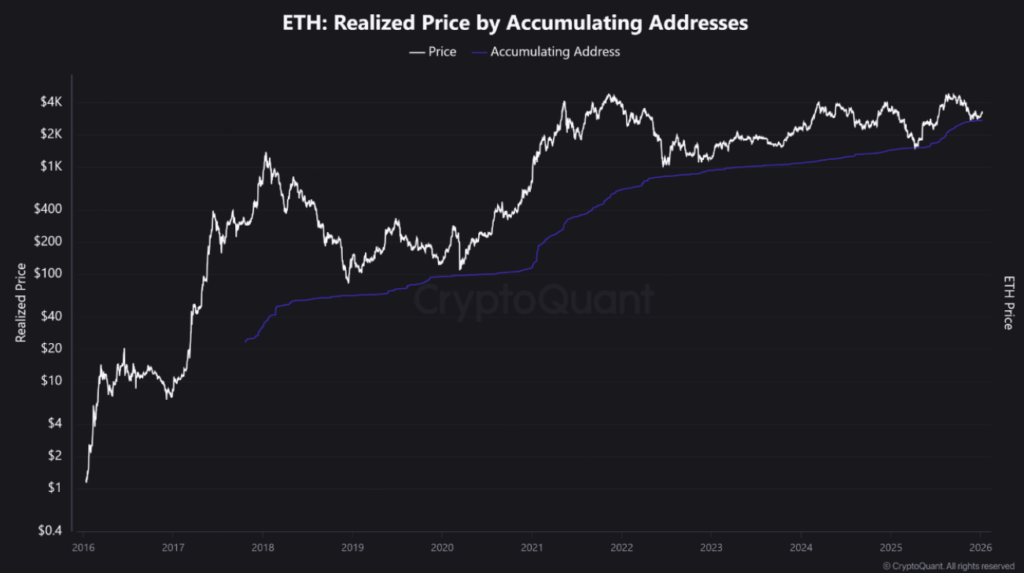
Amid the back and forth, a CryptoQuant report offers a calmer, longer-term lens. Instead of focusing on short-term momentum, it looks at Ethereum’s Accumulating Addresses Realized Price. This metric tracks the average cost basis of addresses that consistently accumulate ETH rather than trade in and out.
What stands out is how steady this figure has been over time. Since 2020, the realized price for long-term accumulators has trended higher, even through the brutal 2022–2023 drawdown. While price fell sharply during that period, long-term holders largely stayed put. That behavior helped form a durable foundation under the market.
Today, that accumulation cost sits around the $2,700–$2,800 range. ETH is trading just above it, turning that zone into a structural line in the sand. The question now isn’t just whether price holds there short term, but whether this long-running accumulation regime can keep surviving in a changing macro environment.
Why Ethereum Still Stands Apart From Most Altcoins
CryptoQuant’s data highlights a clear contrast between Ethereum and the broader altcoin market. Since 2022, many altcoins have suffered deep drawdowns without ever establishing a stable accumulation base. That lack of long-term conviction helps explain why their recoveries have been shallow and fragile.
Ethereum has behaved differently. Through multiple stress periods, 2018, 2020, 2022, and even the volatility of 2025, long-term holders continued to defend their positions. That consistency has been a key source of ETH’s relative resilience.
Still, no structure lasts forever. Periods that feel stable often carry hidden risk. If ETH continues trading near or above its accumulation cost, it signals long-term buyers are still engaged. A sustained break below that zone, however, would suggest a real shift in behavior, and potentially a break from the valuation framework Ethereum has lived in for years.
Price Compresses as $3,000 Becomes the Pivot
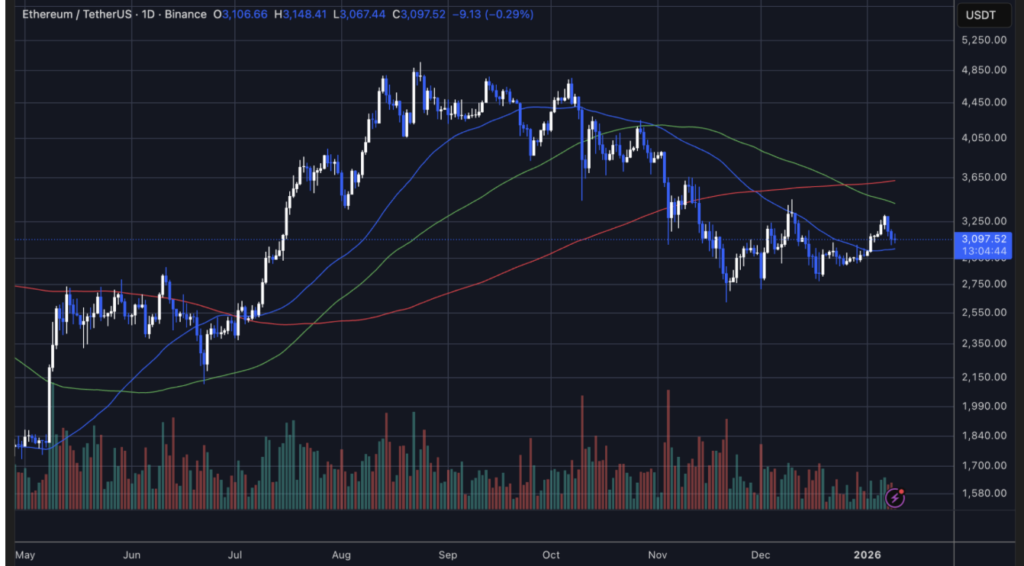
On the price chart, Ethereum is consolidating around the $3,100 area after failing to reclaim higher resistance. ETH is trading below its short- and medium-term moving averages, with the 50-day and 100-day now acting as resistance instead of support. That’s a clear sign the broader structure remains corrective following the rejection from the $4,000–$4,200 region earlier in the cycle.
The $3,000–$3,100 zone has emerged as a key battleground. Buyers have defended it repeatedly, suggesting some level of demand and short-term accumulation. At the same time, each bounce stalls near descending moving averages, which is typical of markets trying to build a base rather than launch a clean reversal.
From a wider view, ETH remains above its long-term moving average, which is still sloping upward. That hints the macro trend hasn’t fully broken. But volume has been fading on recent rebounds, a sign that conviction on the buy side is thin.
For bulls, reclaiming $3,300 and holding it would be a meaningful shift. Until that happens, Ethereum appears stuck in consolidation, with downside risk lingering if the $3,000 level finally gives way.