

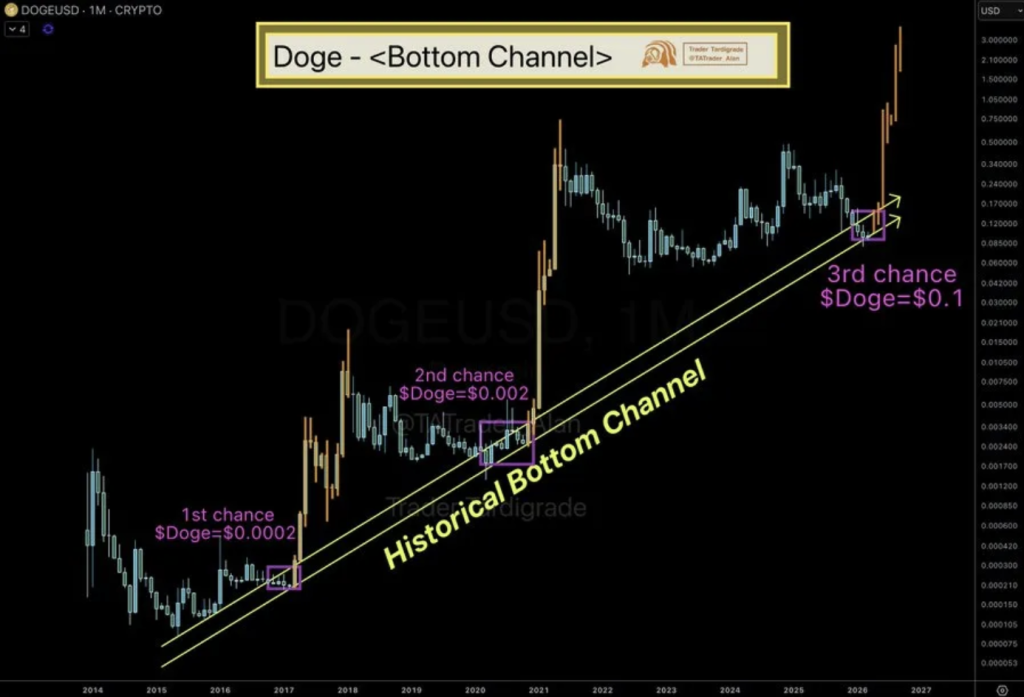
- Dogecoin retested its long-term support channel near $0.10 after an 8% price drop.
- Analysts note that previous dips to this channel historically preceded strong rallies.
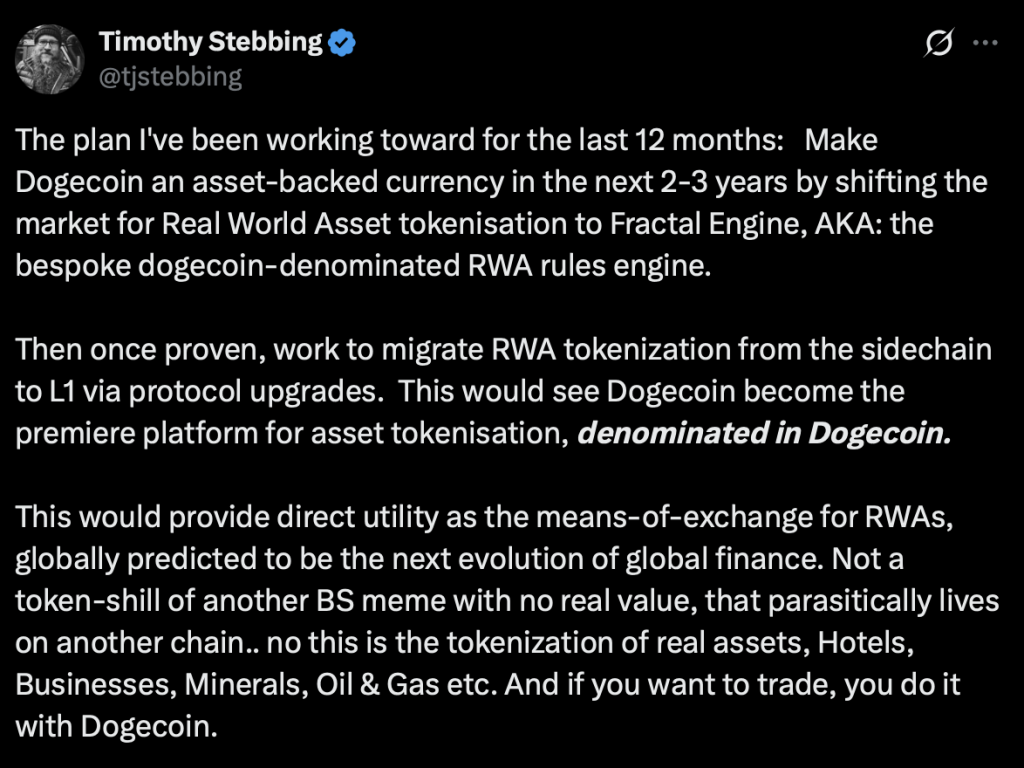
- The Dogecoin Foundation is exploring asset tokenization through the Fractal Engine sidechain.
Dogecoin’s story in the market may be slowly changing. What used to revolve almost entirely around hype cycles and sharp price swings is now starting to include something a little different—actual utility discussions. Recently, the token retested a long-standing technical support pattern, while at the same time the Dogecoin Foundation revealed new plans aimed at expanding DOGE’s real-world use cases.
As of March 6, 2026, Dogecoin is trading near $0.09439 after falling about 8.23% over the past day. The move pushed the asset back toward its historical bottom support channel, a technical structure traders have been watching for years. Meanwhile, daily trading volume dropped roughly 30.8%, landing around $1.62 billion according to CoinMarketCap data. Over the past week the token has slipped about 2.58%, reflecting the broader turbulence seen across the crypto market recently.
Long-Term Support Channel Returns to Focus
Crypto analyst Trader Tardigrade pointed out that this particular support zone has historically acted as a major turning point for Dogecoin. According to the analyst, each time DOGE has reached the lower boundary of this channel, the market eventually followed with strong upward momentum.
That pattern has played out multiple times over the past decade. The first major bounce occurred around 2015–2016 when Dogecoin traded near $0.0002. A second similar touchpoint appeared during the 2018–2019 cycle around the $0.002 level, again preceding a significant rally later on.
Now, the current support zone—estimated around the $0.10 range during the 2025–2026 timeframe—marks the third major test of this same technical structure. Because the channel slopes upward over time, many traders see it as a sign that Dogecoin’s long-term bias remains bullish despite the short-term volatility that often dominates headlines.
Traders Watch for Another Historical Bounce
If historical patterns repeat, dips toward this lower boundary have often served as attractive entry zones for longer-term investors. That doesn’t guarantee another surge, of course. Crypto markets rarely follow scripts perfectly. Still, technical traders tend to respect patterns that have played out repeatedly over long timeframes.
The upward slope of this channel also reinforces the idea that Dogecoin has gradually maintained a broader growth trajectory since its early years. For traders focused on macro patterns rather than day-to-day fluctuations, this area could represent another moment where the market resets before a larger move.
At least, that’s the theory.

Dogecoin Foundation Explores Asset Tokenization
At the same time these technical signals are unfolding, the Dogecoin Foundation has introduced a new initiative aimed at expanding the token’s utility. Timothy Stebbing, a director at the foundation, recently discussed plans to position DOGE as an asset-backed currency through a system called the Fractal Engine sidechain.
The idea revolves around tokenizing real-world assets—things like real estate, businesses, minerals, and even commodities—and denominating those transactions directly in DOGE. Essentially, the system would allow tokenized assets to circulate while using Dogecoin as the primary settlement currency.
Fractal Engine would initially operate as an independent sidechain before potentially integrating with Dogecoin’s base layer through future protocol upgrades. If successful, the infrastructure could open the door for DOGE to participate in the growing real-world asset tokenization sector.
A Shift Beyond Meme-Coin Identity
This proposal represents a notable shift from Dogecoin’s original identity as a purely meme-driven cryptocurrency. While the token’s culture and community remain central to its brand, the foundation appears increasingly interested in giving DOGE more tangible financial applications.
The move also aligns with broader institutional conversations happening across the financial world. Leaders such as BlackRock CEO Larry Fink have repeatedly highlighted asset tokenization as one of the most transformative developments in modern financial infrastructure, particularly when it comes to liquidity and settlement efficiency.
If the Dogecoin Foundation manages to successfully connect DOGE with real-world asset markets, the token could potentially develop a stronger demand base beyond speculation alone. For investors, that would introduce a different dynamic—one where DOGE’s value is influenced not just by social sentiment, but also by its functional role in digital asset infrastructure.
For now though, the market remains in a wait-and-see phase.