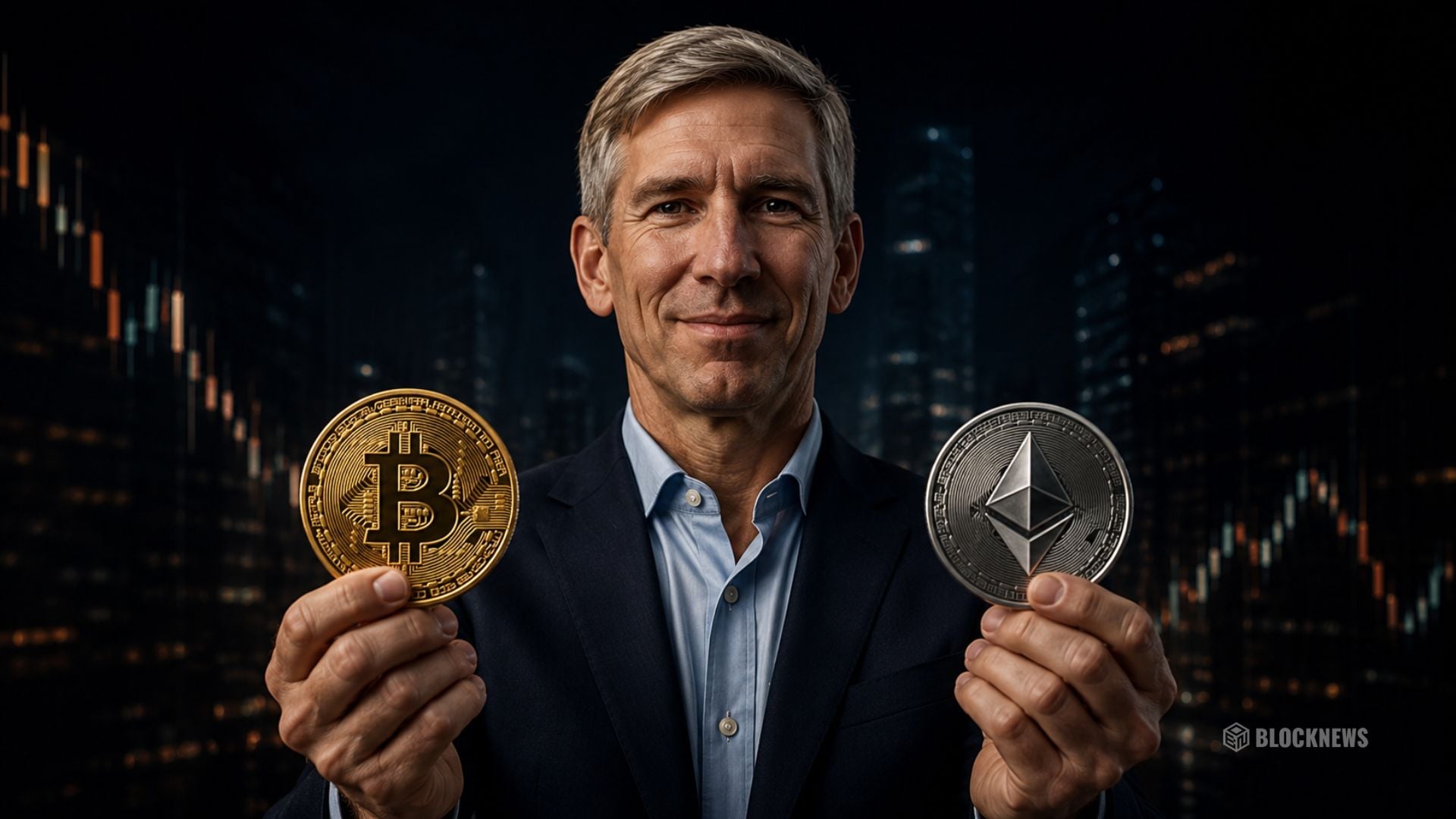
- Financial advisors managing trillions of dollars are showing growing interest in crypto beyond Bitcoin.
- Stablecoins, tokenization, and blockchain infrastructure projects are attracting increasing attention.
- Industry leaders believe the next crypto growth cycle may be driven by real-world utility rather than speculation alone.
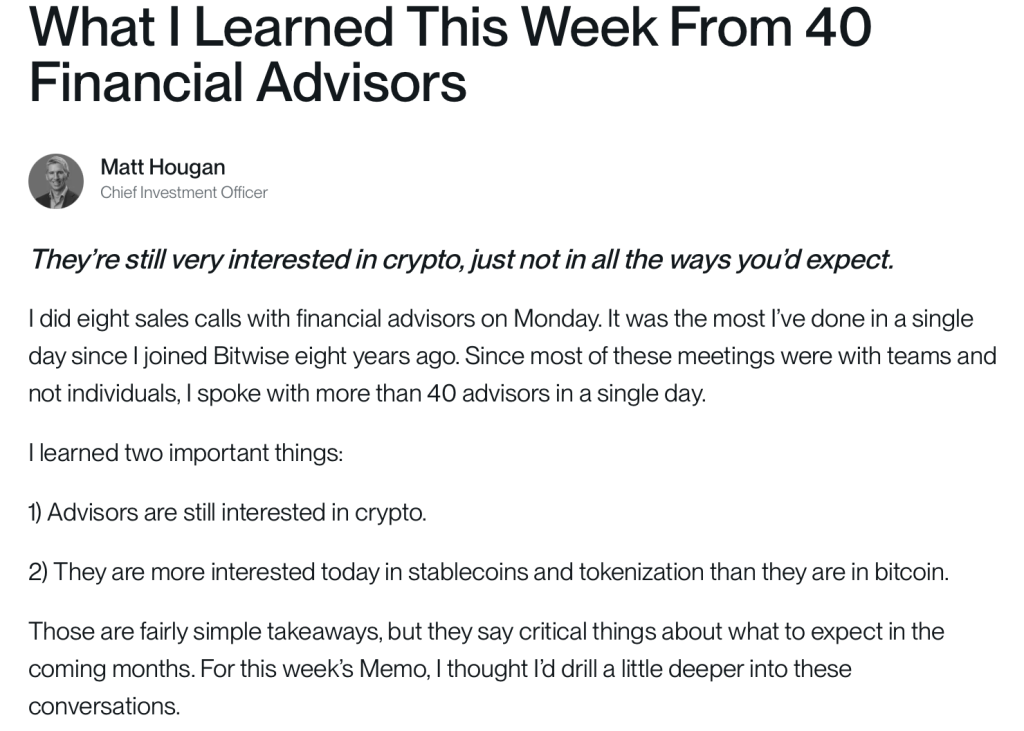
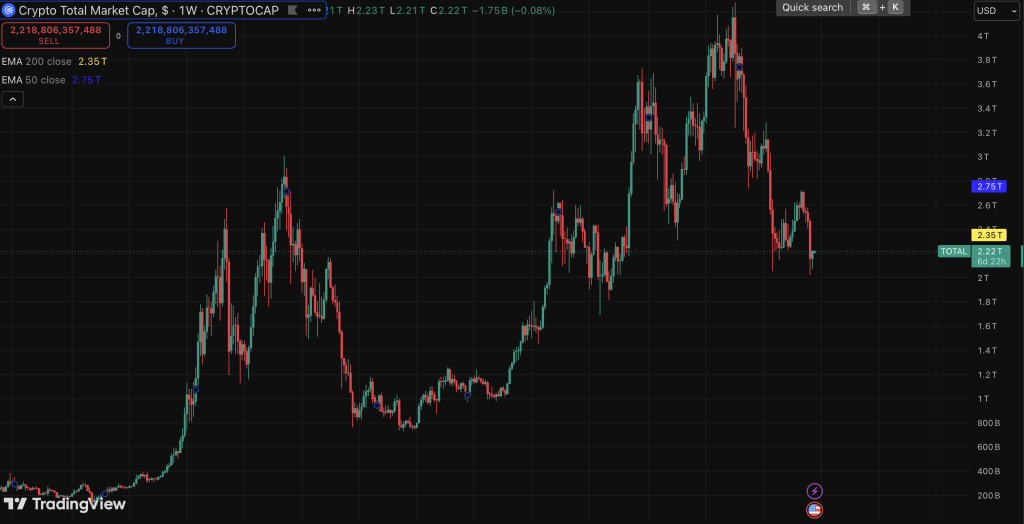
Despite the recent market weakness, interest in crypto appears far from dead. In fact, according to Bitwise Chief Investment Officer Matt Hougan, many financial advisors are becoming more engaged with the sector, even as prices struggle to regain momentum.
After speaking with more than 40 advisory teams responsible for managing over $175 trillion in assets, Hougan came away with a notable takeaway: the conversation has evolved. Bitcoin still matters, of course, but it is no longer the only story attracting attention from traditional finance.
The focus is gradually shifting toward the broader blockchain ecosystem and the real-world applications emerging around it.
Crypto’s Next Growth Phase May Look Different
Historically, every major crypto recovery has been fueled by a combination of innovation and new participants entering the market.
Following the 2014 bear market, Ethereum and smart contracts helped attract a fresh wave of developers and retail investors. After the 2018 downturn, decentralized finance exploded in popularity while stimulus-driven capital found its way into digital assets. More recently, the recovery that followed the FTX collapse was supported by the launch of spot Bitcoin ETFs and growing hedge fund participation.
Hougan believes the next chapter could follow a similar pattern.
The difference is that the technologies attracting attention today are not necessarily the same ones that dominated previous cycles. Instead, stablecoins, tokenization, blockchain-based financial infrastructure, and perpetual futures markets are increasingly becoming the center of institutional discussions.
Stablecoins and Tokenization Take Center Stage
One of the clearest themes emerging from Hougan’s conversations is the growing interest in tokenization and stablecoins.
These concepts have moved well beyond crypto-native circles. Major financial institutions, regulators, and some of the largest asset managers in the world are now openly discussing how blockchain technology can improve traditional financial systems.
Recent comments from SEC Chair Paul Atkins, Goldman Sachs CEO David Solomon, and BlackRock CEO Larry Fink have all highlighted the potential role of tokenized assets and stablecoin infrastructure in the future of finance.
That level of attention matters.
When Wall Street starts discussing blockchain use cases as business opportunities rather than speculative experiments, the investment landscape begins to change. Advisors are increasingly evaluating crypto through the lens of infrastructure, efficiency, and utility rather than simply price appreciation.
Bitcoin Remains Important, But It May Not Lead Alone
Bitcoin has traditionally been the primary driver of crypto market recoveries. Its size, liquidity, and reputation as digital gold have made it the entry point for many investors.
However, Hougan suggests the next cycle may distribute capital differently.
Instead of flowing exclusively into Bitcoin, institutional money could increasingly target networks and companies positioned to benefit from tokenization, stablecoin adoption, and blockchain-based financial products. That doesn’t mean Bitcoin becomes irrelevant. Far from it.
Rather, it means the market may become more diversified as investors seek exposure to the infrastructure supporting these emerging trends.
This represents a significant shift from earlier cycles, where Bitcoin often captured the majority of institutional attention.
Advisors Are Watching More Than Just BTC
Several blockchain projects are already emerging as beneficiaries of this broader interest.
Hougan highlighted Ethereum, Solana, Chainlink, Avalanche, and Canton as networks attracting increasing attention from advisors and institutional investors. Each plays a different role within the evolving blockchain ecosystem, whether through smart contracts, tokenization infrastructure, oracle services, or financial settlement systems.
Trading-focused platforms are also entering the conversation. Hyperliquid, for example, has gained visibility as decentralized derivatives markets continue growing.
The interest extends beyond tokens as well. Companies operating within the digital asset sector, including Circle, Coinbase, and Figure, are increasingly viewed as direct ways to gain exposure to the expansion of stablecoins and tokenized financial products.
Traditional Finance Is Becoming More Sophisticated About Crypto
Perhaps the most important takeaway from Hougan’s discussions is not which projects advisors are watching. It’s how much their understanding of the industry has matured.
A few years ago, many advisors viewed crypto primarily through the lens of Bitcoin and speculative trading. Today, conversations are becoming more nuanced. Discussions now include settlement systems, digital asset infrastructure, stablecoin adoption, tokenized securities, and blockchain-based financial products.
That evolution matters because institutional capital tends to move where understanding grows.
The crypto market has often been driven by excitement and narratives. The next phase, however, may be shaped by something much more durable: real-world utility combined with institutional adoption.
If that happens, the next bull market may look very different from the ones that came before it.