

- Bitcoin entered a prolonged correction after its $126,000 October peak
- China’s mining clampdown may have triggered a short-term hashrate and price drop
- Hashrate shocks tend to cause volatility, but rarely alter Bitcoin’s long-term trajectory
The last few months haven’t been kind to crypto, and Bitcoin’s price action tells that story pretty clearly. After pushing to an all-time high near $126,000 in early October, BTC lost momentum and began sliding lower. What followed wasn’t a quick shakeout, but a correction phase that’s still unfolding.
Since that peak, Bitcoin has turned bearish in Q4 2025, slipping below several key support levels and denting sentiment along the way. While multiple factors are in play, one familiar theme is resurfacing, China’s renewed pressure on Bitcoin mining.
China’s Mining Clampdown Returns to the Spotlight
Bitcoin was trading around $90,000 before the latest sell-off picked up speed. Then price dropped roughly 4–5%, falling back into the $85,500 to $86,000 range. Some analysts believe this move wasn’t purely market-driven, and that China may be involved again.
A market watcher known as NoLimitGains claimed that China had tightened domestic mining regulations, particularly in Xinjiang. According to the report, multiple mining facilities were shut down in December, forcing an estimated 400,000 miners offline in a short period of time. That sudden exit dragged Bitcoin’s hashrate down by about 8%.
When miners are pushed offline like this, they lose revenue immediately. Some are forced to sell Bitcoin to cover expenses or relocate operations. At the same time, uncertainty rises, and that combination often creates short-term sell pressure, even if the long-term outlook stays intact.
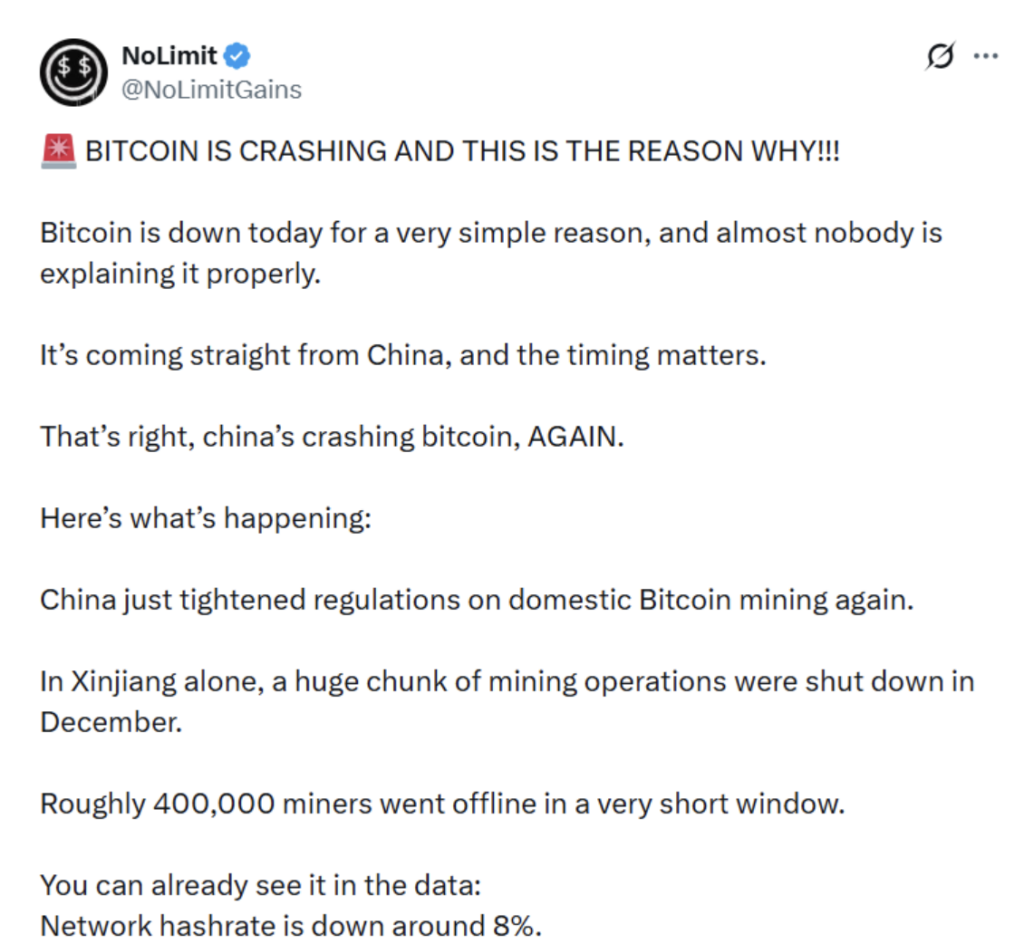
How Hashrate Drops Impact Bitcoin Price
An 8% decline in hashrate sounds dramatic, but it doesn’t mean the network is in trouble. Bitcoin mining today is far more geographically diversified than it once was. Large operations in the U.S. and other regions are already offsetting some of China’s offline capacity.
There are no security risks tied to the current dip. Still, sudden hashrate changes can amplify short-term volatility by affecting miner behavior and supply dynamics. The key point is that Bitcoin’s difficulty adjustment exists for moments like this, allowing the network to stabilize over time.
Hashrate fluctuations may shake price briefly, but they are not a permanent driver of Bitcoin’s long-term value.

CCP vs Bitcoin, A Long-Running Conflict
China’s stance on Bitcoin remains firmly hostile. The Chinese Communist Party views decentralized crypto as a threat to capital controls and centralized financial oversight. Mining, trading, and most crypto-related activities remain restricted, while the state continues to promote its own digital yuan.
This contrast has sparked discussion elsewhere. Some market commentators argue that China’s rejection of Bitcoin creates opportunity abroad. A recent quote attributed to U.S. Vice President JD Vance summed up that view, if America’s biggest adversary is running from Bitcoin, perhaps the U.S. should lean into it.
The Bigger Picture for Bitcoin
China’s mining restrictions may be adding short-term pressure to Bitcoin’s price, but they don’t change the bigger story. The network adapts, activity shifts geographically, and the system moves forward.
History suggests these events create turbulence, not collapse. Once again, regulatory pressure in one region is redistributing opportunity rather than defining Bitcoin’s future.