

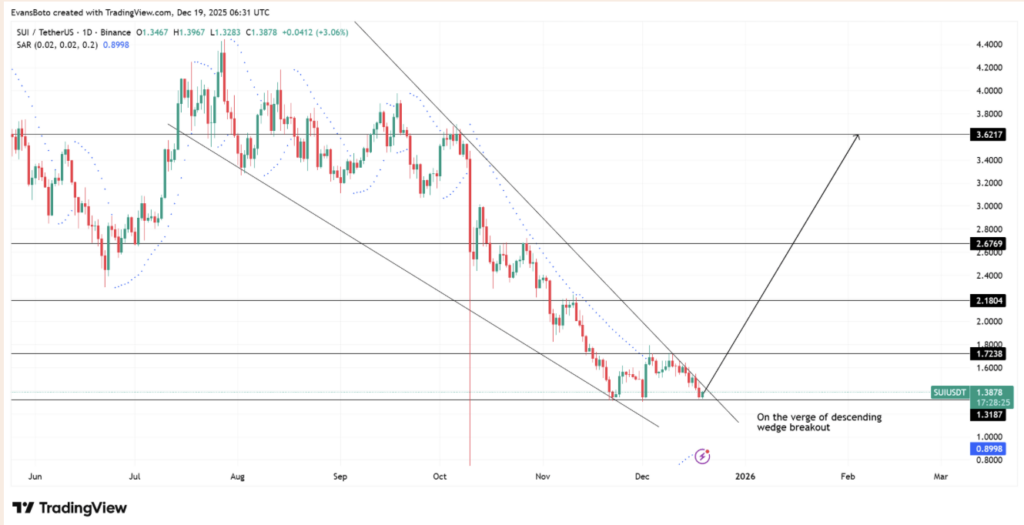
- SUI is compressing inside a descending wedge near the $1.32–$1.38 support zone, setting up a potential volatility expansion.
- Shorts are taking more liquidation pressure while open interest rises, hinting at rotation and fresh leverage, not traders exiting.
- Binance top traders remain net long, and if price breaks above the wedge, upside targets near $1.72 and $2.18 come into focus.
Bitwise’s move to file an S-1 for a spot Sui (SUI) ETF has quietly pushed the token back onto institutional radars. This isn’t just another speculative product. The structure points to something more deliberate.
The filing outlines full spot backing, staking integration, and in-kind creations, all of which imply direct interaction with actual SUI supply. That’s an important shift. It reframes SUI from a high-beta altcoin into something that could function as a regulated allocation tool, not just a trade.
Adding to that, the Parabolic SAR now sits below price, a subtle but notable technical signal that often appears near trend transitions. Still, headlines alone don’t move markets for long. Structure and derivatives behavior have to agree, and that’s where timing starts to matter.
SUI Price Compresses Near a Crucial Support Zone
SUI remains locked inside a descending wedge, with price grinding along the lower boundary between roughly $1.32 and $1.38. This area has absorbed repeated sell attempts since early December, refusing to break cleanly.
Each push lower has been met with quicker dip-buying responses, which suggests sellers are losing leverage, slowly but surely. Below this zone, the next meaningful support sits near $1.18, a level that previously caught bids after the November breakdown. Price has tested that region, but never truly accepted below it.
On the upside, resistance begins near $1.72, with a broader supply zone around $2.18 where prior recoveries stalled. The wedge itself doesn’t signal direction. It signals compression. And compression, sooner or later, resolves with force.
Short Liquidations Start to Outpace Longs
Liquidation data adds another layer to the story. During the most recent volatility spike, short liquidations reached about $165.9K, edging out long liquidations near $132.6K.
That imbalance matters. It suggests bearish positions are feeling pressure near support, especially as price refuses to roll over. Shorts tend to get aggressive late in trends, and forced exits often follow when downside follow-through fails.
This alone doesn’t confirm a reversal, but it does point to stress building on the bearish side. When liquidation pressure starts skewing against sellers during a prolonged downtrend, markets often transition into re-pricing phases rather than continuing straight down.
Fresh Leverage Builds During Compression
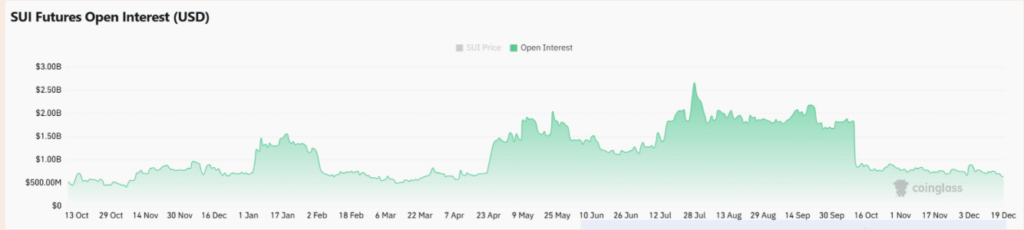
Open Interest has climbed to roughly $658.5 million, up 1.86% at the time of writing. That rise signals fresh leverage entering the market, not traders backing away.
What stands out is where that leverage is being added. It’s building near structural support, not at euphoric highs. That reduces the odds of an immediate downside cascade and increases the impact of any directional break.
Combined with rising short liquidations, the OI increase suggests rotation rather than reckless speculation. If price escapes the wedge, leverage could amplify the move quickly, in either direction, though current pressure appears tilted upward.
Binance Top Traders Maintain a Clear Long Bias
Data from Binance’s top traders shows 64.06% of accounts positioned long, compared to 35.94% short, producing a Long/Short ratio of 1.78. That’s not retail enthusiasm. That’s experienced positioning.
More importantly, this long bias exists while price remains compressed, not after a breakout. That distinction matters. Professionals tend to position early, before confirmation becomes obvious.
When long dominance aligns with rising Open Interest and growing pressure on shorts, markets often sit near decision points. Price still needs to confirm, but the positioning backdrop is quietly constructive.
The Setup Is Tight, and Resolution Is Approaching
Bitwise’s ETF filing arrived at an interesting moment. SUI is sitting on critical structural support, shorts are absorbing heavier liquidations, leverage is rebuilding, and top traders continue to lean long.
Together, these signals suggest downside momentum is weakening, not accelerating. Compression is doing its job.
If SUI breaks above the descending wedge, the alignment between institutional narrative, derivatives positioning, and price structure favors an upside expansion toward higher resistance zones. Until then, the market waits. But it’s clearly paying attention now.