
- Bitcoin bear markets average ~406 days, current cycle around 210 days in
- Bull cycles historically last over 1,000 days, showing long-term structure
- Institutional flows and macro shifts may be breaking old patterns
Bitcoin’s cycle timing has always felt almost… mechanical. For over a decade, it’s followed a rhythm that traders have come to rely on, bull runs stretching for years, followed by sharp but shorter bear markets that reset everything.
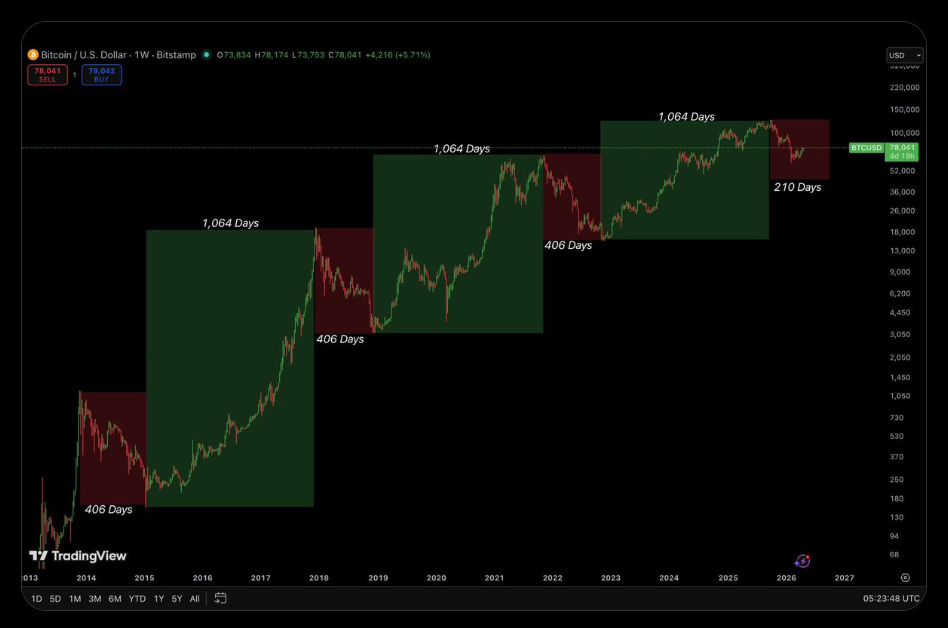
Right now, based on that history, we’re sitting somewhere in the middle of the current downturn. Not early enough to dismiss it, not late enough to call it over either. Just that awkward phase where nobody’s quite sure what comes next.
The Historical Pattern Still Matters
Looking back, bear markets have typically lasted just over a year, averaging around 400 days. Bull markets, on the other hand, have been much longer, often running close to three years from bottom to peak.
By that math, the current cycle isn’t done yet. At roughly 210 days in, Bitcoin could still have time left before a full reset, assuming the pattern holds, which, to be fair, it usually has.
But This Cycle Feels Different
Here’s where things start to get less predictable. For the first time, the year after a halving didn’t deliver the expected upside, instead closing slightly negative.
That breaks a pattern many considered almost guaranteed. It’s raised a bigger question too, whether Bitcoin is still following its old cycle logic, or if it’s evolving into something more tied to global macro conditions.
A Shallower Drawdown Changes the Narrative
Another difference is the depth of the decline. Previous bear markets often saw drops of 70% or more from all-time highs. This time, the pullback has been noticeably smaller.

That could mean the market is maturing, with stronger hands and institutional support reducing volatility. Or it could mean the full downside hasn’t played out yet. Both interpretations are floating around, and neither is easy to dismiss.
Mid-Cycle Correction or Something Bigger?
Some analysts are starting to frame this as a mid-cycle correction rather than a full bear market. The argument is that the drawdown hasn’t been deep enough to signal a true cycle top.
But that perspective depends heavily on historical comparisons, and those comparisons might be less reliable now than they used to be. The market is bigger, more liquid, and far more influenced by external factors than it was even a few years ago.
History Rhymes, But Doesn’t Repeat Perfectly
If the old timelines still apply, there could be more downside, or at least more time, before the next sustained bull phase begins. But relying too heavily on past cycles might be risky in a market that’s clearly evolving.
Bitcoin is no longer just a retail-driven asset cycling through hype and fear. With ETFs, institutions, and macro forces in play, the rhythm could be changing.
For now, the clock is still ticking. Whether we’re at halftime or heading into overtime… that’s the part nobody knows yet.