
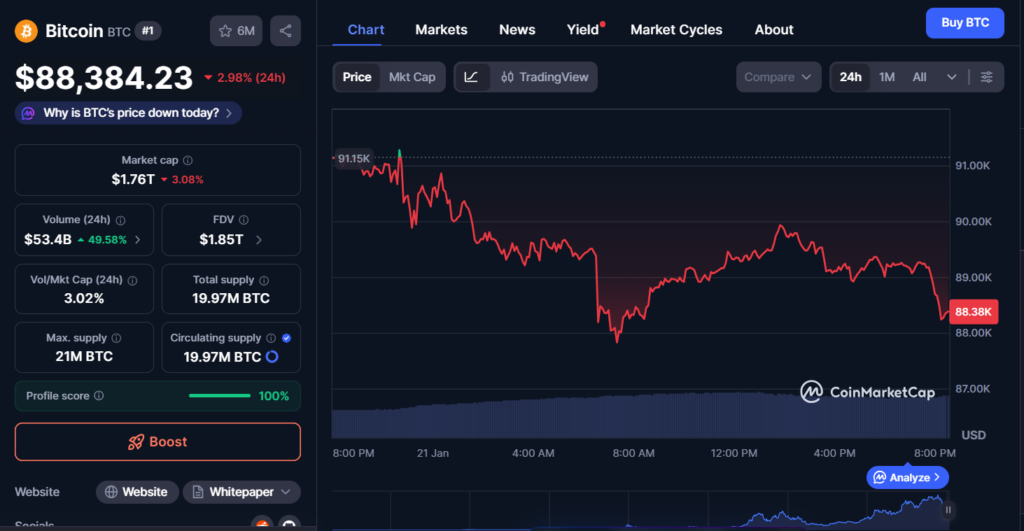
- Bitcoin dipped to $88,000 before rebounding, but remains under macro pressure.
- Trade tensions and risk-off sentiment have weighed on crypto since October.
- Upcoming Fed liquidity injections could support a short-term recovery.
Bitcoin briefly dipped to the $88,000 level on Wednesday, January 21, before bouncing back toward $89,000, suggesting buyers are still defending this range, at least for now. Even with the rebound, the broader trend has been shaky. BTC is down 2.1% over the last 24 hours, 6% on the week, and more than 13% since January 2025. Monthly performance remains slightly positive, but momentum has clearly cooled compared to earlier this cycle.
Why Bitcoin Has Been Struggling
The current weakness didn’t appear overnight. Crypto markets have been under pressure since October 2025, when Bitcoin surged to a new all-time high near $126,080 and then experienced the largest liquidation event of the year. That reversal coincided with rising macro uncertainty, and rate cuts from the Federal Reserve in both October and December failed to restore confidence. Instead of fueling a rally, those cuts were interpreted as signs of broader economic stress.
Trade Tensions Add Fresh Pressure
Bitcoin briefly showed strength earlier this month, reclaiming the $97,000 level around January 15. That move didn’t last. Prices rolled over again after President Trump announced new tariffs targeting countries supporting Greenland’s autonomy. The geopolitical fallout rattled markets and reinforced a risk-off environment. Investors rotated toward safety, pushing gold and silver to new all-time highs on January 20, while Bitcoin moved in the opposite direction.

Are We Entering a Crypto Winter?
Calling this a full-blown crypto winter may be premature, but the warning signs are there. Risk appetite has thinned, volatility remains elevated, and macro headlines are driving price action more than on-chain narratives. Still, Bitcoin hasn’t completely lost its footing. Holding above the $88,000–$89,000 zone suggests the market is searching for equilibrium rather than capitulating outright.
Liquidity Could Change the Picture
There’s also a potential catalyst on the horizon. The Federal Reserve is set to inject roughly $55 billion in liquidity over the coming weeks, with the first $8.3 billion already deployed on January 20. Historically, liquidity injections have provided tailwinds for Bitcoin, sometimes with a lag. If that pattern repeats, BTC could stabilize and attempt a trend reversal as liquidity filters through markets.