

- Roughly $838 billion has been wiped from the crypto market since October, but internal structure is improving.
- ETH/BTC is trending higher, signaling early capital rotation from Bitcoin into Ethereum.
- Bitcoin dominance has fallen 1.25%, implying an estimated $16.5 billion has shifted toward altcoins and stablecoins.
Altcoins haven’t had an easy stretch. Since the broader crypto downturn kicked in, pressure has been steady, sometimes quiet, sometimes sharp. According to TradingView data, roughly $838 billion has been erased from total crypto market capitalization since October last year. That’s not a small drawdown. It’s a structural reset.
And yet, beneath the surface, something is shifting.
The correction has been deep, but internal market structure is starting to show faint signs of repair. Not explosive strength. Not euphoria. Just small, measurable improvements that tend to show up before narratives change.
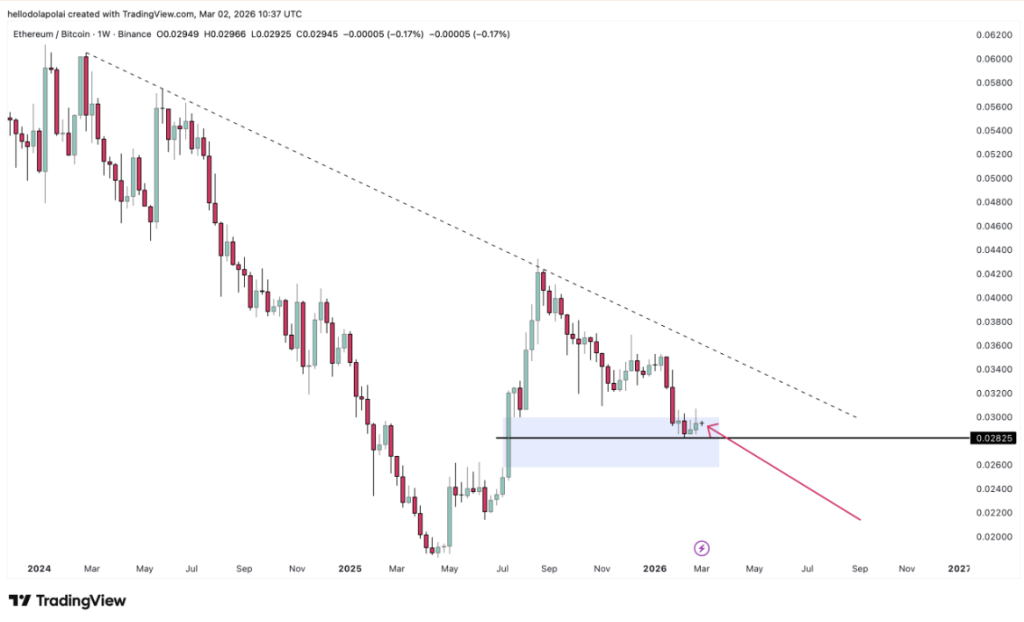
Ethereum Starts to Reclaim Ground
One of the clearest gauges of capital rotation inside crypto is the ETH/BTC pair. When that chart trends higher, it means Ethereum is absorbing liquidity faster than Bitcoin. When it trends lower, Bitcoin tightens its grip on dominance.
Over the past two weeks, ETH/BTC has printed higher highs on the weekly timeframe. The move isn’t dramatic, but direction matters more than magnitude at inflection points. It suggests capital is slowly rotating toward Ethereum rather than clustering exclusively in Bitcoin.
Historically, this kind of shift doesn’t stay isolated. Ethereum often acts as a bridge. When it begins outperforming Bitcoin, liquidity tends to cascade further down the risk curve into selected altcoins. Not all of them. Just the stronger names first.
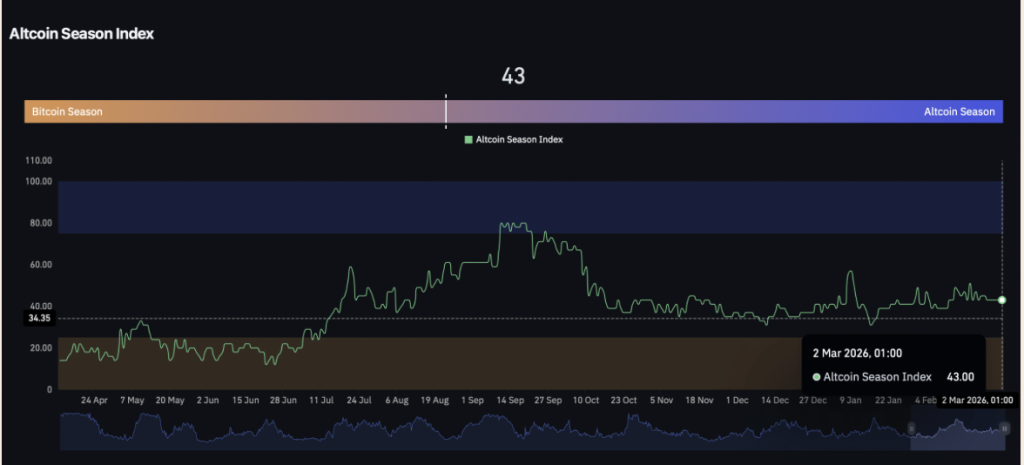
Altcoin Structure Quietly Improves
Broader metrics reinforce this subtle rotation. The Altcoin Season Index has started ticking upward, reflecting widening performance dispersion among alternative assets. It’s not full-blown alt season territory yet. But Bitcoin is no longer the only leader.
Derivatives data from CoinGlass shows positioning remains relatively balanced. Liquidations have cooled. Speculative excess has been flushed out, at least compared to peak froth periods. Stable derivatives conditions, paired with improving spot demand, often form the base for healthier capital rotation cycles.
Selective strength is already visible. CoinMarketCap data shows Canton Network (CC) up roughly 115% over the past 90 days, while LayerZero (ZRO) gained around 46% in the same window. In total, 35 altcoins have outperformed Bitcoin during that period. That’s not dominance, but it’s breadth quietly expanding.
Bitcoin dominance itself has slipped from 59.26% in January 2026 to 58.01%. That 1.25 percentage point drop may look small, but at Bitcoin’s current market cap near $1.32 trillion, it implies roughly $16.5 billion has rotated out of Bitcoin into altcoins and stablecoins. That’s real capital. Not just noise.
Macro Risks Still Hover Over the Market
Of course, internal improvement doesn’t exist in a vacuum. Macro risks remain stubborn. Rising geopolitical tension between the United States and Iran has elevated global risk sensitivity again. And historically, during stress periods, capital tends to flow toward defensive assets like gold.
Crypto, particularly altcoins, usually absorbs disproportionate selling pressure in risk-off environments. They have thinner liquidity. Higher beta. Sharper swings. When fear spikes, they feel it first.
So the path forward isn’t purely technical. If geopolitical tensions ease and Ethereum continues strengthening relative to Bitcoin, the foundation for a broader altcoin expansion could solidify. The rotation would likely accelerate from ETH into mid-cap and smaller-cap names.
But if global risk aversion intensifies, investors may hesitate. Capital rotation can stall quickly when macro uncertainty dominates sentiment.
For now, altcoins aren’t surging. They’re stabilizing. And sometimes, stabilization is where the next phase quietly begins.