

- ADA is holding a bullish wedge, but the buyer mix has shifted toward short-term participants
- Long-term holders appear to be distributing, weakening conviction beneath the surface
- Key levels at $0.437 and $0.351 will likely decide Cardano’s next directional move
Cardano is drifting back into the spotlight, mostly because a breakout attempt failed to stick. ADA is down about 2% over the past 24 hours and has trended lower since January 6, yet the damage hasn’t really spread. Zoom out a bit and the picture looks calmer, with ADA broadly flat over the last seven days and still holding above key levels.
That balance isn’t random. Cardano is technically still sitting inside a bullish structure, and buying pressure hasn’t vanished. But the makeup of that demand has changed, and that shift is quietly becoming the biggest risk factor deciding whether ADA stabilizes or slips.
Bullish Wedge Holds, but Momentum Only Tells Half the Story
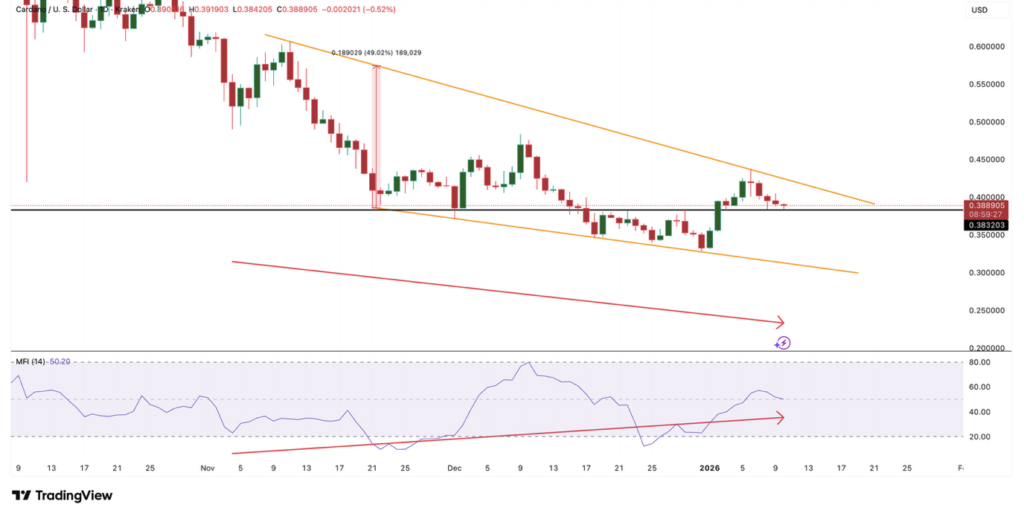
ADA continues to trade within a falling wedge that’s been forming since early November. This pattern is generally bullish, with price compressing lower while selling pressure gradually weakens. As long as the lower boundary remains intact, the breakout thesis technically stays alive.
That structure explains why ADA has defended the $0.383 zone so far. This level previously acted as resistance and flipped to support after January’s breakout attempt. Holding it has prevented a deeper pullback, at least for now.
Momentum indicators initially support this resilience. The Money Flow Index trended higher from early November through January 10, even as price moved lower. That divergence usually signals dip buying under the surface. On paper, that looks constructive and helps explain why ADA hasn’t broken down despite being rejected at the upper trendline.
Still, momentum doesn’t tell you who is buying, and that detail matters more than it seems.
Holder Behavior Shows Cracks Beneath the Surface
On-chain data reveals a growing split between long-term conviction holders and shorter-term participants.
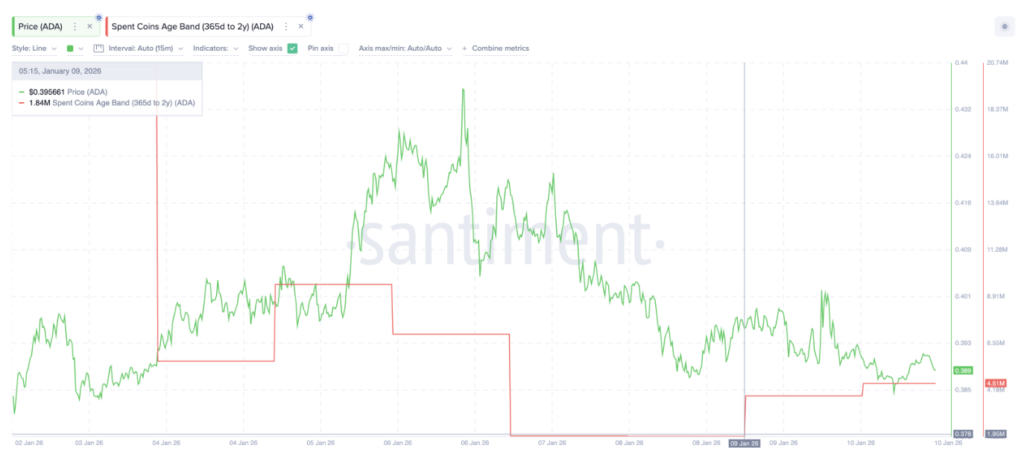
Longer-term holders appear to be distributing. The spent coins age band covering the 365-day to 2-year cohort spiked sharply on January 9. Activity from this group jumped from roughly 1.92 million ADA to about 4.51 million ADA in a single day, a surge of nearly 135%. That kind of move suggests older holders may be exiting positions instead of waiting out volatility.
Short-term behavior tells a very different story. The 30-day to 60-day cohort sharply reduced selling. Spent coins in this group dropped from around 55.42 million ADA to just 4.28 million ADA, a decline of nearly 92%. In other words, newer participants appear to be absorbing supply rather than adding pressure.
This context reframes the earlier MFI signal. The rising MFI now likely reflects short-term dip buying, not renewed long-term confidence. When patient capital sells and speculative capital steps in, price can stabilize temporarily. But that kind of support tends to be fragile, especially if sentiment shifts quickly.
Derivatives Skew Adds to the Risk Profile
Derivatives data reinforces that imbalance. On Binance’s ADA-USDT perpetual market, cumulative long liquidation leverage sits near $26.66 million, while short liquidation leverage is closer to $14.11 million. That leaves long exposure roughly 89% higher than shorts, creating a clear bullish skew.
At first glance, that bias looks supportive. In reality, it increases downside risk. If price weakens and short-term capital pulls back, crowded long positions can unwind fast, triggering forced liquidations and accelerating losses.
From a technical perspective, the roadmap is fairly clean. ADA needs a daily close above $0.437 to revive the bullish case. That would break the descending trendline and reopen the path toward the wedge’s projected upside, roughly 49% from current levels.
If that reclaim fails, downside risk grows. A break below $0.351 would weaken the wedge structure and expose $0.328 as the next major support. Losing those levels would suggest recent stability was distribution, not accumulation.
For now, Cardano looks balanced on the surface but uneasy underneath. The wedge remains intact, momentum hasn’t collapsed, yet long-term holders are selling, short-term traders are stepping in, and derivatives positioning leaves very little room for error. The next move likely depends on how long speculative capital stays interested.