
- Chainlink Labs expects AI agents and robots to become a growing source of blockchain transactions.
- Andrew McCormick says cheaper AI-assisted development could lead to a future with many specialized blockchains.
- Chainlink sees interoperability becoming increasingly important as autonomous systems transact across different networks.
AI agents and robots could become major users of blockchain infrastructure as autonomous systems increasingly need to communicate, trade and make payments without constant human involvement, according to Chainlink Labs.
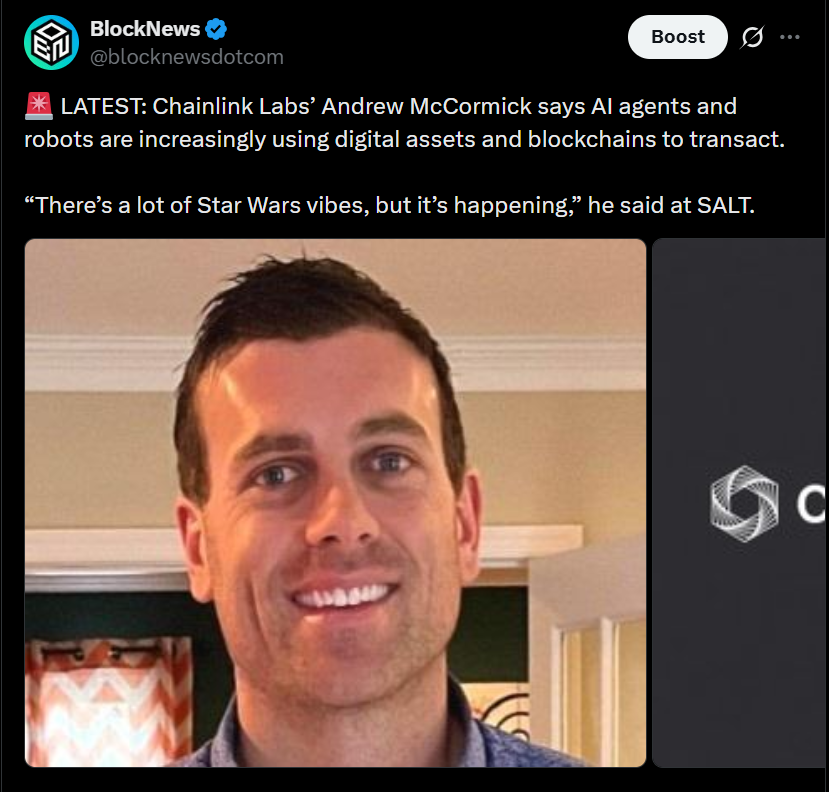
Speaking at the Wyoming Blockchain Symposium 2026, Chainlink Labs Head of Institutional Strategy Andrew McCormick said advances in AI could also make blockchain development significantly cheaper, accelerating the creation of new networks.
Chainlink Expects a Multi-Chain Future
McCormick expects the industry to develop around many different blockchains rather than consolidating entirely around a small number of networks.
AI could reinforce that trend by reducing the engineering costs involved in creating and operating specialized chains. However, having more networks would also increase the need for infrastructure capable of moving information and assets between them.
That’s where Chainlink’s interoperability strategy becomes increasingly relevant. McCormick highlighted Wyoming’s Frontier Token, which uses Chainlink’s Cross-Chain Interoperability Protocol, or CCIP, to support distribution across multiple blockchains.

AI Agents Could Trade Around the Clock
One potential use case involves autonomous AI agents trading tokenized assets. Instead of waiting for their owners to manually execute transactions, agents could potentially monitor markets and trade continuously.
Blockchain-based markets could be particularly useful because many operate around the clock, unlike traditional financial markets with fixed trading hours.
McCormick believes the concept could eventually extend beyond software. Humanoid robots working in factories, warehouses or docks could communicate and transact with other machines using stablecoins and blockchain networks.
If that vision develops, blockchain activity may increasingly come from machines rather than humans, creating a new source of demand for payments, tokenized assets and cross-chain infrastructure.