
- President Donald Trump says the U.S. is not negotiating with Iran and has no new talks scheduled, reversing his earlier claims that discussions were underway.
- Trump maintains that the Strait of Hormuz is open and cleared of mines, although U.S. Central Command has not publicly confirmed those claims.
- Regional tensions remain elevated after the UAE reported detecting two ballistic missiles launched from Iran, while oil markets face continued supply concerns.
President Donald Trump says Washington is no longer holding talks with Iran, marking a sharp shift from his previous statements that negotiations between the two countries were underway.
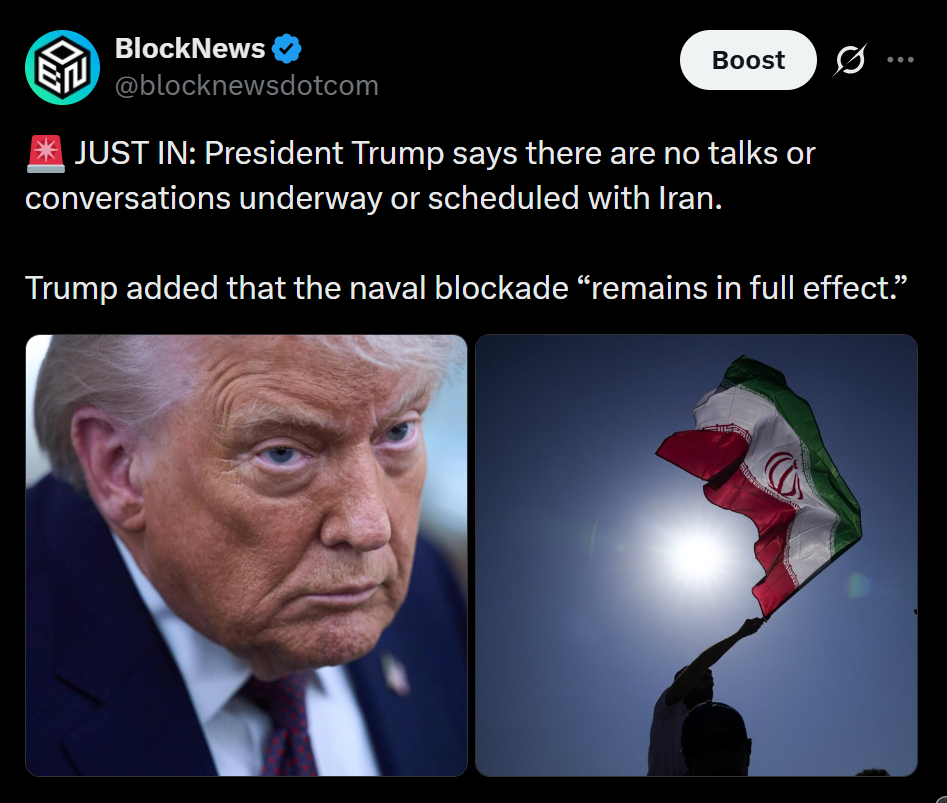
In a Truth Social post Tuesday, Trump said there were “no talks or conversations” taking place or scheduled with Iran. The statement comes after weeks of conflicting claims from Washington and Tehran about whether diplomatic discussions were actually happening.
Trump Says Strait of Hormuz Is Open
Trump also claimed the U.S. naval blockade remains fully operational and that the Strait of Hormuz is open, with water mines either removed or destroyed.
However, U.S. Central Command has not publicly confirmed that the waterway has been completely cleared. Shipping activity also remains severely disrupted, with relatively few vessels attempting to pass through the strategically important route.
That matters well beyond the Middle East. Before the conflict, roughly 20% of global oil trade moved through Hormuz, making continued disruption a major risk for energy prices and inflation.
Iran-UAE Missile Incident Raises Tensions
Regional risks increased further Tuesday after the United Arab Emirates said its air defenses detected two ballistic missiles launched from Iran toward the country.
According to the UAE’s defense ministry, one missile landed outside its territorial waters while another fell within them. The incident adds another layer of uncertainty as diplomatic prospects between Washington and Tehran appear to deteriorate.
Oil prices subsequently extended their recent gains as markets weighed the possibility of prolonged disruption to regional energy supplies.
Trump Floats US Control of Hormuz
Trump has also repeatedly suggested that the Strait of Hormuz could effectively become U.S.-controlled territory, arguing that America’s naval blockade gives Washington control over the waterway.
Such a move would face serious international legal and diplomatic challenges. Iran and Oman border the strait, while the route serves as one of the world’s most important international shipping corridors.
For markets, the immediate issue is whether military tensions continue escalating while shipping remains constrained. With U.S.-Iran diplomacy apparently stalled, developments around Hormuz could remain a major driver of oil, inflation expectations and broader risk assets, including crypto.