
- Senate Majority Leader John Thune filed a cloture motion on the CLARITY Act, keeping the crypto market structure bill alive for possible action in September.
- The legislation still faces a difficult 60-vote threshold, with disputes over government ethics, illicit finance rules, and stablecoin rewards remaining unresolved.
- Passage could provide regulatory certainty for Bitcoin, altcoins, DeFi, and institutional crypto investors, but failure in September could effectively end the bill’s 2026 prospects.
The CLARITY Act has taken its biggest procedural step yet after Senate Majority Leader John Thune filed a formal cloture motion Saturday morning. The move keeps the sweeping crypto market structure legislation alive after lawmakers failed to bring it to a vote before the August recess.
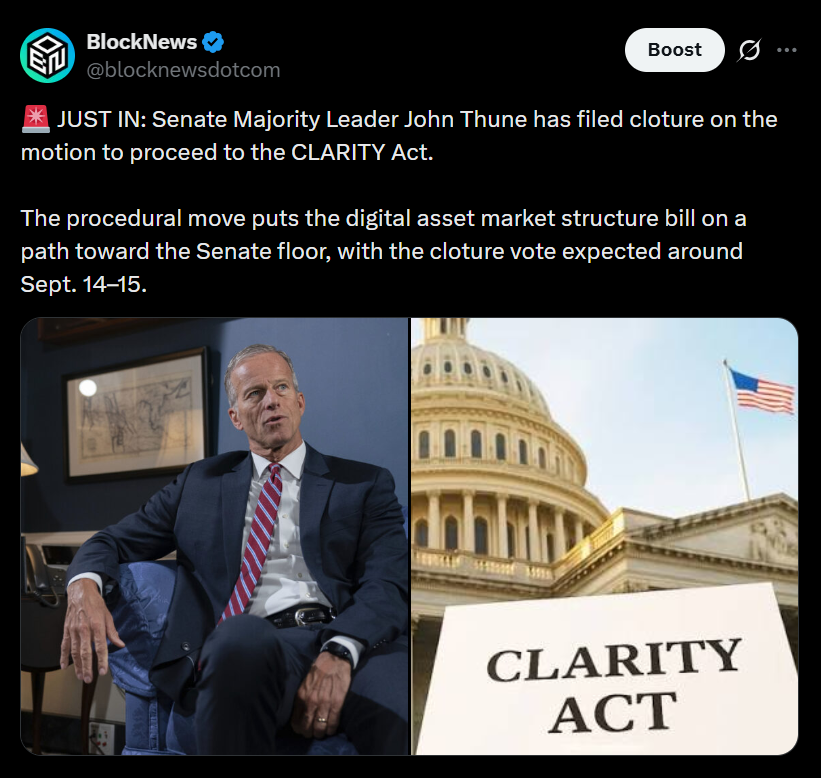
The filing sets up the possibility of an early procedural vote when senators return to Washington in September. With Congress facing a short legislative window before attention shifts toward the November midterm elections, the coming weeks could determine whether the United States finally establishes a comprehensive regulatory framework for digital assets.
What the Senate Cloture Filing Means
Thune filed cloture on the motion to proceed with the legislation, an important procedural step required before senators can begin considering the bill on the floor.
The filing does not mean the CLARITY Act has passed or even guarantee a final vote. Instead, it starts a process designed to overcome opposition and move legislation toward debate.
After the required waiting period, senators can vote on whether to invoke cloture. If enough lawmakers support the motion, the Senate can move forward with debate before eventually considering final passage.
That makes September technically workable. If negotiators resolve their remaining disagreements during the recess, lawmakers could move through the procedural stages within the Senate’s limited September session.
Democratic Support Remains the Biggest Challenge
The bigger problem is not the calendar but the votes.
Republicans hold 53 Senate seats, meaning they cannot reach the 60-vote cloture threshold without Democratic support even if Republicans remain united.
Government ethics rules remain one of the most difficult issues. Democrats have pushed for stronger restrictions covering senior federal officials and their involvement with cryptocurrency projects, with President Donald Trump’s crypto interests becoming central to the negotiations.
A bipartisan ethics compromise has reportedly been presented to the White House. How the administration responds could play an important role in determining whether enough Democrats ultimately support the legislation.
Lawmakers are also negotiating provisions covering illicit finance, AML and KYC requirements, decentralized finance, and stablecoin rewards.
September Could Decide the CLARITY Act’s Future
The recess gives negotiators additional time to resolve those disagreements before senators return.
One possibility is that Republicans, Democrats, and the White House reach compromises before the procedural vote. That could transform the cloture vote into a genuine attempt to advance the legislation toward passage.
The alternative is that major disagreements remain unresolved. In that case, the vote could fail to reach the required threshold, significantly reducing the chances that comprehensive crypto market structure legislation becomes law in 2026.
With the November elections approaching, another lengthy negotiating period would become increasingly difficult.
Why the Bill Matters for Crypto
The CLARITY Act seeks to establish clearer federal rules governing cryptocurrency markets while defining responsibilities between the Securities and Exchange Commission and Commodity Futures Trading Commission.
Among its most important provisions are rules determining when digital assets should be treated as securities or commodities. The legislation would also establish requirements affecting crypto exchanges, decentralized finance, token markets, and other industry participants.
For institutional investors, regulatory certainty could remove one of the biggest barriers preventing larger allocations to digital assets.
Bitcoin already benefits from comparatively clear commodity treatment, but a broader market structure framework could give pension funds, endowments, financial institutions, and other major investors greater confidence when expanding their crypto exposure.
Altcoins could potentially see an even greater impact because uncertainty surrounding SEC and CFTC jurisdiction has historically complicated institutional participation.
Bitcoin Investors Watch September Catalyst
The renewed legislative momentum arrives as institutional interest in Bitcoin shows signs of improving.
Bitcoin ETF inflows and whale accumulation have strengthened recently, while BTC continues attempting to establish support around the $65,000 area. Regulatory progress could provide another catalyst if investors believe comprehensive U.S. crypto rules are becoming more likely.
However, the cloture filing itself does not resolve the political disagreements surrounding the legislation. The most important development during the August recess will be whether negotiators can secure enough bipartisan support to reach the Senate’s 60-vote threshold.
For now, the biggest change is straightforward: the CLARITY Act still has a viable path forward in 2026, and September could determine whether that path ultimately leads to passage.