

- Bitcoin slipped below $62,000 after President Donald Trump declared the U.S.-Iran memorandum of understanding “is over.”
- Oil prices surged as traders priced in renewed supply risks and escalating tensions in the Middle East.
- Analysts warn a daily close below $62,000 could increase the likelihood of Bitcoin testing the $60,000 level.
Bitcoin came under heavy selling pressure after President Donald Trump announced that the memorandum of understanding between the United States and Iran was effectively over. The statement reignited fears of renewed conflict in the Middle East, sending investors away from risk assets while pushing oil prices sharply higher.
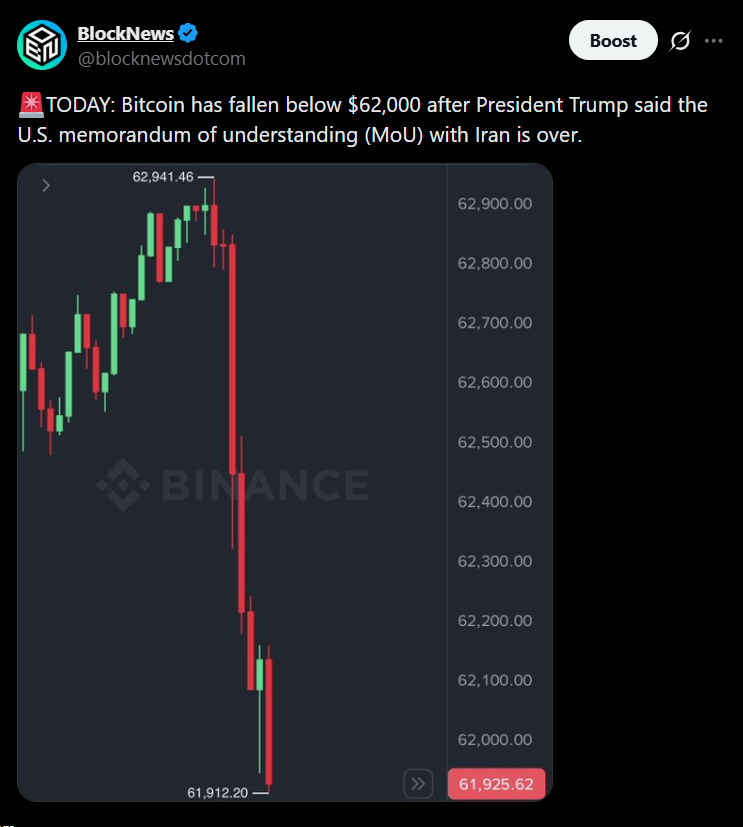
The sudden shift in sentiment erased Bitcoin’s earlier gains, with the cryptocurrency falling below the $62,000 mark within minutes of Trump’s remarks. The move reflects how quickly geopolitical uncertainty can reshape investor positioning across global markets.
Trump Declares Iran Agreement Is Over
A memorandum of understanding (MoU) is a formal but non-binding agreement outlining the intentions of both parties before a permanent deal is reached. Trump said the agreement with Iran had collapsed after negotiations failed to produce a lasting resolution.
The breakdown follows a fresh wave of military strikes that ended a brief period of reduced tensions. Reports indicate both sides resumed military operations across the region, renewing fears that the conflict could expand further.
Speaking after the latest developments, Trump signaled little interest in restarting diplomatic talks, suggesting the previous negotiations had failed completely.
Oil Prices Jump as Supply Fears Return
Crude oil reacted immediately to the escalating tensions. Prices surged as traders once again focused on the possibility of supply disruptions near the Strait of Hormuz, one of the world’s most important energy shipping routes.
Oil had previously fallen as markets anticipated a period of de-escalation, but the collapse of the agreement quickly reversed that optimism. Investors moved back into energy markets as concerns over future supply intensified.
The sharp rise in oil prices reflects how closely geopolitical developments in the Middle East continue to influence global energy markets.
Why Bitcoin Moved in the Opposite Direction
While oil rallied, Bitcoin declined as investors reduced exposure to higher-risk assets. The cryptocurrency had traded above $64,000 earlier in the session before geopolitical headlines triggered widespread selling across risk markets.

Historically, Bitcoin has often behaved similarly to growth stocks during periods of geopolitical uncertainty. Rather than acting as a safe-haven asset, it tends to face selling pressure as investors shift toward cash and defensive investments.
The latest decline highlights that dynamic once again, with Bitcoin falling as geopolitical risks increased while oil benefited from supply-related concerns.
Traders Watch the $60K Support Level
Technical analysts are now closely monitoring Bitcoin’s ability to hold above key support levels. Some market observers believe that if Bitcoin closes below $62,000 on the daily chart, the next major support zone around $60,000 could come into focus.
Although long-term sentiment toward Bitcoin remains constructive for many investors, short-term price action will likely continue to be driven by developments surrounding the Middle East conflict and broader global risk appetite.
For now, traders remain on alert as geopolitical headlines continue influencing both cryptocurrency and traditional financial markets.