- Binance has entered the Philippine market through a regulatory sandbox partnership with BlockShoals Technologies.
- The Philippine SEC approved BlockShoals to begin sandbox testing with Binance serving as its global crypto-asset service provider partner.
- Binance still does not hold a Philippine Virtual Asset Service Provider (VASP) license, meaning the rollout remains subject to additional regulatory requirements.
Binance has taken a major step toward expanding into the Philippines after the country’s Securities and Exchange Commission (SEC) approved a regulatory sandbox that allows local fintech firm BlockShoals Technologies to begin testing crypto services using Binance’s infrastructure.
The development marks Binance’s official entry into the Philippine market under the SEC’s Strategic Regulatory Sandbox (Stratbox) framework, although the exchange must still navigate additional regulatory requirements before offering broader services.
SEC Approves Binance-Backed Sandbox
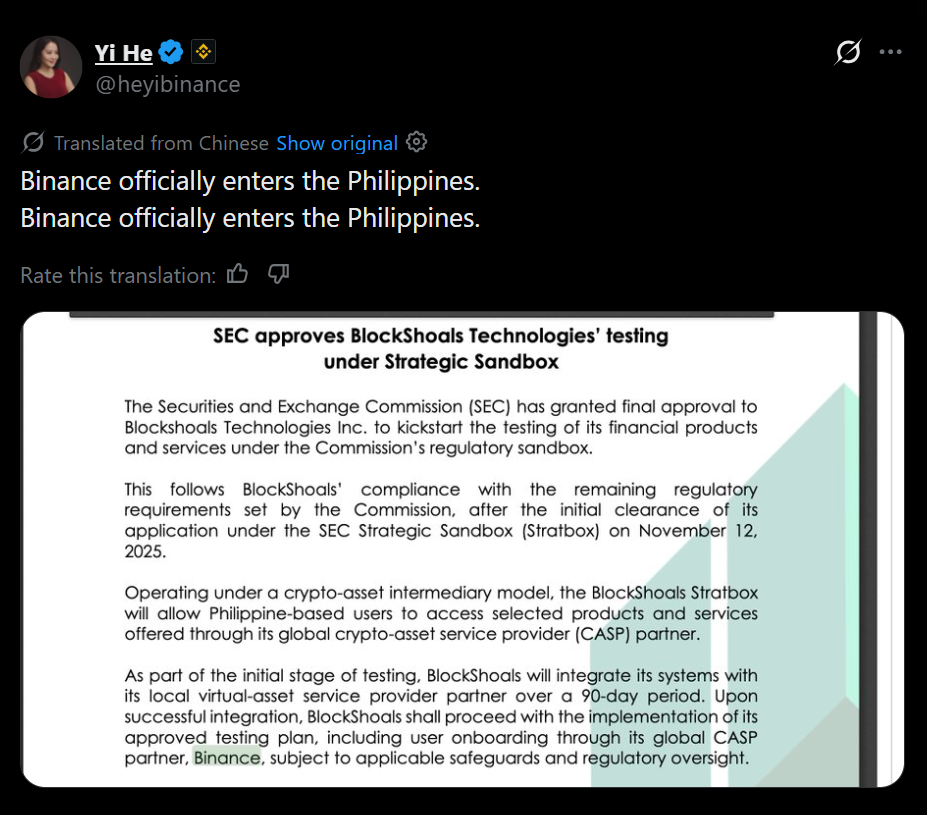
According to the SEC’s approval, BlockShoals will operate under a crypto-asset intermediary model that gives eligible users access to selected crypto products and services through Binance, which will act as the company’s global crypto-asset service provider (CASP) partner.
Before testing officially begins, BlockShoals must complete a 90-day integration process with a licensed local virtual asset service provider. Once that phase is complete, the sandbox program can proceed under SEC supervision with customer onboarding and regulatory safeguards in place.
The approval follows the SEC’s initial clearance of BlockShoals’ Stratbox application in late 2025 after the company satisfied the remaining regulatory requirements.
Binance Still Needs a Separate License
While the SEC approval represents meaningful progress, Binance has not yet secured a Philippine Virtual Asset Service Provider (VASP) license.
The Bangko Sentral ng Pilipinas (BSP) recently clarified that participation in the SEC’s sandbox does not replace the need for separate authorization from the central bank, as each regulator oversees different areas of the country’s financial system.
The BSP also stated that BlockShoals must complete integration with a licensed domestic VASP before users can begin accessing services through Binance’s infrastructure.
Part of Binance’s Global Expansion
The Philippine sandbox adds to Binance’s broader efforts to strengthen its regulatory presence worldwide.
The exchange continues working with regulators across multiple jurisdictions while adapting its operations to new compliance requirements. Earlier this month, Binance also implemented service changes for European Union users as new MiCA regulations came into effect while continuing to pursue full authorization under the framework.
The Philippine sandbox represents another step in Binance’s strategy of expanding through regulated partnerships while working toward long-term licensing.
Why It Matters
The approval does not grant Binance full operating authority in the Philippines, but it gives the company an opportunity to demonstrate its services within a regulated testing environment.
If the sandbox proves successful and additional licensing requirements are satisfied, Binance could significantly expand its presence in one of Southeast Asia’s fastest-growing cryptocurrency markets.
For now, the rollout remains a supervised pilot program, with broader expansion depending on future regulatory approvals from both the SEC and the Bangko Sentral ng Pilipinas.