
- XRP continues to struggle as stablecoins increasingly compete for the same cross-border payment use cases.
- Ripple’s RLUSD stablecoin may offer institutions a less volatile alternative to XRP for transactions.
- Some analysts believe XRP’s design as a bridge asset creates long-term challenges for sustained value appreciation.
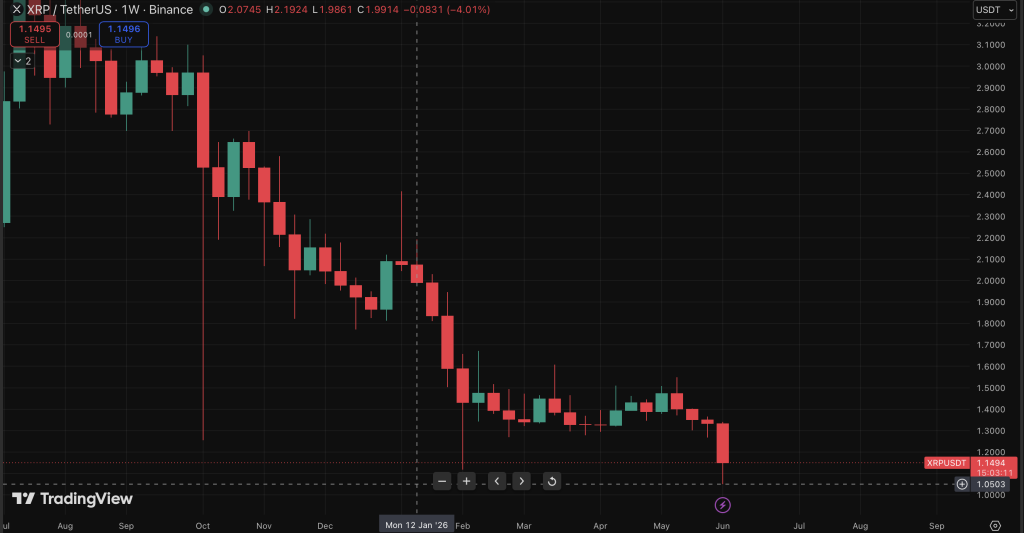
It’s been a brutal year for cryptocurrency investors. The total crypto market has shrunk dramatically, with the combined value of all digital assets slipping below $2.4 trillion after peaking at roughly $4.4 trillion last year. That’s a decline of around 45%, and some major tokens have suffered even steeper losses. XRP is one of them. The cryptocurrency, created by Ripple, has fallen about 66% from its July 2025 highs, reigniting questions about its long-term future in an increasingly competitive digital payments landscape.
At its core, XRP was built to solve a real problem. Cross-border payments remain slow, expensive, and often rely on multiple intermediaries before funds finally reach their destination. Ripple’s network was designed to streamline that process. By acting as a bridge asset, XRP allows financial institutions to move value between different currencies quickly and at a fraction of traditional costs. In theory, that utility should support demand over time. The challenge, however, is that banks using Ripple’s payment infrastructure don’t actually need XRP to access those benefits.
Ripple’s Biggest Threat May Be Coming From Within
This is where the investment thesis becomes more complicated. Ripple Payments can facilitate instant settlements regardless of whether participating banks use XRP or traditional fiat currencies. That means widespread adoption of Ripple’s technology doesn’t automatically translate into increased demand for the token itself. A bank can benefit from faster and cheaper transfers without ever holding a meaningful amount of XRP.
The situation became even more complicated when Ripple launched Ripple USD (RLUSD) in 2024. Unlike XRP, RLUSD is a stablecoin pegged to the U.S. dollar, meaning its value remains relatively stable. For banks and institutions that prioritize predictability, that’s a major advantage. XRP can experience sharp price swings within hours, creating additional risk even during short holding periods.
Stablecoins also offer regulatory advantages. Because they are designed to maintain a fixed value and often operate under stricter oversight frameworks, institutions may view them as a safer option. Ripple retains certain controls over RLUSD transactions, including the ability to comply with court-ordered reversals when necessary. For many financial firms, those features could be more appealing than dealing with the volatility associated with XRP.
History Suggests More Volatility Ahead
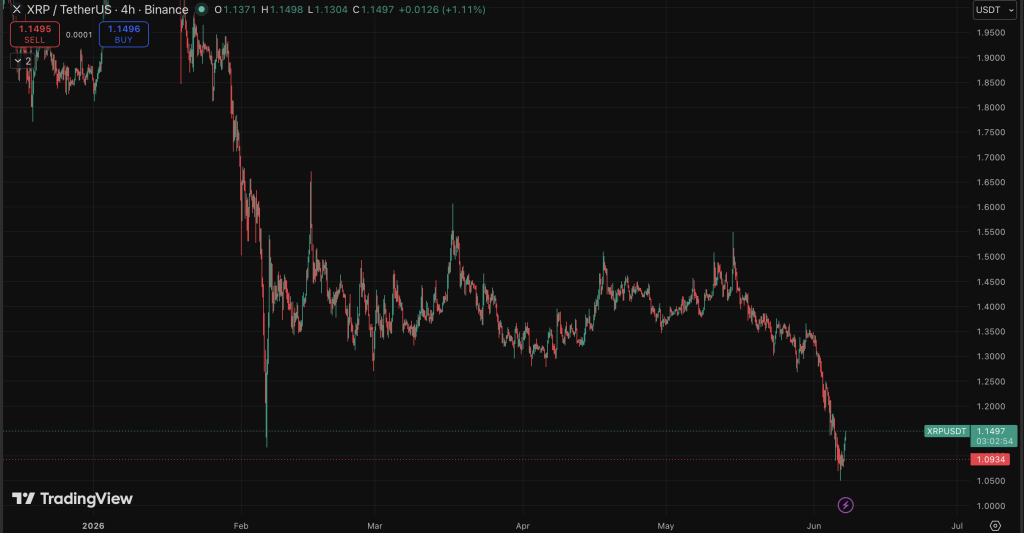
XRP’s recent decline isn’t its first major downturn. While the token reached a fresh all-time high of $3.65 during the last bull cycle, it has since dropped to around $1.16. Long-time market participants have seen this movie before. Following its previous peak in 2018, XRP lost more than 90% of its value and spent years trading below the $1 mark.
What’s concerning for some analysts is that the fundamentals supporting XRP haven’t necessarily improved enough to justify a different outcome. If anything, competition has intensified. Stablecoins have emerged as one of the fastest-growing segments of the crypto industry, offering many of the transactional benefits XRP was originally designed to provide without the same degree of volatility.
If history were to repeat itself and XRP experienced another 90% decline from its peak, the token could theoretically revisit levels near $0.36. That doesn’t mean such a scenario is guaranteed, of course. Markets rarely move in exactly the same way twice. Still, the possibility highlights the risks investors face when betting on assets that remain heavily dependent on market sentiment.
The Structural Issue Behind XRP’s Value Debate
Perhaps the biggest challenge facing XRP isn’t competition or regulation. It’s the way the token was designed to function. As a bridge currency, XRP facilitates transactions between parties, but it isn’t necessarily meant to be held indefinitely. One institution buys XRP to send value, another sells it after receiving the funds. The transaction is completed, and the asset moves on.
That creates an unusual dynamic. For a cryptocurrency to appreciate consistently over long periods, there typically needs to be a growing group of participants willing to accumulate and hold it. Bitcoin benefits from this as a store-of-value asset. Ethereum has demand tied to staking, decentralized applications, and network activity. XRP’s primary use case naturally encourages circulation rather than long-term holding.
As a result, much of XRP’s biggest price appreciation has historically been driven by speculation rather than utility. The explosive rallies seen in 2017 and again in 2024 were fueled largely by investors betting that future buyers would pay higher prices. While speculation can drive impressive gains during bull markets, it’s a fragile foundation if underlying demand doesn’t expand alongside it.
Can XRP Defy the Odds?
None of this guarantees XRP will fail. The token still has one of the largest communities in crypto, maintains strong liquidity across exchanges, and remains deeply integrated into Ripple’s broader ecosystem. Yet the rise of stablecoins, shifting regulatory preferences, and XRP’s own structural limitations continue to raise difficult questions about its long-term value proposition.
For investors, the key issue may not be whether Ripple’s technology succeeds. It may be whether XRP itself remains essential to that success. And right now, that’s a debate the market hasn’t fully settled.