- Coinbase has launched pre-IPO perpetual futures, starting with contracts tied to SpaceX.
- Eligible traders can now gain exposure to private company valuations before a public listing occurs.
- The move highlights crypto’s growing expansion into markets traditionally controlled by Wall Street.
For decades, some of the most lucrative investment opportunities have been reserved for venture capital firms, private equity funds, and accredited investors. Retail participants often watched from the sidelines as private companies created billions of dollars in value long before ever reaching public markets. Coinbase appears determined to challenge that model.
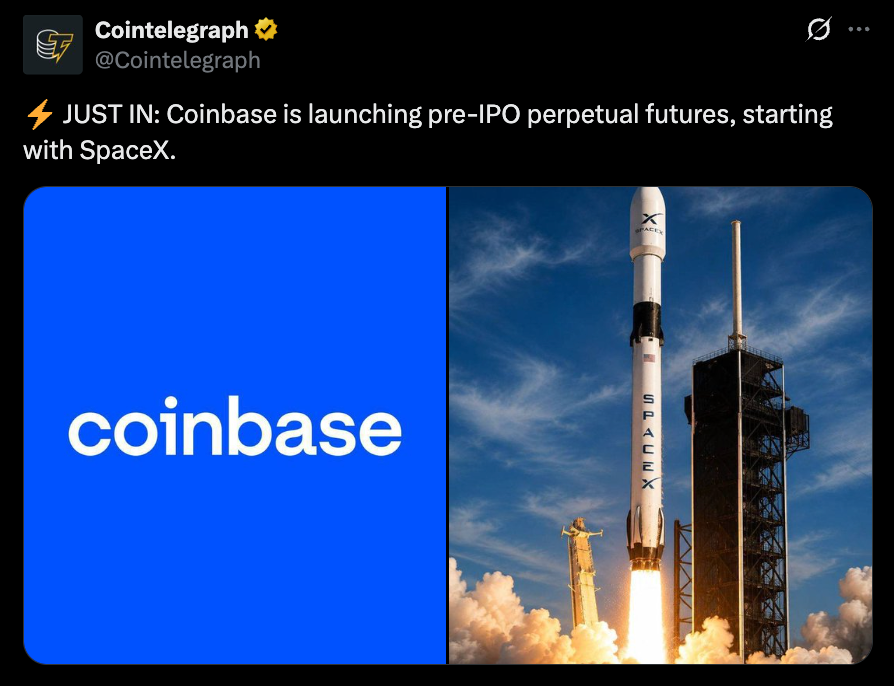
This week, the exchange announced the launch of pre-IPO perpetual futures, beginning with Elon Musk’s SpaceX. The product allows eligible international traders to speculate on the company’s valuation before any potential public offering. While U.S. users are currently excluded, the launch marks another significant step toward bringing traditionally inaccessible financial markets onto blockchain-powered infrastructure.
More Than Just Another Crypto Product
At first glance, SpaceX perpetual futures might look like a niche derivatives offering. In reality, the launch reflects a much larger shift taking place across the financial industry. Crypto exchanges are rapidly evolving beyond digital assets and transforming into multi-asset trading platforms capable of supporting a wide range of financial products.
A few years ago, Bitcoin perpetual futures were considered revolutionary. Today, traders can access products linked to equities, commodities, indices, and increasingly, private companies. Coinbase’s international exchange has steadily expanded its offerings, demonstrating an ambition that extends far beyond cryptocurrency trading alone.
The result is a platform that increasingly resembles a modern global brokerage operating around the clock rather than a traditional crypto exchange.
Why SpaceX Matters
The choice of SpaceX is unlikely to be accidental.
SpaceX is widely viewed as one of the most valuable private companies in the world, with investors closely tracking its fundraising rounds and estimated valuation growth. Despite enormous public interest, access to the company remains limited for most investors because its shares do not trade on public stock exchanges.
By creating a perpetual futures product tied to SpaceX, Coinbase is effectively allowing traders to participate in one of the market’s most sought-after private-company narratives without requiring direct ownership of the underlying shares.
For many investors, the appeal lies in gaining exposure to market sentiment surrounding a high-profile company that may remain private for years.
Crypto Keeps Expanding Beyond Crypto
The launch reflects a broader trend that has accelerated throughout the industry.
Crypto infrastructure is increasingly being used to create synthetic exposure to traditional financial assets. Traders are no longer limited to buying and selling digital currencies. Instead, blockchain-based platforms are becoming venues where users can access a growing variety of markets from a single account.

This expansion is gradually blurring the distinction between traditional finance and decentralized finance. What began as an alternative financial ecosystem is slowly developing into a parallel market structure capable of supporting many of the same products offered by conventional institutions.
That evolution could have major implications for both industries.
The End Of Market Hours?
One of crypto’s biggest advantages has always been its ability to operate continuously.
Traditional stock markets close overnight, shut down on weekends, and observe holidays. Crypto markets do none of those things. By bringing assets like SpaceX exposure into perpetual futures markets, Coinbase is extending that always-on model into areas traditionally governed by fixed trading schedules.
For global traders, this offers flexibility that conventional financial systems often struggle to match. News does not stop on Friday afternoon, and increasingly, investors do not want markets to stop either.
As more assets move onto blockchain-based trading platforms, the concept of limited market hours may begin to look increasingly outdated.
Why Wall Street May Be Nervous
The real significance of Coinbase‘s announcement is not necessarily SpaceX itself. It is what the product represents.
Historically, Wall Street generated enormous value by controlling access to private markets, IPO allocations, and specialized investment opportunities. Blockchain technology has the potential to make many of those barriers less relevant by creating new ways for investors to gain exposure to market narratives and asset classes.
While regulatory hurdles remain and synthetic products are not the same as direct ownership, the direction of travel is becoming increasingly clear. Crypto platforms are steadily absorbing pieces of the traditional financial ecosystem.
That process may still be in its early stages, but it is accelerating.
The Bigger Picture
Coinbase’s SpaceX perpetual futures launch is another example of crypto moving beyond its original boundaries. What started as a market for digital currencies is gradually evolving into a broader financial infrastructure capable of supporting everything from commodities and equities to private-company exposure.
Critics will point to leverage, speculation, and risk, and those concerns are valid. Yet the larger trend remains difficult to ignore. Every time crypto successfully incorporates another segment of traditional finance, the distinction between the two becomes a little less clear.
For years, crypto promised to democratize access to financial markets. Products like SpaceX perpetual futures suggest that promise may be starting to take shape in ways Wall Street can no longer afford to ignore.