

- Bitmine now holds nearly 5.4 million ETH, representing approximately 4.47% of Ethereum’s circulating supply.
- Tom Lee believes AI and tokenization could become the catalysts that drive Ethereum into a new phase of growth.
- Lee argues that corporate Ethereum validators are replacing traditional ecosystem funding models and reshaping the network’s future.
Ethereum has spent much of 2026 frustrating investors. Despite growing institutional interest, expanding tokenization efforts, and continued development across the ecosystem, ETH remains well below the levels many bulls expected.
That disconnect is exactly why Fundstrat’s Tom Lee believes the market may be missing the bigger picture.
Speaking recently about Ethereum’s future, Lee suggested that if Ethereum successfully becomes the backbone for tokenization and artificial intelligence infrastructure, the upside could be far greater than most investors currently imagine. His most eye-catching prediction was simple: Ethereum could eventually reach $250,000 per coin if those trends fully materialize.
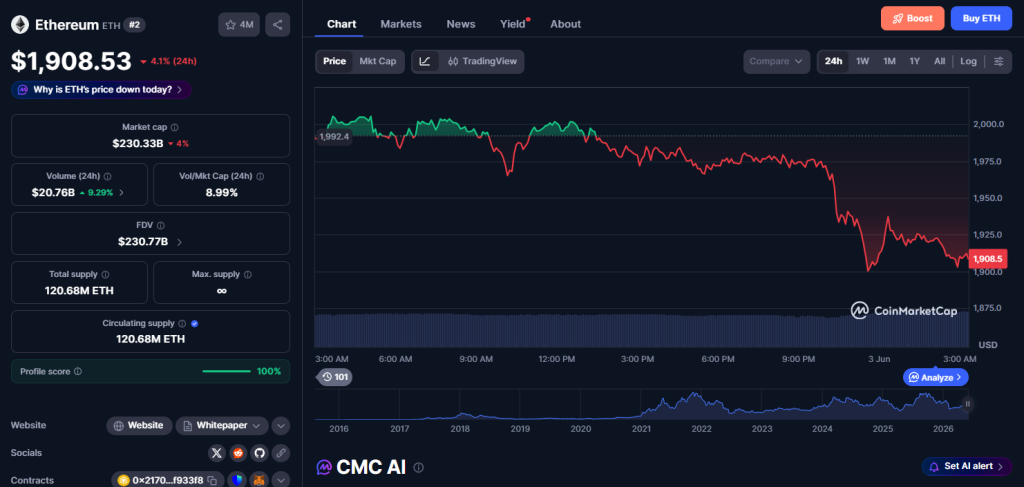
At current prices near $1,900, that forecast sounds almost absurd. Lee, however, believes the foundations are already being built.
Bitmine Is Making A Massive Ethereum Bet
Lee’s conviction is backed by more than words.
His company, Bitmine, has become one of the largest corporate Ethereum holders in the world. The firm recently acquired an additional 111,942 ETH worth roughly $237 million, increasing total holdings to nearly 5.4 million ETH.
That position now represents approximately 4.47% of Ethereum’s entire circulating supply.
For Bitmine, the strategy is straightforward. Rather than viewing Ethereum as simply another crypto asset, the company sees ETH as critical infrastructure for future digital economies. The accumulation strategy reflects a belief that Ethereum’s role could expand significantly as tokenization and blockchain adoption accelerate.
Why AI Could Become Ethereum’s Biggest Growth Driver
Lee’s thesis centers heavily on artificial intelligence.
As AI systems become more autonomous and increasingly interact with one another, machines will need ways to exchange value, verify identities, authenticate actions, and process payments. Traditional banking systems were not designed for billions of automated machine-to-machine interactions occurring in real time.
According to Lee, crypto infrastructure offers advantages in areas such as payment speed, identity management, authentication, and automated settlement. As AI agents handle a larger share of online activity, blockchain networks could become the coordination layer that enables those systems to function securely.
The result would be a dramatic expansion of blockchain utility far beyond speculative trading.
Ethereum’s Role Is Changing
For years, Ethereum has been viewed primarily as a platform for decentralized applications, NFTs, DeFi protocols, and smart contracts.
Lee believes the next chapter could be much larger.
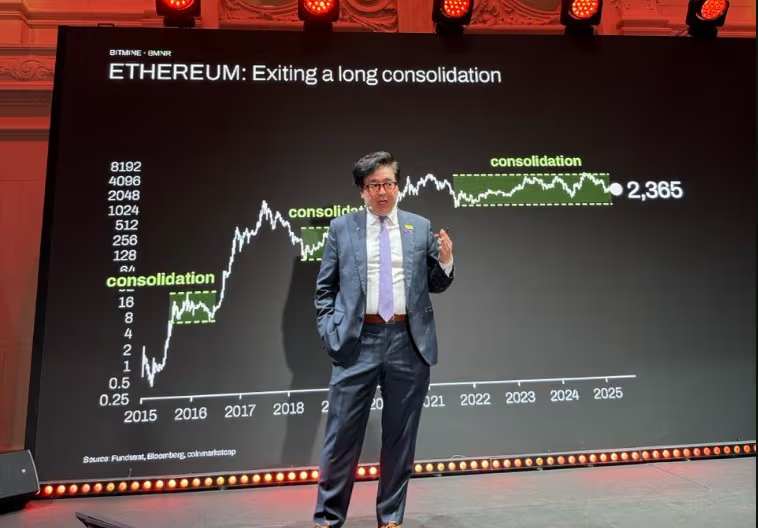
If tokenization continues expanding and AI-driven systems increasingly require blockchain-based settlement, Ethereum could evolve into a core infrastructure layer supporting global digital commerce. Under that scenario, ETH becomes more than a speculative asset. It becomes a resource required to power economic activity across automated networks.
That possibility is one reason institutional interest in Ethereum continues growing despite recent price weakness.
Corporate Validators Are Taking Center Stage
Another major shift highlighted by Lee is the changing structure of Ethereum’s ecosystem.
The Ethereum Foundation has gradually reduced its relative influence over the network, with holdings reportedly declining to around 100,000 ETH. At the same time, large corporate entities have dramatically increased their participation.
Companies such as Bitmine and other major staking operators now collectively control a meaningful percentage of Ethereum’s circulating supply. These organizations generate substantial staking rewards that can be reinvested into infrastructure, development, and ecosystem growth.
According to Lee, this represents a transition from foundation-led funding toward a more market-driven model supported by corporate validators.
Wall Street Exposure Continues Growing
Lee also pointed to another development he believes investors are underestimating: Bitmine’s expected inclusion in the Russell 1000 Index.
The index is one of the most widely followed benchmarks in global finance. Inclusion would place Bitmine on the radar of institutional asset managers overseeing trillions of dollars in capital.
While index inclusion alone does not guarantee buying activity, it significantly increases visibility among professional investors. For companies building large crypto treasury strategies, that exposure can become an important catalyst for broader adoption.
Looking Beyond Short-Term Fear
Ethereum’s recent decline has understandably created caution among investors. Crypto markets remain volatile, macroeconomic uncertainty persists, and sentiment can change rapidly.
Lee’s argument is that short-term price movements may be distracting investors from larger structural trends. Tokenization continues expanding. Stablecoins continue growing. AI development continues accelerating. Corporate participation continues increasing.
Whether Ethereum ultimately reaches anything close to $250,000 remains highly speculative. What is harder to dismiss is the growing number of institutions treating Ethereum as long-term infrastructure rather than a short-term trade.
For Lee, that distinction makes all the difference. While many investors focus on today’s volatility, he believes the market may be overlooking the foundations of a much larger transformation already underway.