
- South Carolina signed a law protecting Bitcoin self-custody, mining, and crypto payments
- The legislation also bans state participation in any Federal Reserve CBDC programs
- Meanwhile, former regulators say the U.S. is still quietly exploring CBDC infrastructure
South Carolina just became one of the latest U.S. states to formally push back against central bank digital currencies, signing new legislation designed to protect crypto rights while blocking state involvement with CBDCs entirely. At almost the exact same time, former federal officials were openly discussing how the United States may still end up building a CBDC anyway.
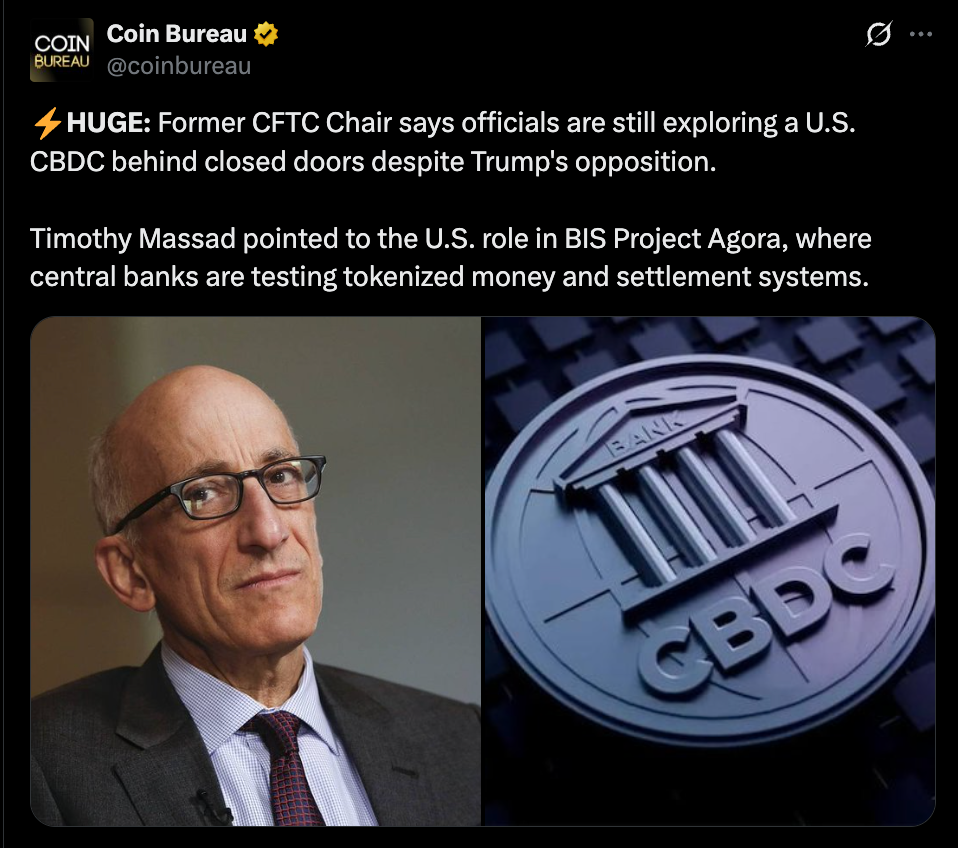
Honestly, the timing could not have been more absurdly perfect if someone scripted it. One side of government is banning the idea while another appears to still be quietly testing the plumbing underneath it.
South Carolina Doubles Down On Crypto Rights
Governor Henry McMaster officially signed bill S.163 into law, giving legal protections to self-custody Bitcoin users, proof-of-work miners, and crypto payment activity across the state. The legislation also blocks discriminatory taxation targeting digital assets and prevents state agencies from participating in any Federal Reserve CBDC pilot programs.
That places South Carolina alongside states like Florida, Oklahoma, Kentucky, Arkansas, and Arizona, all of which have passed legislation aimed at limiting CBDC expansion while strengthening protections for crypto users. Much of the momentum behind these bills has been driven by advocacy groups like the Satoshi Action Fund, which has increasingly focused on state-level digital asset legislation.
The broader message from these states is becoming pretty clear. They view CBDCs less as innovation and more as a potential expansion of centralized financial surveillance.
Meanwhile, Washington Appears To Be Testing Anyway
While states continue publicly rejecting CBDCs, former CFTC Chairman Timothy Massad suggested this week that a U.S. CBDC remains largely inevitable regardless of current political rhetoric. According to Massad, federal institutions are already involved in international tokenized payment initiatives that strongly resemble foundational CBDC infrastructure work.
The biggest example is Project Agora, a cross-border payments initiative coordinated through the Bank for International Settlements involving seven central banks and roughly 40 major financial institutions. The Federal Reserve Bank of New York is actively participating in the project, which is currently in its testing phase with a major report expected soon.

That’s the part raising eyebrows across parts of the crypto community. Publicly, many officials continue distancing themselves from CBDCs. Privately, the technical experimentation appears to be moving forward anyway.
The Messaging Gap Is Fueling Distrust
For crypto advocates, this disconnect between public messaging and behind-the-scenes development is exactly what has fueled distrust around CBDC discussions for years. Politicians publicly promise resistance to centralized digital currencies while financial institutions and regulatory bodies continue exploring tokenized payment rails in the background.
To be fair, some officials argue these projects are simply research initiatives rather than direct CBDC rollouts. But for critics already skeptical of government-controlled digital money, the distinction often feels more semantic than meaningful.
South Carolina’s new law essentially codifies that skepticism directly into state policy. Instead of waiting for clearer federal answers, lawmakers decided to draw a line now before any national framework becomes more difficult to resist later.
The U.S. Is Heading Toward A Financial Identity Clash
What’s unfolding now increasingly looks like a deeper ideological conflict over the future of money itself. One side envisions decentralized ownership, self-custody rights, and minimal government involvement in digital finance. The other appears focused on regulated tokenized systems where central banks and financial institutions remain deeply embedded in the infrastructure.
Ironically, both sides are using blockchain technology to pursue very different versions of financial modernization. That’s why these CBDC debates are becoming so politically charged. The fight is no longer just about crypto, it’s about who ultimately controls digital money as the financial system evolves.
For now, states like South Carolina are making it very clear which side they’ve chosen.