

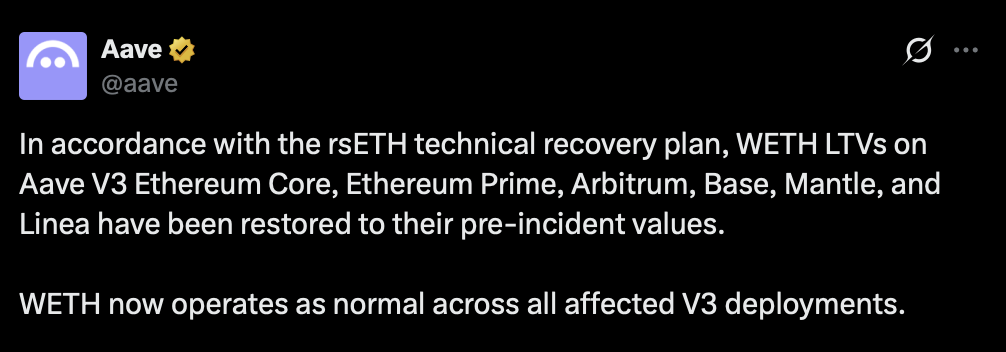
- Aave restored WETH loan-to-value ratios across six Aave V3 markets after temporary cuts tied to the rsETH incident.
- The rollback marks another stage in the rsETH recovery plan led by Aave and KelpDAO.
- Users can once again borrow against WETH under earlier limits, although some rsETH safeguards may still remain active.
Aave has officially restored WETH loan-to-value ratios across six affected Aave V3 markets, giving users access to previous borrowing limits once again. The adjustment applies to Ethereum Core, Ethereum Prime, Arbitrum, Base, Mantle, and Linea, signaling that the protocol is gradually moving past the turbulence tied to the rsETH incident. For many traders using ETH-backed strategies, this is a pretty meaningful shift because it reopens leverage conditions that had been temporarily tightened during the risk review phase.
The restored WETH LTV ratios allow users to borrow more against the same collateral positions, bringing conditions back closer to what traders were used to before the disruption. Aave founder Stani Kulechov described the change as “the next phase” of the broader rsETH technical recovery plan, suggesting the platform now sees the immediate contagion risks as more controlled. The update also reactivates smoother collateral swap and debt swap functionality, tools that many advanced DeFi users rely on to manage positions without fully closing them out. It’s a practical move, not flashy, but one that quietly improves flexibility across the protocol again.
Why Aave Reduced WETH Limits Earlier
The temporary reduction in WETH borrowing power came after the KelpDAO-related rsETH incident, which reportedly affected around $290 million in linked collateral exposure. Once concerns around rsETH liquidity and collateral stability emerged, Aave and its risk management providers responded by lowering leverage potential across exposed markets. The idea was simple: reduce the chances of cascading liquidations while teams assessed how deep the risks actually went. It wasn’t necessarily popular among aggressive traders, though it bought the protocol valuable time.
One of the main areas impacted involved recursive borrowing strategies, where users repeatedly borrow against collateral near the maximum allowed threshold. By lowering WETH LTV ratios, Aave effectively slowed down that cycle and reduced the amount of leverage circulating through sensitive markets. The restrictions were broad, maybe even a little blunt, but they helped stabilize conditions while risk teams reviewed liquidity behavior, oracle dependencies, and exposure tied to rsETH positions. During volatile periods, even temporary controls like these can matter a lot more than people realize.
Recovery Plan Enters Another Stage
KelpDAO has continued repayment efforts tied to affected rsETH holders, while Aave reviewed market conditions connected to the incident over the past several weeks. That review included evaluating collateral efficiency, liquidity depth, and whether related exposure channels still posed systemic concerns. With WETH LTV ratios now returning to pre-incident levels, the protocol appears more comfortable with the current state of risk, although some rsETH-specific safeguards may still remain in place behind the scenes.
Importantly, Aave has not confirmed that every single rsETH parameter has returned to earlier settings. Market participants are still closely monitoring supply caps, peg stability, and liquidity conditions surrounding the asset. So while this update is definitely a sign of recovery progress, it doesn’t necessarily mean the entire cleanup process is over. DeFi protocols tend to move carefully after events like this, especially when collateral risks spread across multiple chains and lending markets.
Traders Regain Flexibility Across Aave V3
For users holding WETH positions on Aave V3, the restored borrowing limits create more breathing room again. Traders who were previously close to temporary borrowing caps may now have additional flexibility to manage or expand positions without needing to inject extra collateral. Of course, liquidation thresholds, oracle pricing, and market volatility still apply exactly as before, so risk hasn’t disappeared entirely. But compared to the restrictions introduced after the rsETH incident, the environment now feels noticeably less constrained.
The timing also comes as broader crypto markets continue facing pressure, with Bitcoin trading near $78,104 and Ethereum hovering around $2,183 on May 17, 2026. Against that backdrop, Aave’s decision looks more like a measured confidence signal rather than an aggressive reopening. The protocol is restoring normal WETH borrowing conditions while still keeping certain rsETH protections intact, which honestly feels like a balanced approach given how fragile DeFi liquidity can become after major collateral events.